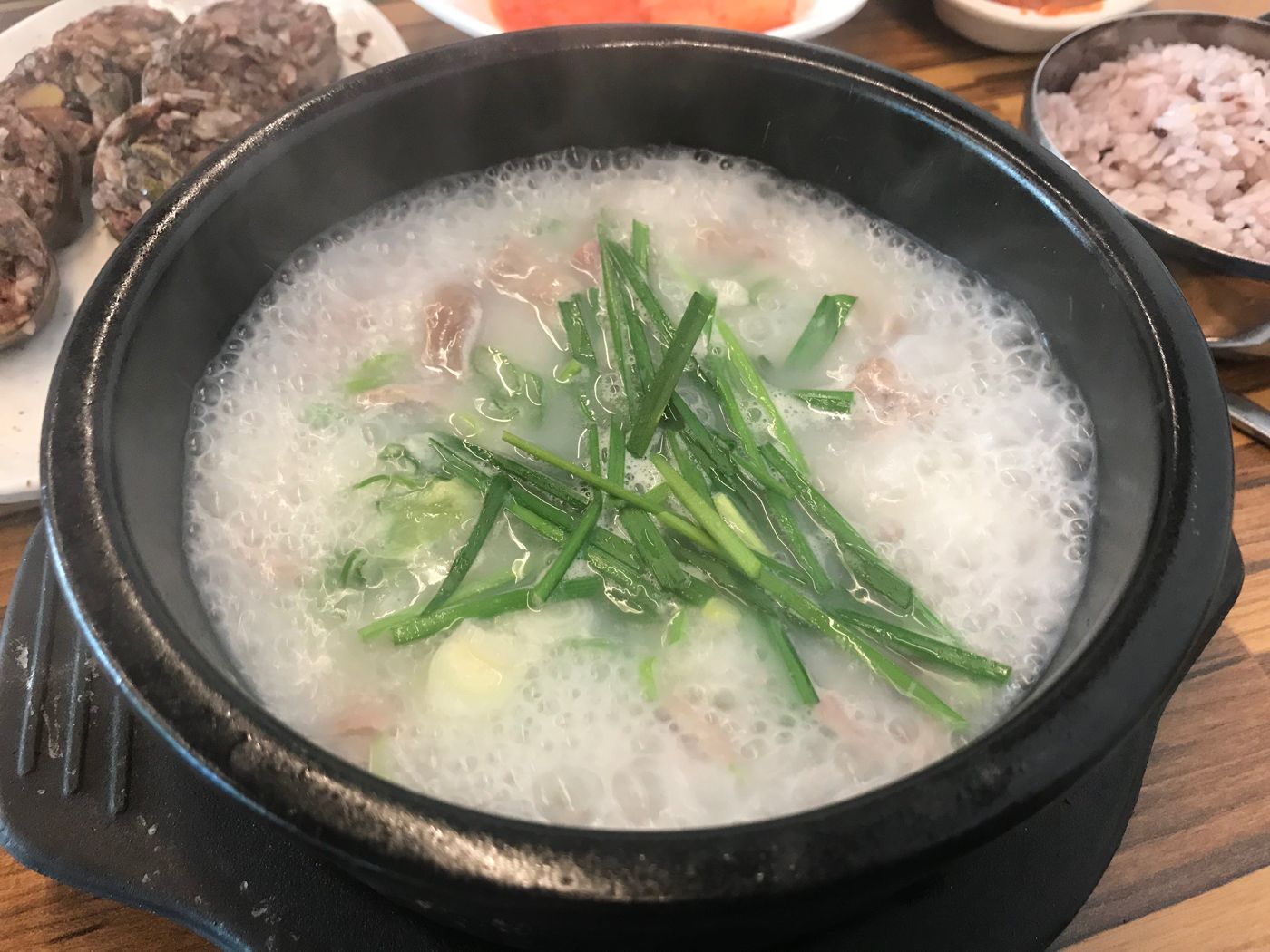
 Photo: lazy fri13th, CC BY 2.0, via Wikimedia Commons
Guk & Tang · Soups 국·탕
Sundaeguk (Blood Sausage Soup)
순댓국
Romanization: sundaeguk
Slices of Korean blood sausage and pork offal in a rich pork-bone broth, seasoned at the table with salted shrimp — a cheap, hearty market-day bowl served with rice.
- Serves
- 4
- Prep
- 60 min
- Cook
- 240 min
RegionChungcheong · Seoul & Gyeonggi
Jump to recipeRecipe
Ingredients · Serves 4
- 1.5 kgPork leg or neck bones
- 400 gPork head meat or shoulder, plus mixed cooked offalcooked offal is sold ready to slice
- 400 gCooked Korean blood sausage (sundae)sliced 1.5 cm thick
- 4 lWaterplus more for topping up
- 1 mediumOnionhalved
- 2 stalksLarge green onion (daepa)1 whole, 1 sliced for serving
- 8 clovesGarlic
- 20 gGingersliced
- 1 tbspDoenjang
- to tasteSalted shrimp (saeujeot)for the table
- 4 tbspGround perilla seedoptional, for the table
- 80 gGarlic chives (buchu)cut short, for the table
- 2 tbspGochugarufor a quick dadaegi with garlic and a little broth; optional
- 4 bowlsCooked rice
Method
Technique: Making Guk and Jjigae, Making Yuksu: Anchovy-Kelp Stock
Step 1: Soak the bones in cold water for 2 hours, changing the water once. Blanch in boiling water for 10 minutes, drain and rinse.
Step 2: Return the bones to a clean pot with the 4 liters of water, the onion, whole daepa, garlic, ginger and doenjang. Simmer briskly for 3–4 hours, topping up with boiling water; the broth turns milky.
Step 3: Add the head meat or shoulder for the last hour if it is raw; lift it out when tender and slice. Strain the broth and skim off the fat.
Step 4: Bring about 2 liters of broth to a boil. Add the sliced meat and offal and simmer 5 minutes, then add the sundae and simmer 2–3 minutes more — just long enough to heat through, so the casings don't split.
Step 5: Ladle into earthenware bowls and top with sliced green onion. Serve with rice, and set out salted shrimp, perilla seed, chives and chili paste so each diner can season the bowl.
Origin & History
Sundaeguk (also sundae-gukbap) is sundae — pig intestine stuffed with blood, vegetables, grains or glass noodles and steamed — sliced into a pork-bone broth with offal and served with rice. The Encyclopedia of Korean Folk Culture finds stuffed-intestine dishes in Joseon cookbooks from the late 1600s, mostly made with beef intestine and meat. The word sundae first appears in the late-nineteenth-century Siuijeonseo, describing pig intestine stuffed with blanched mung bean sprouts, water dropwort, radish, kimchi, tofu and pig's blood — close to today's sausage. A soup version followed: the folk encyclopedia notes that Lee Yong-gi's 1924 cookbook has a pork-intestine soup, jeosuktang, recommended as a good partner for drinks.
It belongs to the wider family of gukbap, soup with rice, which the folk encyclopedia traces to the taverns of Joseon periodic markets. As market trade grew, taverns moved from simple vegetable soups to beef soups and to blood-sausage soups. Soups made from cattle and pig by-products spread especially in the 1960s and 1970s, when slaughterhouses were modernized and meat consumption rose, and from the 1970s gukbap shops moved from the markets into city centers. Seoul, Gyeonggi and Chungcheong became the heartland of sundae and ox-head gukbap, as Gyeongsang is of pork gukbap.
The most famous local version comes from Byeongcheon in Cheonan, home of the Aunae market. The Encyclopedia of Korean Culture links its rise to a pork-processing plant that opened nearby in the 1960s, whose leftover intestines went into sundae. Cheonghwajip, known as the original shop, sold soup only on market days until it hung up a sign in 1968; others followed, and the folk encyclopedia notes that Byeongcheon sundae was designated a Cheonan specialty in 1998.
Key Ingredients
 Pork (dwaeji-gogi)돼지고기Korea's most widely eaten meat, prized cut by cut: fatty belly for samgyeopsal, neck for the grill, lean legs for boiled suyuk and stir-fried jeyuk. Pork also anchors Jeju Island's feast cooking.
 Yangpa (onion)양파The bulb onion, literally the "Western scallion." A latecomer to Korea, it is now everywhere: sweetening stir-fries and braises, pickled in soy sauce as yangpa-jangajji, and served raw beside grilled meat.
 Green onion파Korean green onion (pa), from thick-stemmed daepa to slender scallions — chopped into nearly every seasoning sauce, soup and kimchi, and the star of pa-kimchi.
 Garlic마늘Used raw, minced, pickled and roasted, garlic is one of the essential aromatics of Korean food — in seasonings, marinades, kimchi and namul.
 Ginger생강Fresh ginger root, used in small amounts to brighten kimchi paste and marinades and to tame the strong smells of fish and meat.
 Doenjang된장Fermented soybean paste — the savory foundation of doenjang-jjigae, many soups and dressings for namul. It is one of Korea's core jang, or fermented sauces.
 Salted fermented shrimp새우젓Tiny shrimp packed in salt and left to ferment — a jeotgal (salted seafood) that seasons kimchi and stews and accompanies boiled pork with briny, savory depth.
- Perilla Seed Powder들깨가루Roasted perilla seeds ground to a coarse, oily powder, sold whole or hulled. Stirred into soups and stews it makes them creamy and nutty; tossed with namul it adds body and fragrance.
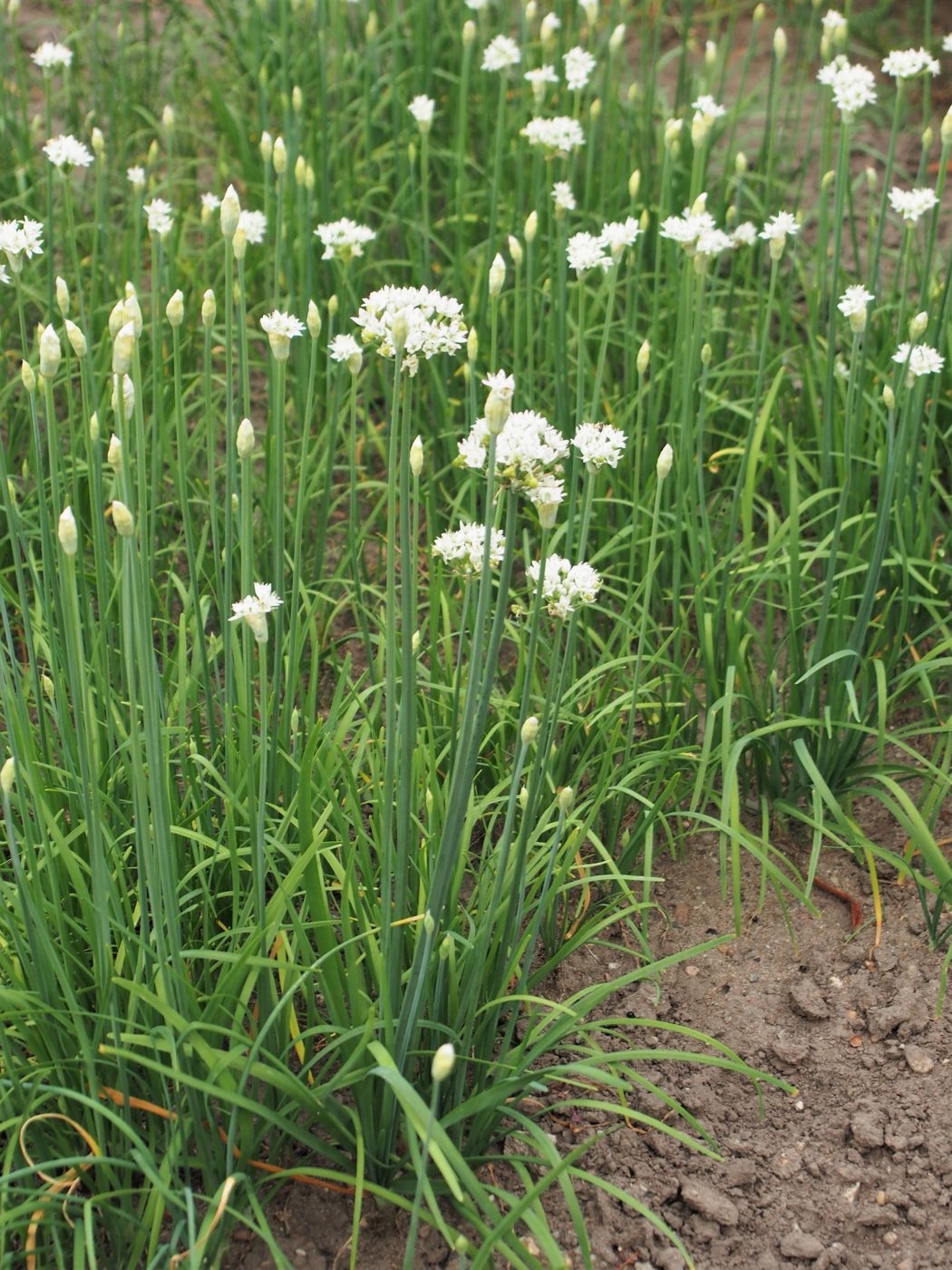 Garlic chives (buchu)부추Flat-leaved garlic chives with a bright, garlicky perfume. Tossed raw into buchu-muchim, folded into savory pancakes and tucked into cucumber kimchi.
 Gochugaru고춧가루Korean red chili powder, made from dried red peppers ground coarse or fine. It gives kimchi, gochujang and countless banchan their color and warmth.
 Rice쌀Short, round grains of japonica rice that cook up glossy, soft and gently clinging. Steamed white rice, bap, is the center of the Korean table: every banchan, soup and stew is planned to be eaten with it.
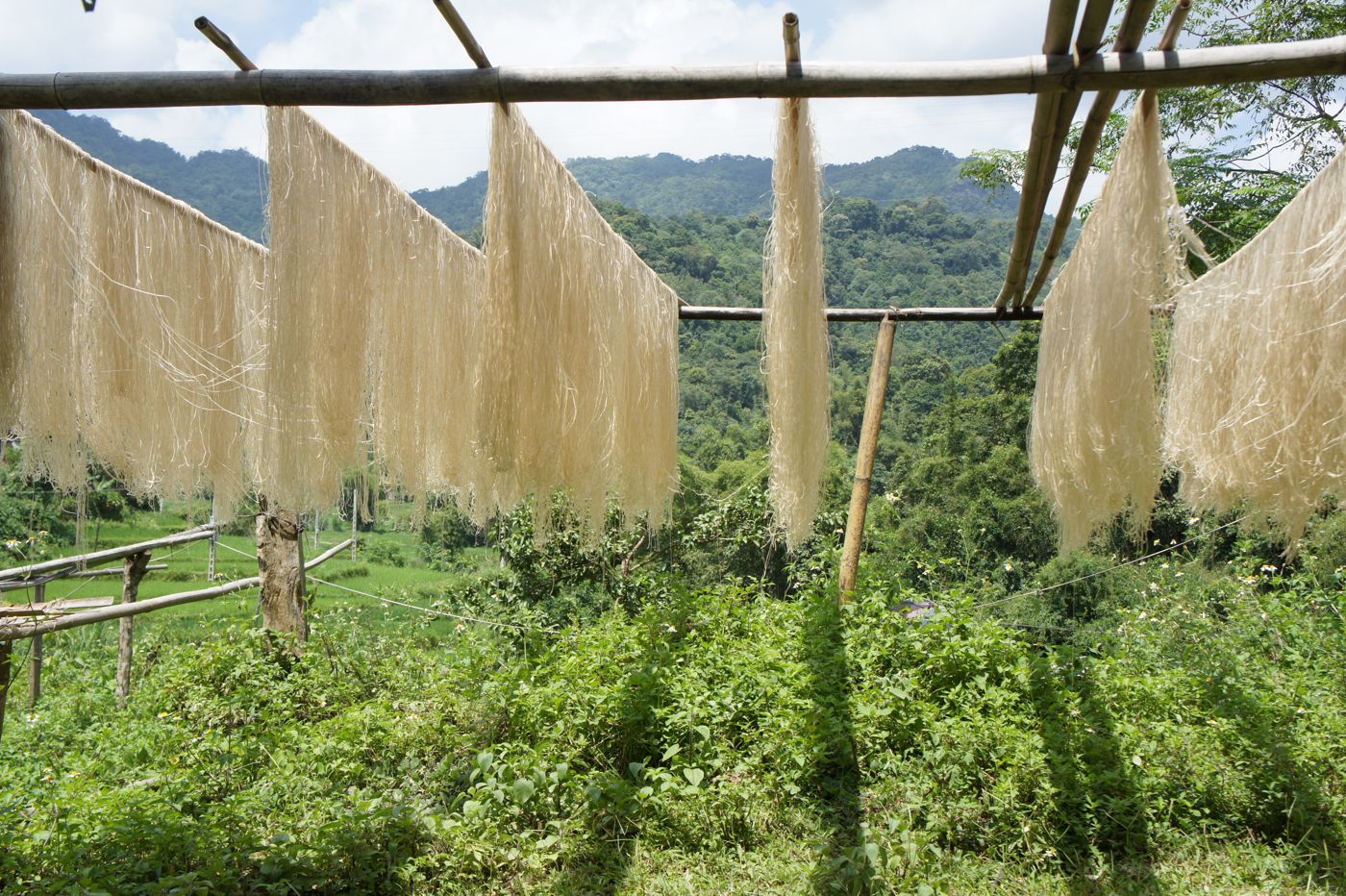 Sweet potato glass noodles당면Chewy, translucent noodles made from sweet potato starch. Introduced from China in the late Joseon period and mass-produced from 1919, they became the heart of modern japchae.
Nutrition
| Calories | ~544 kcal |
|---|---|
| Protein | ~43.5 g |
| Fat | ~33 g |
| Carbohydrates | ~17.3 g |
| Fiber | Not reported |
| Sodium | ~1504 mg |
Notable forProtein · Iron · Saturated fat
Offal and sausage vary too much to estimate from raw ingredients, so these figures are scaled from the MFDS analysis of restaurant sundaeguk (per 100 g: 68 kcal, 5.44 g protein, 4.13 g fat, 2.16 g carbohydrate, 188 mg sodium, 1.37 g saturated fat) to the database's 800 g serving, about 11 g saturated fat per bowl. The source reports 3.3 g fiber per 100 g (about 26 g per bowl), which is implausible, so fiber is shown as not reported; its iron value (0.01 mg per 100 g) is likewise implausible for blood sausage. The MFDS home-style analysis (600 g bowl; per 100 g: 85 kcal, 330 mg sodium, 1.31 mg iron, 14.95 g carbohydrate, which suggests rice or noodles were included) comes to about 1,980 mg sodium and 7.9 mg iron per bowl. Salted shrimp added at the table is extra. Actual values vary with ingredients, portion size and preparation.
Health Benefits
- A high-protein one-bowl meal; blood sausage is a source of iron, about 8 mg per bowl in the MFDS home-style analysis.
- Turning blood, intestines and bones into food is a long tradition of using the whole animal.
- Chives added at the table bring a little fresh green to a rich bowl.
Regional Variations
- Byeongcheon (Aunae) style: made with the thin, tender small intestine, filled with more blood and glutinous rice and less glass noodle (sometimes none), with garlic, chives and ginger; served in a skimmed pork-bone broth.
- Northern style: the folk encyclopedia notes that cooks from Hamgyeong and Pyeongan prefer fat, large-intestine sundae; see also abai-sundae in Sokcho.
- Market style: sausage plus mixed offal (liver, lung, stomach and head meat) in a cloudy broth, often with radish greens or bean sprouts.
- Seasoning: the folk encyclopedia notes that sundae is eaten with salt mixed with chili flakes or with salted-shrimp brine, and the same salted shrimp is the usual way to season the soup at the table.
Pairings
 Cubed Radish Kimchi깍두기Korean radish cut into neat cubes and tossed with chili, garlic and salted shrimp — crunchy, juicy and a classic partner to rich soups.
- Buchu Muchim부추무침Raw Korean chives tossed with soy sauce, chili flakes, vinegar and sesame — a pungent, garlicky salad that cuts through grilled meat and rich soups.
- Soy-Pickled Onions양파장아찌Chunks of onion steeped in a sweet, tangy soy brine until mellow and crunchy — a quick modern jangajji that cuts through grilled meats and fried foods.
Sources
- 01순대 (Sundae) — Encyclopedia of Korean Folk Culture (한국의식주생활사전)
- 02국밥 (Gukbap) — Encyclopedia of Korean Folk Culture (한국의식주생활사전)
- 03병천순대 (Byeongcheon sundae) — Encyclopedia of Korean Culture
- 04병천순대 (Byeongcheon sundae) — Encyclopedia of Korean Folk Culture (한국의식주생활사전)
- 05순대국 (Sundaeguk, restaurant and home-style, analyzed) — MFDS K-FIND food composition database
- 06Global Perspectives on Allergen Labeling: Harmonization of Regulations and Practices — Allergy, Asthma & Immunology Research, 2025
Last updated