Techniques
Making Ssam and Wraps
쌈 싸기
How Koreans wrap rice, meat and banchan in lettuce and other leaves: the classic ssam greens, ssamjang, bossam, and how to build a good one-bite wrap.
Ssam means a wrap, and the word comes from the verb ssada, to wrap. The Encyclopedia of Korean Culture defines ssam as rice and seasoned sauce placed on a leafy green and folded up to eat. The standard dictionary broadens the filling to rice, meat or banchan, and the leaves to lettuce, napa cabbage, crown daisy, perilla, aster and pumpkin leaves. It is one of the most hands-on ways of eating at a Korean table, and one of the most flexible. For the history and customs around it, see ssam culture.
An old habit
Wrapping rice in raw leaves is old enough to have reached China. The encyclopedia tells a story about Goryeo women taken to the Yuan court in the late Goryeo period, who planted lettuce in the palace gardens and wrapped rice in it to ease their homesickness, until the Mongols took up the habit too. That is a story, but it has documentary support: the encyclopedia quotes a poem by the Yuan writer Yang Yunfu praising Goryeo lettuce, with his own note that Goryeo people wrap rice in raw greens. It also cites a Chinese text recording that Goryeo lettuce seed was so prized it was nicknamed the "thousand-gold vegetable." See sangchu.
By late Joseon, wrapping also carried a wish. On the first full moon of the lunar year, the nineteenth-century Dongguk sesigi records, people wrapped rice in greens and called it boksam, "wrapping good fortune." The encyclopedia says it was originally done with gim, with blanched aster, cabbage, taro or castor-bean leaves as alternatives, and a farming-household saying held that the first spoonful of the day should be eaten as a wrap. See seasonal foods.
Choosing the leaves
The encyclopedia lists lettuce, soybean leaves, aster (chwinamul), pumpkin leaves and the tender inner leaves of napa cabbage, as well as miyeok and gim. It divides them into two kinds:
- Raw leaves: lettuce and fragrant greens such as Ligularia (gomchwi), as in the late-Joseon Siuijeonseo. Perilla leaves (kkaennip), crown daisy and green onion add aroma.
- Cooked leaves: in the Gosa sibijip, Ligularia and perilla leaves are boiled or steamed before wrapping, which softens tougher greens.
The Siuijeonseo recipe for lettuce wraps, quoted in the encyclopedia, is worth knowing: wash the lettuce, soak it in fresh water with a little sesame oil stirred in so the oil coats each leaf, then serve it with a braised gochujang sauce of minced beef and fish, and always set out thin green onions and crown daisy alongside.
The sauce: ssamjang
The dictionary defines ssamjang as gochujang or doenjang mixed with seasonings, eaten with wraps. Recipes vary by household. The constant is a thick paste, salty and savory, with sesame oil and garlic, used sparingly because it seasons the whole bite. Plain doenjang, chogochujang or salted seafood can take its place; at the barley-rice restaurants of Gwangju, wraps are topped with salted anchovy or cutlassfish innards. See yangnyeom seasoning basics.
Bossam: wrapped pork
Bo (褓) means a wrapping cloth. Bossam-kimchi, a Gaeseong specialty, is named for the way its fillings are folded into cabbage leaves like a cloth bundle, and bossam carries the same idea of wrapping. The restaurant dish most people know today, sliced boiled pork eaten in cabbage with kimchi filling, echoes a kimjang custom recorded in the encyclopedia: households making winter kimchi boiled a couple of geun of pork and set it out with the yellow inner cabbage leaves and seasoning for the helpers. This was called sokdae-ssam.
Building a wrap
- Start with a dry leaf. Wash greens well and shake or spin them dry, or the wrap will be soggy. Large leaves can be used alone; small ones work doubled, or with a perilla leaf on top of lettuce.
- Add a little rice. A small spoonful acts as the base and holds things together.
- Add the main filling. A piece of grilled meat, such as bulgogi, jeyuk-bokkeum or pork belly, boiled pork, fish or a spoonful of banchan.
- Season. A dab of ssamjang, then extras to taste: a slice of raw garlic, a sliver of green chili, pajeori, or sangchu-geotjeori.
- Fold and eat in one bite. Gather the edges into a bundle small enough to eat whole.
Ssam is also a home-table habit, not just a barbecue one. In Gwangju, diners mix barley rice with namul and then wrap that bibimbap in leaves, a doubly assembled bite. Raw leaves are a food-safety point, so wash them thoroughly; see food safety at home. Leafy greens are also rich in vitamin K; see vegetables and namul.
Dishes using this technique
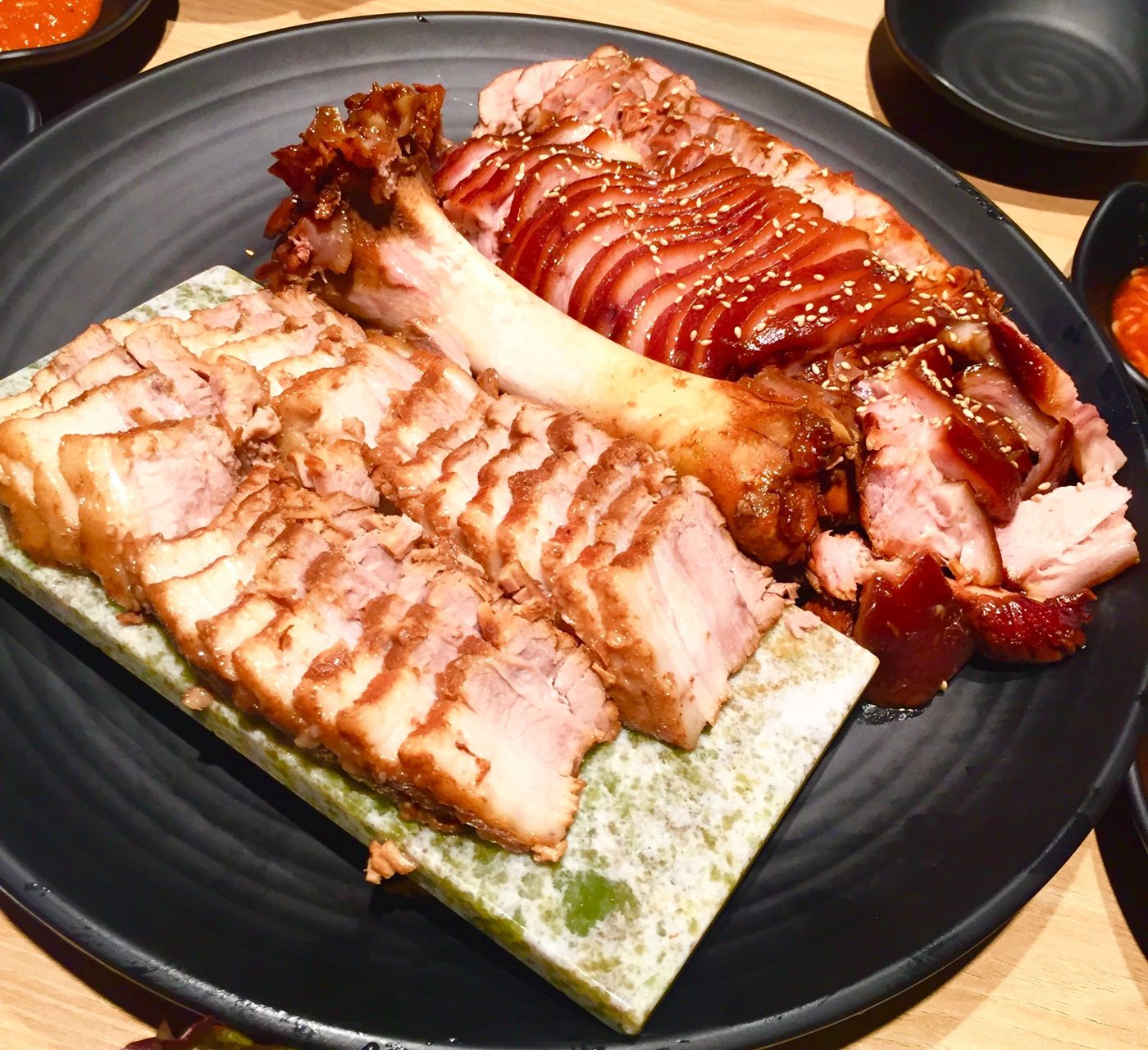 Bossam (Boiled Pork Wraps)보쌈Pork belly simmered with doenjang and aromatics, pressed and sliced, then wrapped in salted cabbage with spicy radish and salted shrimp — a feast dish built for sharing.
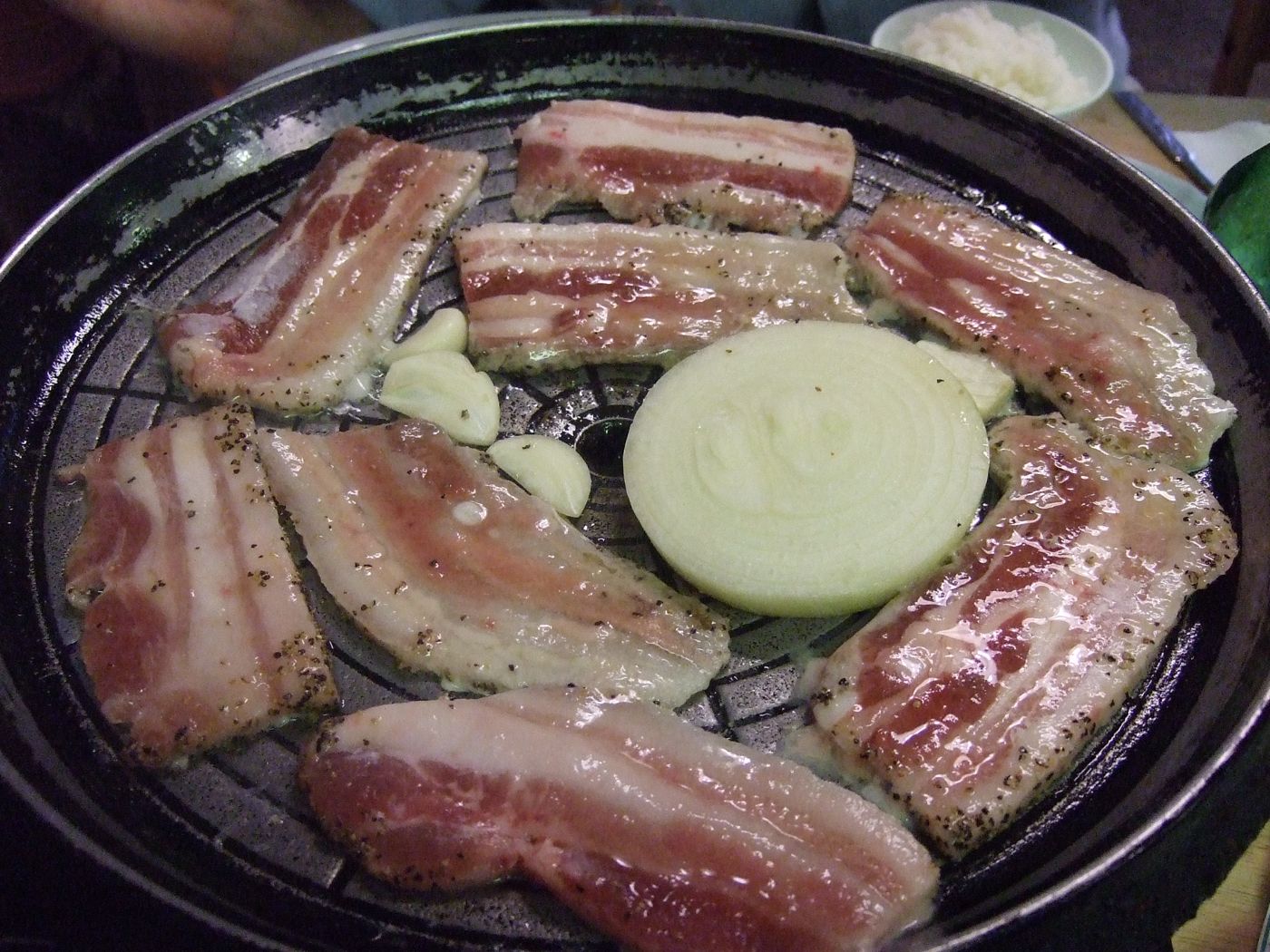 Samgyeopsal-gui (Grilled Pork Belly)삼겹살구이Thick, unseasoned slices of pork belly grilled at the table and wrapped in lettuce with garlic and ssamjang — Korea's favorite barbecue, though only since the late 1970s.
Sources
- 01쌈 (Ssam) — Encyclopedia of Korean Culture
- 02상추쌈 (Sangchu-ssam) — Encyclopedia of Korean Culture
- 03복쌈 (Boksam) — Encyclopedia of Korean Culture
- 04김장 (Kimjang) — Encyclopedia of Korean Culture
- 05보쌈김치 (Bossam-kimchi) — Encyclopedia of Korean Culture
- 06쌈장 (Ssamjang) — Standard Korean Language Dictionary, National Institute of Korean Language