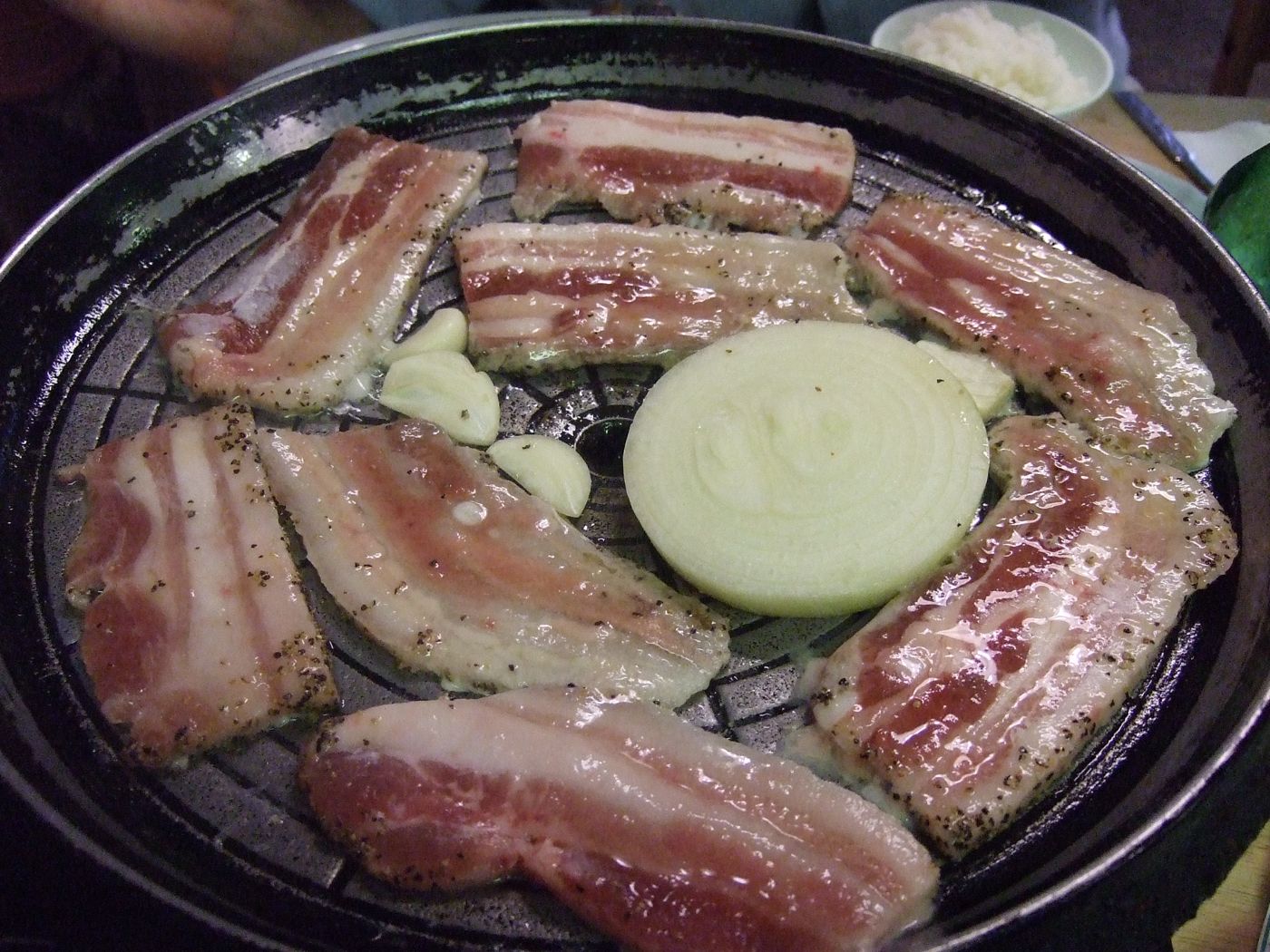
 Photo: hellochris, CC BY 2.0, via Wikimedia Commons
Gui · Grilled 구이
Samgyeopsal-gui (Grilled Pork Belly)
삼겹살구이
Romanization: samgyeopsal-gui
Thick, unseasoned slices of pork belly grilled at the table and wrapped in lettuce with garlic and ssamjang — Korea's favorite barbecue, though only since the late 1970s.
- Serves
- 4
- Prep
- 15 min
- Cook
- 20 min
RegionSeoul & Gyeonggi
Jump to recipeRecipe
Ingredients · Serves 4
- 800 gSkinless pork bellysliced 1–1.5 cm thick
- 200 gLettuce leaveswashed and dried; add perilla leaves if you like
- 8 clovesGarlichalf sliced for grilling, half raw (about 40 g)
- 2 Green chili pepperssliced (about 30 g)
- 4 tbspSsamjang
- 1 tbspToasted sesame oilfor the dipping salt
- ½ tspCoarse salt and black peppermixed into the sesame oil
- Well-fermented kimchioptional, for grilling in the fat
Method
Technique: Grilling Gui, Making Ssam and Wraps
Step 1: Pat the pork dry. Mix the sesame oil, salt and pepper in a small dish, and set out the lettuce, garlic, chilies and ssamjang.
Step 2: Heat a heavy grill pan, cast-iron skillet or tabletop grill over medium-high heat. Lay the slices on the dry pan without crowding — no oil is needed.
Step 3: Grill 3–4 minutes until the underside is deep golden, turn, and cook another 3 minutes. Cut into bite-size pieces with kitchen scissors and keep turning until the fat is crisp and the meat cooked through (145 °F / 63 °C).
Step 4: Grill the sliced garlic, and the kimchi if using, in the rendered fat. Pour off excess fat between batches so it doesn't smoke or flare.
Step 5: To eat, dip a piece of pork in the sesame salt or smear with ssamjang, set it on a lettuce leaf with garlic and chili, and wrap it into one bite.
Origin & History
Samgyeopsal is pork belly — the cut below the loin, from where the ribs are removed back to the hind leg — named for the three layers (sam gyeop) of lean and fat it shows in section. The Encyclopedia of Korean Culture and the folk encyclopedia, both written by food historian Lee Kyu-jin, note that it was long called segyeopsal, using the native word for three. A 1934 Dong-A Ilbo article already ranked segyeopsal as the tastiest part of the pig, ahead of the neck; a 1957 court-cuisine cookbook made boiled sliced pork (jeyuk pyeonyuk) from it; and as late as 1983 a Chosun Ilbo article treated "samgyeopsal" as slang. The folk encyclopedia also reports — as a claim, not a fact — that Gaeseong merchants bred pigs for a layered belly and punned the name on sam, ginseng.
For most of history Koreans boiled pork, and belly went into sliced boiled pork, braises and steamed dishes; even a 1988 cookbook recommended it for mince and braising and suggested leg meat for grilling. Restaurants moved first. The folk encyclopedia cites a 1978 newspaper list of unlicensed eateries that included a pork-belly grill house in Seoul's Samseon-dong, and the Encyclopedia of Korean Culture quotes a 1983 article naming Samgak-dong as Seoul's samgyeopsal alley and a 1980 novel describing belly sizzling on a foil-lined iron plate over a coal-briquette stove. Packaged pork sold in three cuts, one of them belly, reached shops in August 1983, and portable gas burners, common from the mid-1980s, made grilling easy in restaurants, homes and picnics alike.
Hard times made it a national dish. During the 1997 financial crisis, cheap belly earned the nickname "IMF samgyeopsal," and belly with soju became a cultural shorthand. After a foot-and-mouth outbreak in 2000, the city of Paju and its livestock cooperative declared March 3 "Samgyeopsal Day" to support pig farmers, and the 2003 mad-cow scare pushed more diners from beef to pork. The 2000s brought chilled, branded belly and trendier "samgyeopsal bars." A 2017 Rural Development Administration survey cited by the folk encyclopedia found 61.3 percent of Koreans named belly their favorite pork cut, about twice the share for neck. See Korean BBQ culture, ssam culture and anju and drinking culture.
Key Ingredients
 Pork (dwaeji-gogi)돼지고기Korea's most widely eaten meat, prized cut by cut: fatty belly for samgyeopsal, neck for the grill, lean legs for boiled suyuk and stir-fried jeyuk. Pork also anchors Jeju Island's feast cooking.
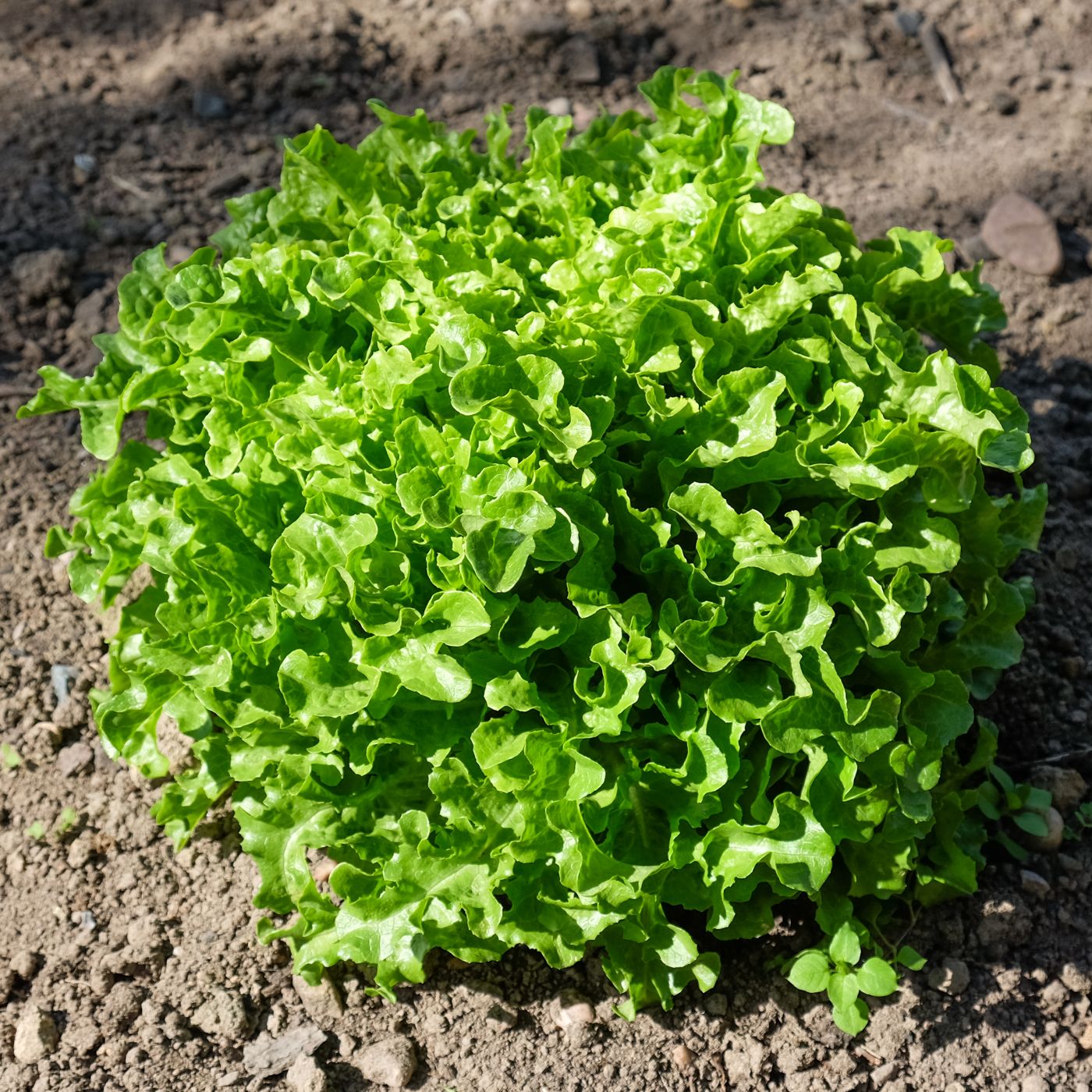 Sangchu (lettuce)상추Soft, loose-leaf lettuce, green or red-tinged, that anchors the Korean habit of ssam: wrapping rice, grilled meat and a dab of ssamjang in a fresh leaf. It is also dressed quickly as sangchu-geotjeori.
 Garlic마늘Used raw, minced, pickled and roasted, garlic is one of the essential aromatics of Korean food — in seasonings, marinades, kimchi and namul.
- Korean Chili Peppers (Fresh)고추Fresh Korean chili peppers, eaten green (putgochu) or red (hong-gochu): from the fiery cheongyang-gochu to the small, wrinkled, mild kkwari-gochu that is braised and stir-fried as banchan.
- Ssamjang (Wrap Dipping Paste)쌈장A thick, savory-sweet paste of doenjang and gochujang with garlic, sesame and other seasonings, made to be dabbed onto lettuce wraps with rice and grilled meat. It is also a dip for raw vegetables.
 Sesame참깨Toasted sesame seeds and sesame oil (chamgireum) finish countless Korean dishes, adding a nutty aroma and gloss.
 Perilla깻잎Perilla leaves have a bold, minty-herbal scent. They are eaten fresh as a wrap, pickled in soy sauce, or layered with seasoning as kkaennip-jangajji.
Nutrition
| Calories | ~835 kcal |
|---|---|
| Protein | ~31 g |
| Fat | ~71 g |
| Carbohydrates | ~11 g |
| Fiber | ~2.4 g |
| Sodium | ~810 mg |
Notable forThiamin (vitamin B1) · Vitamin A · Vitamin K
Estimated by summing Korean Food Composition Table values for raw pork belly (I014000F110a) and ssamjang (R0230000009a) with USDA FoodData Central (SR Legacy) values for green leaf lettuce (FDC 169249), garlic, green chili peppers (FDC 170497), sesame oil and table salt, divided by 4. Uses raw-belly values: part of the fat renders out during grilling and is poured off, so the fat and energy actually eaten are lower. Kimchi and side dishes are not included. Actual values vary with ingredients, portion size and preparation.
Health Benefits
- Thiamin and protein: pork is one of the richest common sources of thiamin, and a serving provides a good deal of protein.
- Wrapped in greens: lettuce and perilla wraps add vitamin A, vitamin K and crunch to every bite. See making ssam and wraps.
- No marinade needed: plain grilled belly carries little sugar; most of the salt comes from the dips.
Regional Variations
- Classic table grill: unmarinated belly grilled on a hot plate, cut with scissors, and wrapped in lettuce with grilled garlic, green chili and ssamjang; kimchi is often grilled in the rendered fat.
- Pot-lid samgyeopsal (sotttukkeong): a late-1990s fashion for grilling on an upturned cauldron lid so the fat runs off down the slope, giving crisper meat.
- Briquette and foil: the early restaurant style of the late 1970s and 80s, with an iron plate set over a coal-briquette stove.
- Chilled and branded belly: thicker, fresh (not frozen) cuts and branded pork that became common in the 2000s.
Pairings
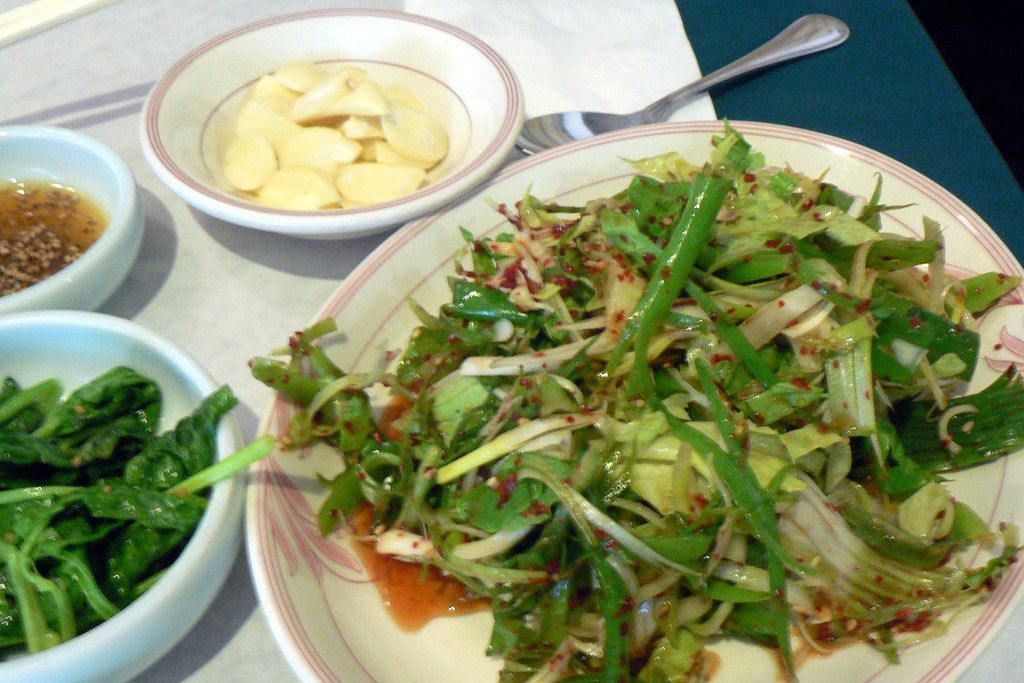 Pajeori (Green Onion Salad)파절이Fine shreds of Korean green onion tossed with chili flakes, soy sauce, vinegar and sesame oil — the sharp, bright salad that cuts the richness of grilled pork.
- Sangchu Geotjeori (Fresh Lettuce Salad, Kimchi-Style)상추겉절이Tender leaf lettuce dressed at the last minute with soy sauce, chili flakes, green onion and sesame — the crisp, spicy salad served beside grilled pork.
 Doenjang Jjigae (Soybean Paste Stew)된장찌개A thick, savory stew of fermented soybean paste with tofu, zucchini and whatever the season offers — the everyday pot at the center of the Korean table.
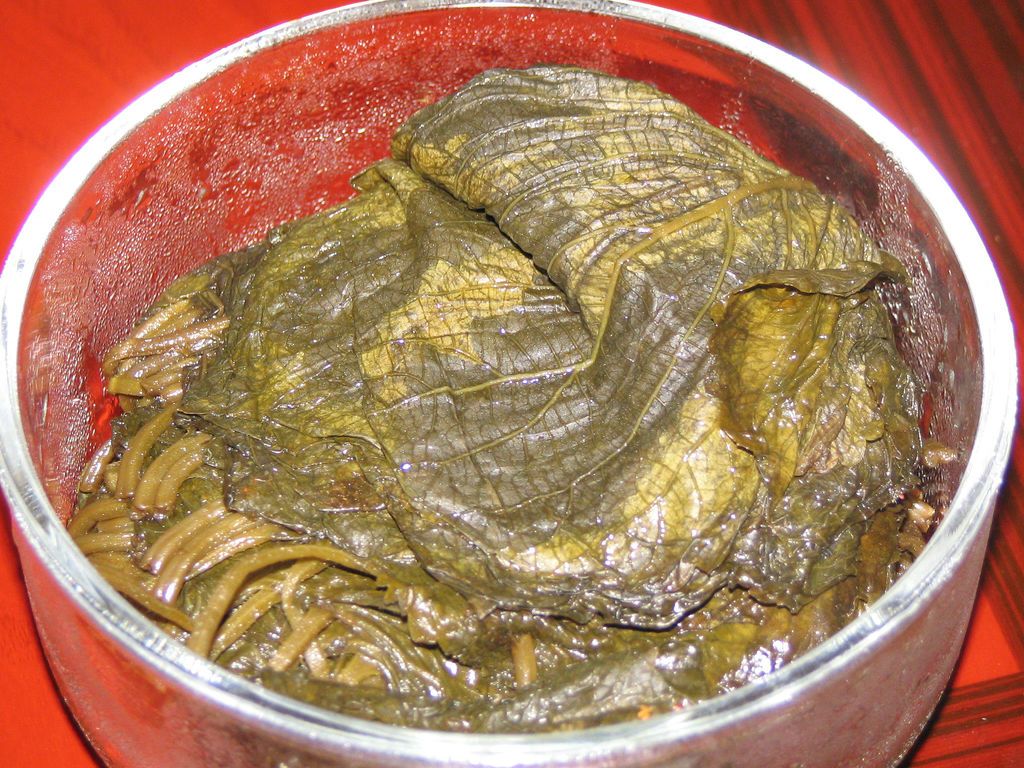 Soy-Pickled Perilla Leaves깻잎장아찌Fragrant perilla leaves steeped in a sweet-salty soy brine — peeled off one at a time and wrapped around a spoonful of rice.
Sources
- 01삼겹살구이 (Samgyeopsal-gui) — Encyclopedia of Korean Culture
- 02삼겹살 (Samgyeopsal) — Encyclopedia of Korean Folk Culture, National Folk Museum of Korea
- 03Pork meat, Belly side (Samgyeopsal), Raw (I014000F110a) — Korean Food Composition Table
- 04Chemicals in Meat Cooked at High Temperatures and Cancer Risk — National Cancer Institute
- 05Safe Food Handling — U.S. Food and Drug Administration
Last updated