History & Culture
Korean Barbecue: A History of Gogi-gui
고기구이 문화
From the ancient maekjeok to neobiani, bulgogi, Suwon galbi and the late rise of samgyeopsal, and why the lettuce wrap and banchan matter as much as the grill.
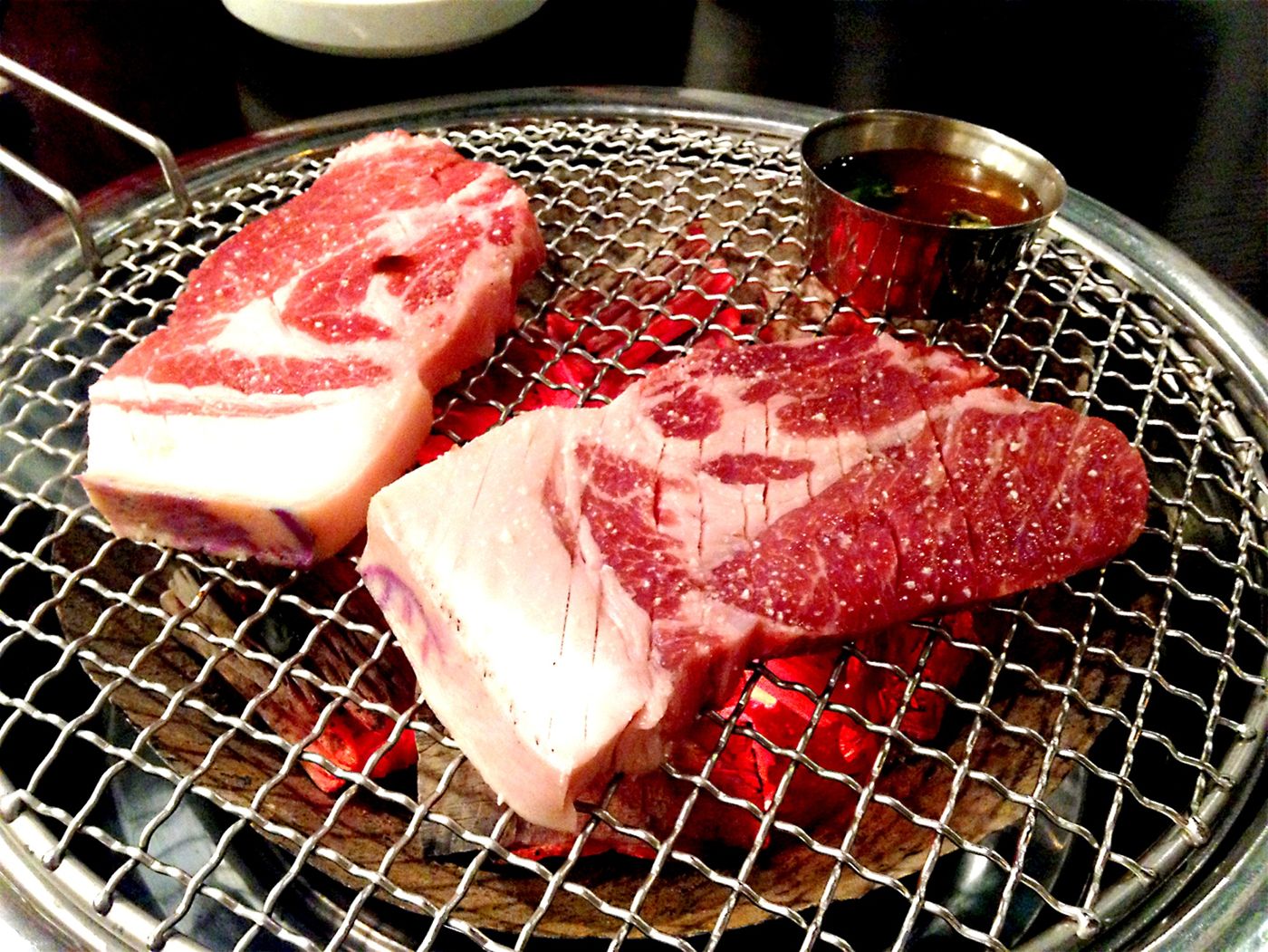
Grilling meat at the table, gogi-gui (고기구이), is one of the most recognizable images of Korean food abroad. Its history is a mix of well-documented modern developments and an ancient lineage that is often told with more confidence than the sources allow. This page sets out what is known, what is claimed and where scholars disagree.
Maekjeok: an ancient reputation
The story usually begins with maekjeok (맥적, 貊炙). A fourth-century Chinese text, the Soushen ji, lists maekjeok among foreign dishes so admired in China that noble and wealthy households served them first at important banquets. Maek referred to peoples of the northeast, often identified with Buyeo or Goguryeo, and jeok to grilled meat. The Encyclopedia of Korean Culture describes it as meat seasoned in advance and grilled on skewers, and treats it as the ancestor of Korean jeok dishes. Another early Chinese dictionary, however, describes maekjeok as meat roasted whole and carved by each diner with a knife, so even the form of the dish is uncertain.
From neobiani to bulgogi
Korean reference works commonly draw a line from maekjeok to neobiani (너비아니), the court and Seoul upper-class name for thin, broad slices of beef marinated and grilled over charcoal, and from neobiani to modern bulgogi. The Encyclopedia of Korean Culture presents the step from skewers to grill as one theory: once the iron grill (seoksoe) came into use, skewers were no longer needed. The link is plausible, since all of these dishes marinate beef in soy sauce, sesame and sweetener before grilling, but it is a reconstruction rather than a documented chain.
The word bulgogi itself is modern. In 2018 the food columnist Hwang Kyo-ik argued that it was a translation of the Japanese yakiniku, pointing to its first appearances under colonial rule. Linguists quoted by the Kyunghyang Shinmun rejected the argument: the earliest known use they found was in the Dong-a Ilbo in 1931, the word's structure (fire plus meat) follows ordinary Korean patterns, and the linguist Lee Ki-moon had proposed that it was Pyongyang dialect before entering standard Korean. No one has found the word before the 1930s, and the scholars agreed there is no proof of a Japanese origin. The fairest summary is that the dish is old, the name is not, and where the name came from is unsettled.
Galbi and Suwon
Beef short ribs, galbi, are also braised; see galbi-jjim. Grilled galbi as a restaurant dish owes much to Suwon, whose cattle market was famous from the late Joseon period. According to the Encyclopedia of Korean Culture, a restaurant called Hwachunok opened in Suwon's Yeongdong market in December 1945, first selling hangover soup with pieces of rib, and began serving charcoal-grilled galbi in 1956. Its style, long ribs seasoned with salt rather than soy sauce, became known as Suwon galbi. The restaurant closed in 1979, but cooks trained there spread the style in the 1980s. Premium native beef, hanu, is still the prestige choice for grilling.
Samgyeopsal: a recent favorite
Pork belly is the most common barbecue meat in Korea today, yet grilling it is recent. The cut was once called segyeopsal, using the native Korean word for three where samgyeopsal uses the Sino-Korean one, and was mostly boiled and sliced or braised. A 1934 newspaper article praised it as the tastiest part of the pig, and as late as 1983 a newspaper treated samgyeopsal as the colloquial name. Restaurants specializing in grilled pork belly appear to date from the late 1970s, and by the early 1980s Seoul had an alley of them in Samgak-dong. Portable gas burners, common from the mid-1980s, made it easy to grill at the table or outdoors. During the 1997 financial crisis cheap pork belly became an emblem of hard times, and pork belly with soju settled into popular culture. March 3 was promoted as Samgyeopsal Day from 2000 to support pig farmers after a foot-and-mouth outbreak.
Ssam and banchan at the grill
Korean barbecue is eaten wrapped. The habit of wrapping rice in leaves, ssam (쌈), is old: a nineteenth-century almanac records eating rice wrapped in greens for luck on the first full moon of the year, and a story tells of Goryeo women taken to the Yuan court who grew lettuce there to wrap their rice. At the barbecue table the wrap is usually lettuce or perilla leaves holding meat, raw or grilled garlic, green chili and a dab of seasoning paste made from doenjang and gochujang. Banchan do the balancing: scallion salad, kimchi and pickles cut the fat, and a bowl of doenjang-jjigae with rice often ends the meal. The cooking side is covered in grilling.