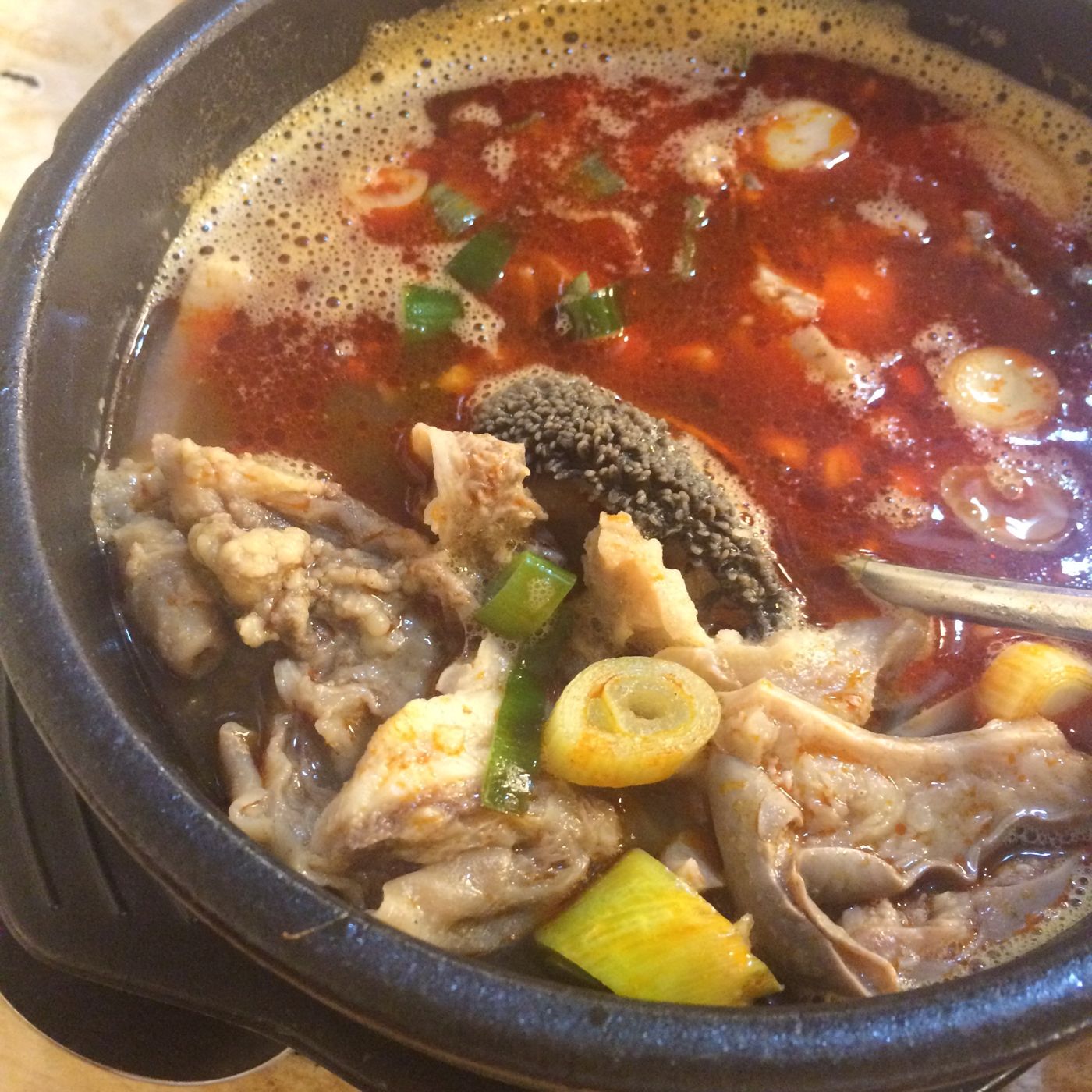
 Photo: chomjong, CC BY 2.0, via Wikimedia Commons
Guk & Tang · Soups 국·탕
Haejangguk (Hangover Soup)
해장국
Romanization: haejangguk
A hot, hearty morning soup — classically beef-bone broth with cabbage greens, bean sprouts and seonji (beef blood curd) — eaten over rice after a night of drinking.
- Serves
- 6
- Prep
- 150 min
- Cook
- 300 min
RegionSeoul & Gyeonggi · Jeonju · Gyeongsang
Jump to recipeRecipe
Ingredients · Serves 6
- 1.5 kgBeef leg or back bones
- 300 gBeef shank or brisket
- 5 lWaterplus more for topping up
- 400 gSeonji (cooked beef blood curd)bought cooked; cut into large cubes
- 300 gUgeoji (outer napa cabbage leaves)blanched and cut into 5 cm lengths
- 200 gSoybean sprouts
- 200 gKorean radishthinly sliced
- 3 tbspDoenjang
- 1 tbspGochugaruoptional, for a red broth
- 6 clovesGarlicminced
- 1 tbspSoup soy sauce (guk-ganjang)plus salt to taste
- 2 stalksLarge green onion (daepa)sliced
Method
Technique: Making Guk and Jjigae, Making Yuksu: Anchovy-Kelp Stock
Step 1: Soak the bones and beef in cold water for 2 hours, changing the water once. Blanch the bones in boiling water for 10 minutes, drain and rinse.
Step 2: Return the bones to a clean pot with the 5 liters of water and the beef. Simmer for 4–5 hours, topping up with water to keep the bones covered; remove the beef after about 2 hours, when tender, and slice it.
Step 3: Strain the broth and skim the fat; you want about 3 liters. Meanwhile, simmer the *seonji* cubes in a separate pot of lightly salted water for 5 minutes and drain — this firms them and keeps the soup broth clean.
Step 4: Toss the *ugeoji* with the doenjang, garlic and gochugaru (if using). Bring the broth to a boil and add the seasoned greens and radish. Simmer 20 minutes.
Step 5: Add the bean sprouts, sliced beef and *seonji* and simmer 10 minutes more, keeping the lid either on or off throughout so the sprouts don't turn beany. Season with soup soy sauce and salt.
Step 6: Ladle into earthenware bowls, scatter with green onion and serve boiling hot with rice and kimchi.
Origin & History
Haejangguk — also called sulguk, "drink soup" — is the general name for soups eaten to settle the stomach after drinking, usually with rice in an earthenware bowl. The Encyclopedia of Korean Culture finds a prototype in the late-Goryeo Chinese conversation primer Nogeoldae, which mentions a sobering soup (seongjutang) of meat broth with finely sliced meat, noodles, Sichuan pepper and green onion. Joseon cookbooks do not record it, but late-Joseon paintings and writings do: Shin Yun-bok's tavern scene shows a hostess ladling soup from a cauldron for idle young men.
The encyclopedia also cites the nineteenth-century Haedong jukji on hyojonggaeng, "dawn-bell soup": in Gwangju, south of Seoul, cooks simmered cabbage hearts, bean sprouts, mushrooms, beef ribs, sea cucumber and abalone all day, wrapped the pot in cotton and sent it overnight to the capital, where it reached high officials' houses still warm at the dawn bell — a gift that may have doubled as a bribe. Old Seoul haejangguk was a beef-bone broth lightly thickened with doenjang, simmered with bean sprouts, radish and cabbage and then seonji; Cheongjin-dong was famous for it.
Folklorist Song Hwa-seop, in the Encyclopedia of Korean Folk Culture, tells a more modern story. He argues that the name itself is recent, and traces the dish to the gukbap of Joseon market taverns and then to the wholesale markets founded from the mid-1950s, where porters ate soup and rice before dawn. From the late 1960s, when the night curfew lifted at 4 a.m., crowds leaving Seoul nightclubs headed for these soup houses, and the market workers' breakfast became the drinker's cure. He is blunt that the hangover-curing power is not scientific; the comfort is the hot broth.
Key Ingredients
 Doenjang된장Fermented soybean paste — the savory foundation of doenjang-jjigae, many soups and dressings for namul. It is one of Korea's core jang, or fermented sauces.
 Napa cabbage배추The tall, pale, tightly headed cabbage at the heart of Korea's best-known kimchi. Salted, layered with seasoning and left to ferment, it becomes baechu-kimchi; fresh, it goes into soups, wraps and quick salads.
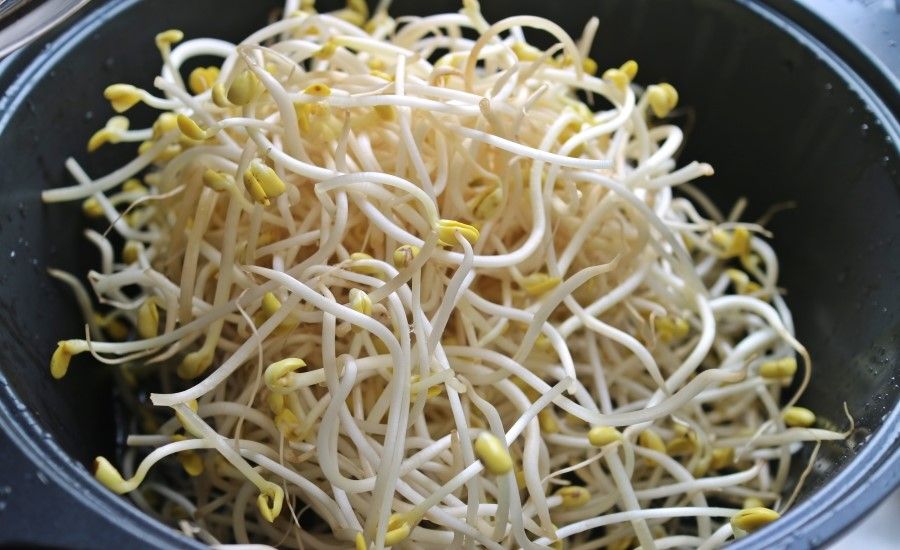 Soybean sprouts콩나물Soybeans sprouted in the dark until they grow long, pale stems topped with a yellow bean. A staple of everyday Korean cooking in kongnamul-muchim, clear sprout soup and sprout rice.
 Korean radish무A stout, heavy white radish, often tinged pale green near the top. It is cubed for kkakdugi, left whole in the clear brine of dongchimi, shredded into salads and simmered into broths.
 Gochugaru고춧가루Korean red chili powder, made from dried red peppers ground coarse or fine. It gives kimchi, gochujang and countless banchan their color and warmth.
 Garlic마늘Used raw, minced, pickled and roasted, garlic is one of the essential aromatics of Korean food — in seasonings, marinades, kimchi and namul.
 Soy sauce간장Korean soy sauce, in two main kitchen forms: pale, salty guk-ganjang (soup soy sauce) brewed the traditional way from meju, and darker, sweeter jin-ganjang for braises and marinades.
 Green onion파Korean green onion (pa), from thick-stemmed daepa to slender scallions — chopped into nearly every seasoning sauce, soup and kimchi, and the star of pa-kimchi.
Nutrition
| Calories | ~174 kcal |
|---|---|
| Protein | ~23.2 g |
| Fat | ~5.8 g |
| Carbohydrates | ~7.4 g |
| Fiber | ~2.4 g |
| Sodium | ~1872 mg |
Notable forIron · Protein · Selenium
Bone broth cannot be estimated reliably from raw ingredients, so these figures are scaled from the MFDS analysis of home-style seonji-haejangguk (per 100 g: 29 kcal, 3.86 g protein, 0.96 g fat, 1.23 g carbohydrate, 0.4 g fiber, 312 mg sodium, 6.83 mg iron, 8.45 µg selenium) to the database's 600 g serving, which works out to about 41 mg of iron per bowl, largely from the blood curd. The MFDS analysis of home-style bone haejangguk (346 mg sodium per 100 g in an 800 g serving) comes to about 2,770 mg sodium per bowl. Actual values vary with ingredients, portion size and preparation.
Health Benefits
- Blood curd is exceptionally rich in iron: by the MFDS analysis, one bowl of seonji-haejangguk holds several times an adult's daily iron requirement.
- The bowl is high in protein and low in fat, and the cabbage greens, radish and sprouts add vegetables.
- Its fame as a hangover cure is cultural rather than proven; the folk encyclopedia calls the curative claim unscientific and credits the comfort of hot broth.
Regional Variations
- Seoul seonji-haejangguk: beef-bone broth with doenjang, cabbage greens (ugeoji), bean sprouts, radish and blocks of seonji.
- Ppyeo-haejangguk: bone soup with meaty back bones; the folk encyclopedia traces a Seoul beef-bone version to soup houses around Yongsan's Yongmun market and Cheongjin-dong.
- Jeonju kongnamul-gukbap: bean sprouts, rice and kimchi in an earthenware pot, often with an egg, seasoned at the table with salted shrimp.
- Other bases: dried or winter-dried pollock (bugeo, hwangtae), freshwater snails (olgaengi, daseulgi), acorn jelly and dried radish greens all have their own hangover soups.
- Uljin: on the east coast, the encyclopedia notes a cold version — squid sliced as thin as noodles, seasoned, then covered with cold water and ice.
Pairings
 Cubed Radish Kimchi깍두기Korean radish cut into neat cubes and tossed with chili, garlic and salted shrimp — crunchy, juicy and a classic partner to rich soups.
 Napa Cabbage Kimchi배추김치Salted napa cabbage layered with a red paste of chili, garlic, ginger and fermented seafood, then left to ripen: the kimchi most people picture first.
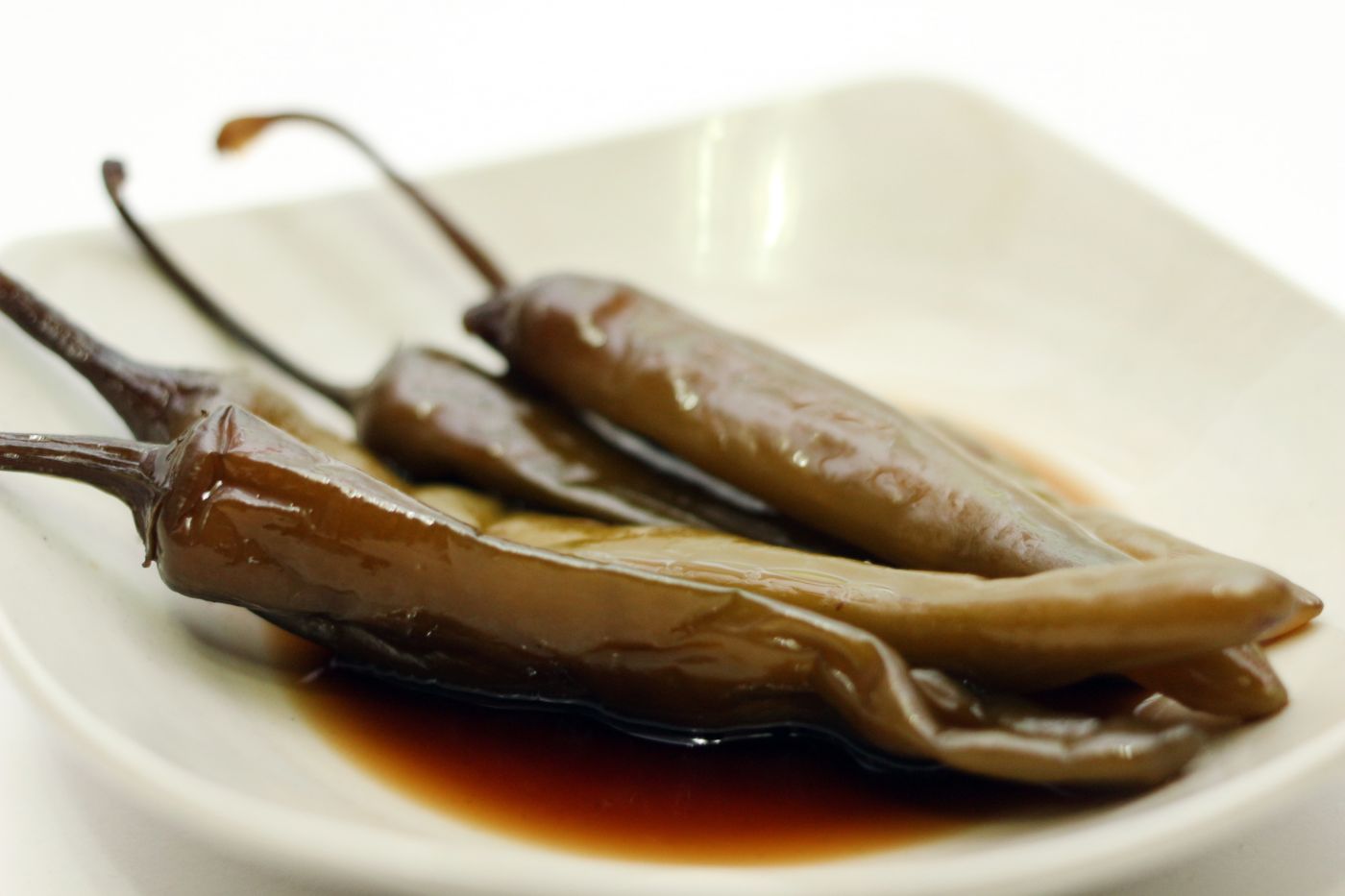 Soy-Pickled Green Chilies고추장아찌Whole green chilies cured in a sweet, tangy soy brine until olive-drab and tender-crisp — a keeping pickle that brings heat and salt to plain rice.
Sources
- 01해장국 (Haejangguk) — Encyclopedia of Korean Culture
- 02해장국 (Haejangguk) — Encyclopedia of Korean Folk Culture (한국의식주생활사전)
- 03뼈해장국 (Ppyeo-haejangguk) — Encyclopedia of Korean Folk Culture (한국의식주생활사전)
- 04해장국_선지 (Seonji-haejangguk, home-style, analyzed) — MFDS K-FIND food composition database
- 05해장국_뼈다귀 (Bone haejangguk, home-style, analyzed) — MFDS K-FIND food composition database
- 06Sodium reduction — World Health Organization fact sheet
Last updated