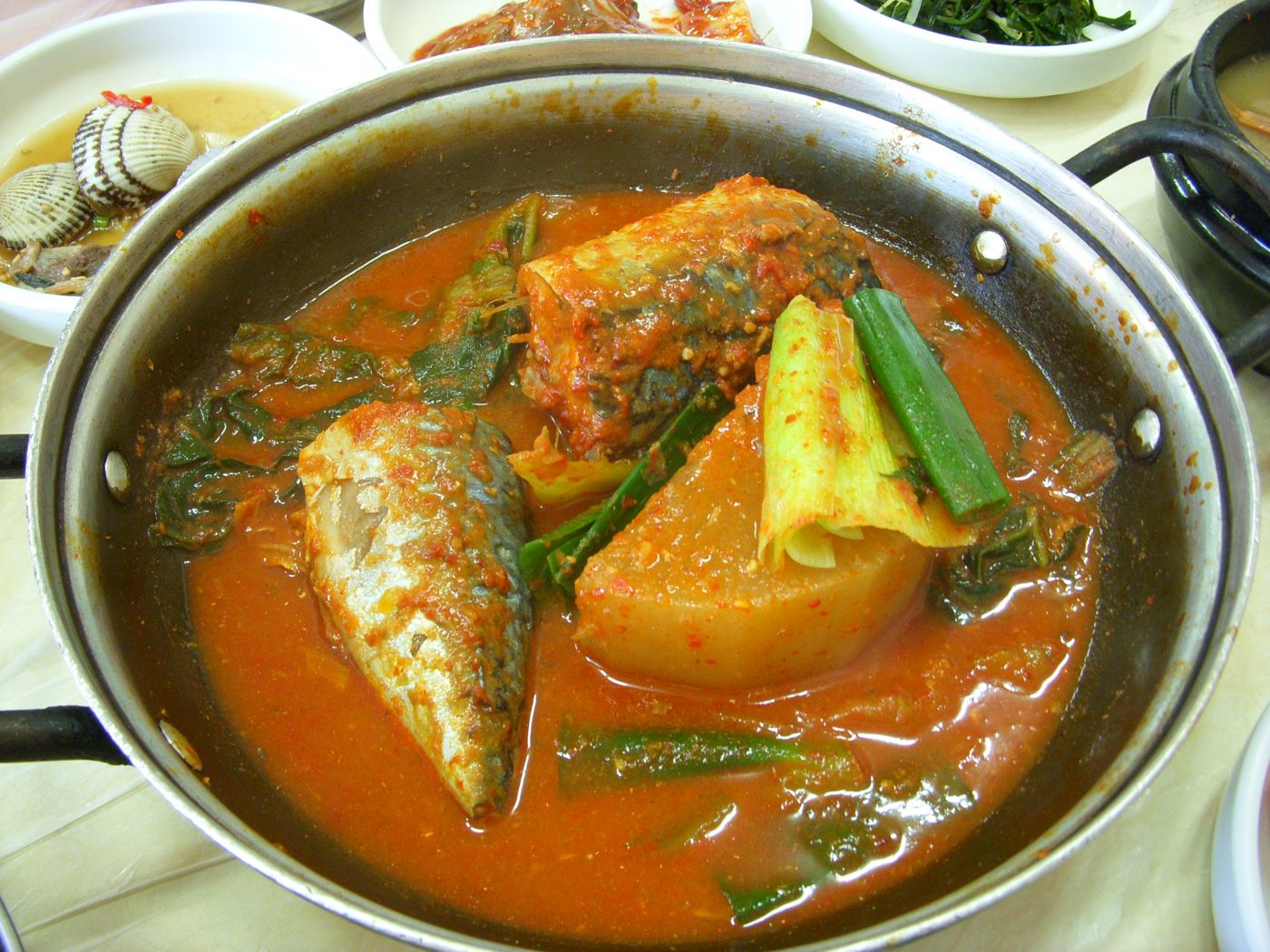
 Photo: LWY at flickr, CC BY 2.0, via Wikimedia Commons
Jorim · Braised 조림
Godeungeo Jorim
고등어조림
Romanization: godeungeo-jorim
Mackerel braised on a bed of Korean radish in a spicy soy and chili sauce — a warming, rice-friendly dish where the radish is often the best part.
- Serves
- 4
- Prep
- 15 min
- Cook
- 30 min
RegionAndong
Jump to recipeRecipe
Ingredients · Serves 4
- 1 wholeMackerelabout 500 g, cleaned and cut into 4–5 pieces (about 360 g edible)
- 300 gKorean radish (mu)cut into 1.5 cm slabs
- ½ mediumOnionabout 100 g, thickly sliced
- 1 smallGreen chiliabout 15 g, sliced
- 2 stalksGreen onionabout 30 g, cut into 4 cm lengths
- 300 mlWateror anchovy-kelp stock
- 2½ tbspSoy sauce
- 2 tbspGochugaru
- 1 tbspGochujang
- 4 clovesGarlicminced
- 1 tspGingerminced
- 2 tbspCooking rice wine
- 1 tspSugar
Method
Technique: Jorim: Braising in Seasoned Liquid
Step 1: Rinse the mackerel pieces, scraping away the dark blood line along the backbone, and pat dry. Keep the fish cold until you cook it.
Step 2: Mix the soy sauce, gochugaru, gochujang, garlic, ginger, rice wine and sugar into a paste.
Step 3: Lay the radish in the bottom of a wide, shallow pot. Add the water and about a third of the sauce, bring to a boil and simmer for 10 minutes, until the radish begins to turn translucent.
Step 4: Arrange the mackerel on top of the radish, scatter over the onion and spoon the remaining sauce evenly over the fish.
Step 5: Simmer over medium heat for 12–15 minutes, spooning the sauce over the fish from time to time, until the fish is cooked through and the liquid has reduced by about half. Leave the lid ajar for the first few minutes so strong fish odors can escape.
Step 6: Add the chili and green onion and simmer 2 minutes more. Serve hot with rice, with radish and sauce alongside each piece.
Origin & History
Mackerel (godeungeo, the chub mackerel Scomber japonicus) is found in all of Korea's seas. The Encyclopedia of Korean Culture describes schools arriving off Jeju's Seongsan coast in late winter and moving north up both the east and west coasts before turning south again in autumn. The fish appears as a local product in fifteenth-century geographies, and Jeong Yak-jeon's Jasan eobo (1814) recorded it under the name byeongmuneo with the folk name godeungeo, noting that fishermen lured it at night with lights.
Jasan eobo judged the fish good for soup or salting but not for eating raw or drying, and for most of Korean history mackerel traveled inland salted. Split, salted mackerel was sold widely in the Joseon period. Today it is eaten fresh or as salted jaban, most often grilled or braised.
The encyclopedia's entry on jorim notes that red-fleshed, strongly flavored fish such as mackerel, saury and horse mackerel are often braised with gochujang added to the soy sauce. Thick slices of radish laid under the fish soak up the sauce and the fish's richness, and chili, garlic and ginger temper its strong flavor.
Key Ingredients
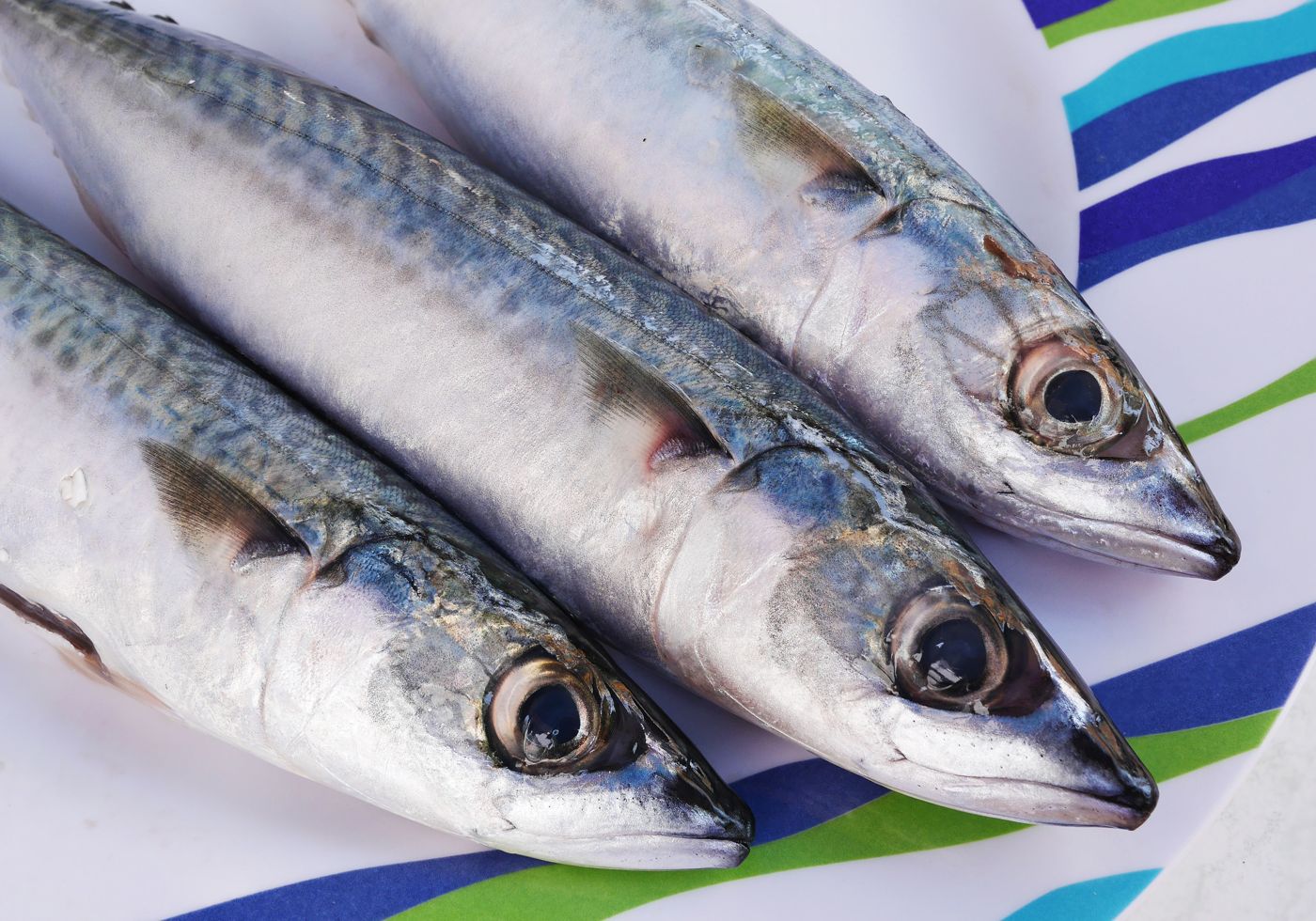 Mackerel고등어Korea's everyday oily fish, blue-green and silver with dark wavy stripes. Grilled until the skin blisters or braised with radish and chili, it is one of the most familiar fish on the home table.
 Korean radish무A stout, heavy white radish, often tinged pale green near the top. It is cubed for kkakdugi, left whole in the clear brine of dongchimi, shredded into salads and simmered into broths.
 Soy sauce간장Korean soy sauce, in two main kitchen forms: pale, salty guk-ganjang (soup soy sauce) brewed the traditional way from meju, and darker, sweeter jin-ganjang for braises and marinades.
 Gochugaru고춧가루Korean red chili powder, made from dried red peppers ground coarse or fine. It gives kimchi, gochujang and countless banchan their color and warmth.
- Gochujang고추장Fermented red chili paste — sweet, savory and hot. Made from meju powder, glutinous rice, malt and gochugaru, it is a later addition to Korea's family of jang.
 Garlic마늘Used raw, minced, pickled and roasted, garlic is one of the essential aromatics of Korean food — in seasonings, marinades, kimchi and namul.
 Ginger생강Fresh ginger root, used in small amounts to brighten kimchi paste and marinades and to tame the strong smells of fish and meat.
 Green onion파Korean green onion (pa), from thick-stemmed daepa to slender scallions — chopped into nearly every seasoning sauce, soup and kimchi, and the star of pa-kimchi.
- Korean Chili Peppers (Fresh)고추Fresh Korean chili peppers, eaten green (putgochu) or red (hong-gochu): from the fiery cheongyang-gochu to the small, wrinkled, mild kkwari-gochu that is braised and stir-fried as banchan.
Nutrition
| Calories | ~200 kcal |
|---|---|
| Protein | ~20.6 g |
| Fat | ~7.9 g |
| Carbohydrates | ~12.9 g |
| Fiber | ~3.1 g |
| Sodium | ~760 mg |
Notable forProtein · Vitamin D · Vitamin B12 · Omega-3 fats
Estimated by summing ingredient values and dividing by four servings, assuming all the sauce is eaten. Mackerel: USDA FDC 173672 (Pacific and jack mackerel, raw, about 360 g edible portion; roughly 8 µg vitamin D, 4 µg vitamin B12 and 1.3 g EPA+DHA per serving); Korean radish: FDC 168451; soy sauce: FDC 174277; gochugaru approximated with red pepper, FDC 170932; gochujang: Korean Food Composition Table entry 고추장, 개량; vegetables and sugar from USDA. Ginger and rice wine were left out as negligible. Leaving some sauce in the pot lowers the sodium. Actual values vary with ingredients, portion size and preparation.
Health Benefits
- Mackerel is an oily fish rich in high-quality protein and the long-chain omega-3 fats EPA and DHA.
- It is also one of the better food sources of vitamin D and vitamin B12, along with selenium.
- The FDA and EPA place Atlantic and Pacific chub mackerel among the "Best Choices" — the lowest-mercury group — in their fish advice.
- Radish, onion and chili add volume, fiber and some vitamin C for very few calories.
Regional Variations
- With radish or aged kimchi: radish is the classic base; another popular version braises mackerel on well-fermented napa cabbage kimchi (mugeunji).
- Soy or spicy: some cooks braise it in soy sauce alone, while most add gochugaru or gochujang for color and heat.
- Andong salted mackerel: inland Andong is known for ganggodeungeo, mackerel gutted and heavily salted so it could survive the journey from the coast. The Encyclopedia of Korean Culture lists its traditional preparations as grilling, steaming and a simmered dish with radish.
Pairings
 Kongnamul Muchim콩나물무침Soybean sprouts cooked under a lid until just tender, then tossed with garlic, green onion and sesame oil — crisp, nutty and on tables across Korea.
 Gyeran Jjim (Steamed Egg)계란찜Eggs whisked with water or broth and gently steamed into a silky, savory custard, often seasoned with salted shrimp and served bubbling hot.
 Sigeumchi Namul시금치나물Spinach blanched for a few seconds, squeezed dry and dressed with garlic, soy sauce and sesame — one of the simplest and most familiar namul.
 Napa Cabbage Kimchi배추김치Salted napa cabbage layered with a red paste of chili, garlic, ginger and fermented seafood, then left to ripen: the kimchi most people picture first.
Sources
- 01고등어 (Mackerel) — Encyclopedia of Korean Culture
- 02조림 (Jorim) — Encyclopedia of Korean Culture
- 03안동간고등어 (Andong salted mackerel) — Encyclopedia of Korean Culture
- 04Fish, mackerel, Pacific and jack, mixed species, raw (FDC 173672) — USDA FoodData Central
- 05Advice about Eating Fish — U.S. Food and Drug Administration
- 06Food Poisoning from Marine Toxins — CDC Yellow Book
Last updated