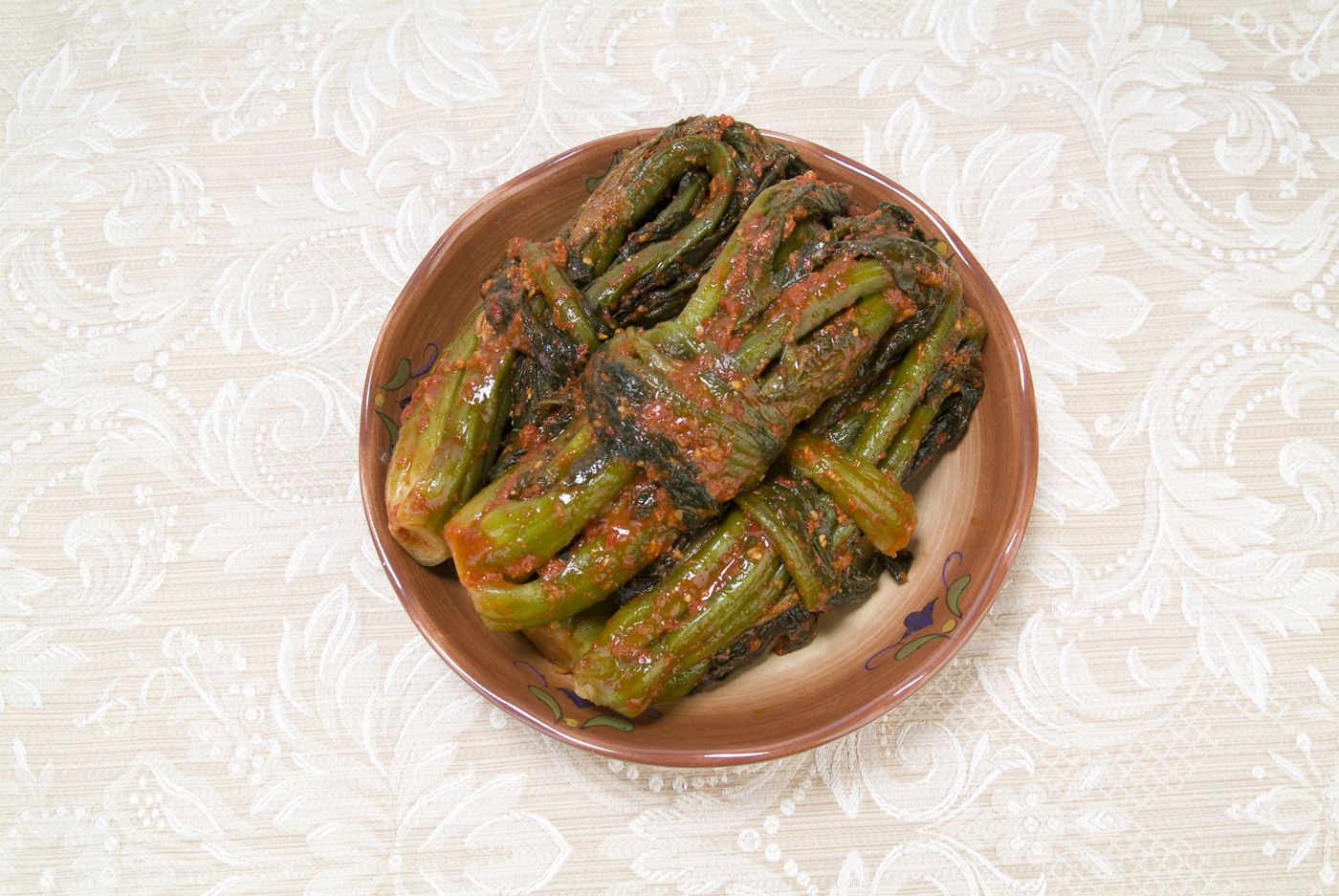
 Photo: kimsco, CC0, via Wikimedia Commons
Kimchi 김치
Mustard Leaf Kimchi
갓김치
Romanization: gat-kimchi
Leaf mustard rolled in a chili and anchovy paste and fermented until its nose-tingling bite mellows — a Jeolla specialty, famously from Dolsan in Yeosu.
- Serves
- 30
- Prep
- 60 min
- Cook
- 10 min
Recipe
Ingredients · Serves 30
- 2 kgKorean leaf mustard (gat), preferably green Dolsan-type
- 120 gCoarse sea salt (cheonilyeom), non-iodizedabout ¾ cup
- 1 LWaterfor dissolving part of the salt
- 3 tbspGlutinous rice flourfor the porridge
- 300 mlWaterfor the porridge
- 80 gGochugaru (Korean chili flakes)about ¾ cup
- 100 mlAnchovy fish sauce (myeolchi-aekjeot)
- 2 tbspSalted fermented shrimp (saeujeot)finely chopped
- 12 clovesGarlicminced
- 1 tbspGingerminced
- 1 tbspSugaroptional
- 150 gKorean chives (jjokpa) or green onionscut into 5 cm lengths
- ½ Carrotoptional, julienned
Method
Technique: Making Kimchi
Step 1: Trim the root ends and any yellowed leaves from the mustard and wash it well. Keep the plants whole if they are small; split thick bases lengthwise.
Step 2: Dissolve about one-third of the salt in 1 L water, dip each plant, then lay them in a tub, sprinkling the rest of the salt over the thick stems. Salt for 2–4 hours, turning once, until the stems bend without snapping (tender Dolsan mustard needs less time than older, tougher plants). Rinse once or twice and drain for 30 minutes.
Step 3: Whisk the glutinous rice flour into 300 ml water and cook over medium heat, stirring, for 4–5 minutes into a thick, glossy porridge. Cool completely.
Step 4: Stir the gochugaru, fish sauce, saeujeot, garlic, ginger and sugar into the cooled porridge, then fold in the chives and carrot.
Step 5: Wearing gloves, coat each mustard plant thoroughly, leaf and stem. Gather two or three plants together, fold them in half and twist the leaves around the stems into a loose bundle.
Step 6: Pack the bundles tightly into a clean jar, pressing out air and leaving 5 cm of headspace; pour any leftover seasoning over the top.
Step 7: Ferment at cool room temperature for 2–3 days, until it smells pleasantly sour, then refrigerate. The raw, sinus-clearing pungency softens after a week or two of chilling, and it keeps for a couple of months. Cut the bundles into short lengths to serve. Use clean utensils and discard if slimy or moldy.
Origin & History
Leaf mustard (gat) has been grown in Korea for a long time. Its cultivation is described in the Sanga yorok of around 1450, which suggests the plant was already familiar before the Joseon dynasty. Later Joseon texts, including the Jeungbo sallim gyeongje, recommend salting or kimchi-ing tender spring mustard and saving autumn mustard for winter kimchi; another early text, Suun japbang, describes a winter kimchi seasoned with ground mustard seed rather than the leaves.
Korean cooks distinguish red (purple) mustard, which is hairy and fiercely pungent, from green mustard, which is smoother and milder. Red mustard is a classic addition to the kimjang stuffing for napa cabbage kimchi, while green mustard is the usual choice for gat-kimchi itself.
The most famous gat-kimchi comes from Dolsan, an island district of Yeosu on the southern coast of South Jeolla. Dolsan mustard grew from a variety introduced during the Japanese colonial period and adapted to the area's warm maritime climate, long sunshine hours and alkaline, sandy soil. It has thick stems, large leaves and a softer, less fibrous bite than ordinary mustard. Dolsan gat-kimchi was designated a regional specialty in 1991, and in 2010 both Yeosu Dolsan mustard and Yeosu Dolsan gat-kimchi were registered under Korea's geographical indication system.
Key Ingredients
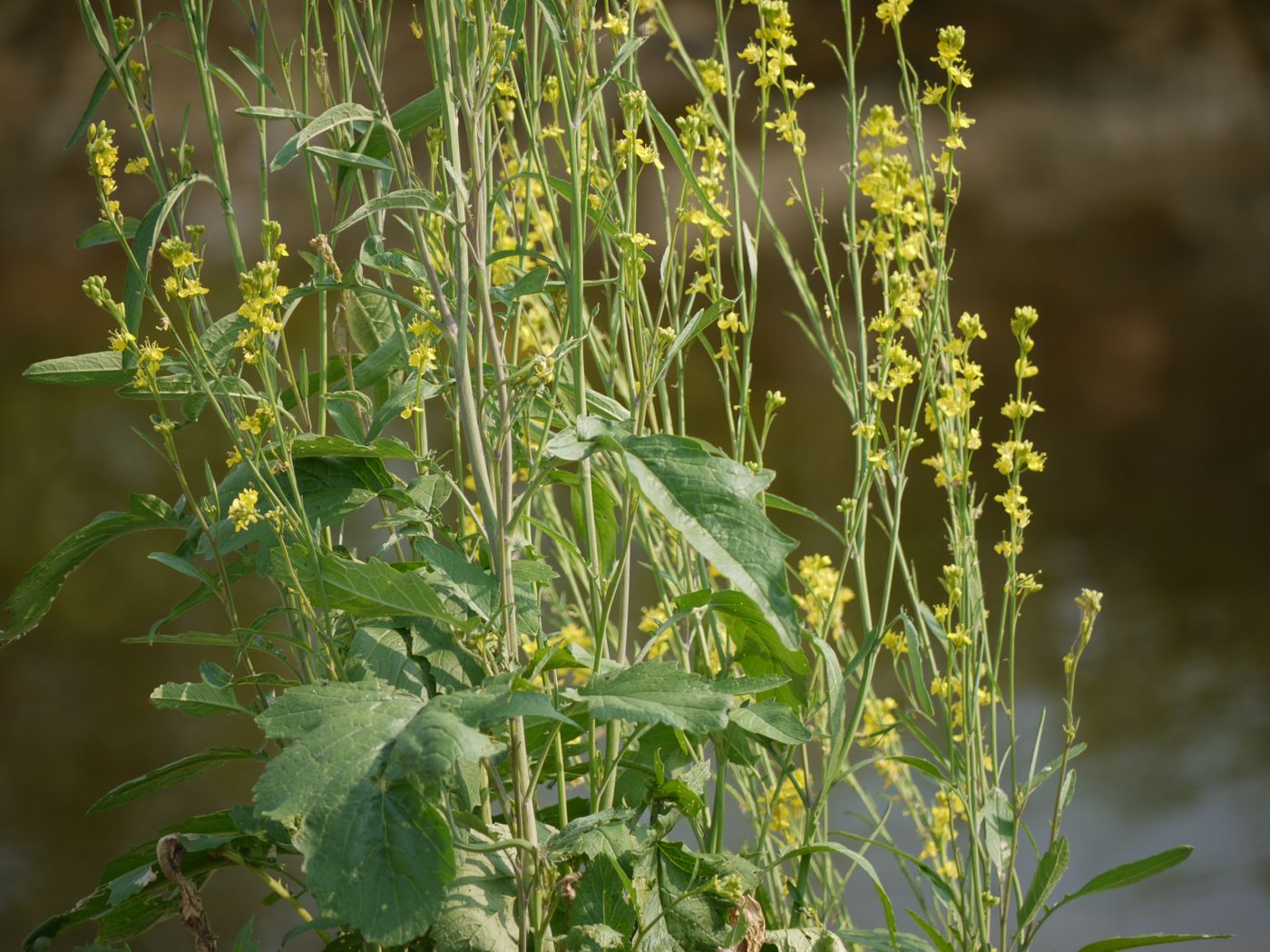 Mustard greens (gat)갓Broad, pungent leaves of Korean leaf mustard, green or deep purple-red. The star of gat-kimchi from Yeosu's Dolsan Island and a sharp, aromatic addition to winter kimchi seasoning.
 Sun-Dried Sea Salt천일염Coarse sea salt made by evaporating seawater with sun and wind in tidal-flat salt pans, most of it from Sinan County off Korea's southwest coast. It is the everyday salt for salting cabbage and making jang.
 Gochugaru고춧가루Korean red chili powder, made from dried red peppers ground coarse or fine. It gives kimchi, gochujang and countless banchan their color and warmth.
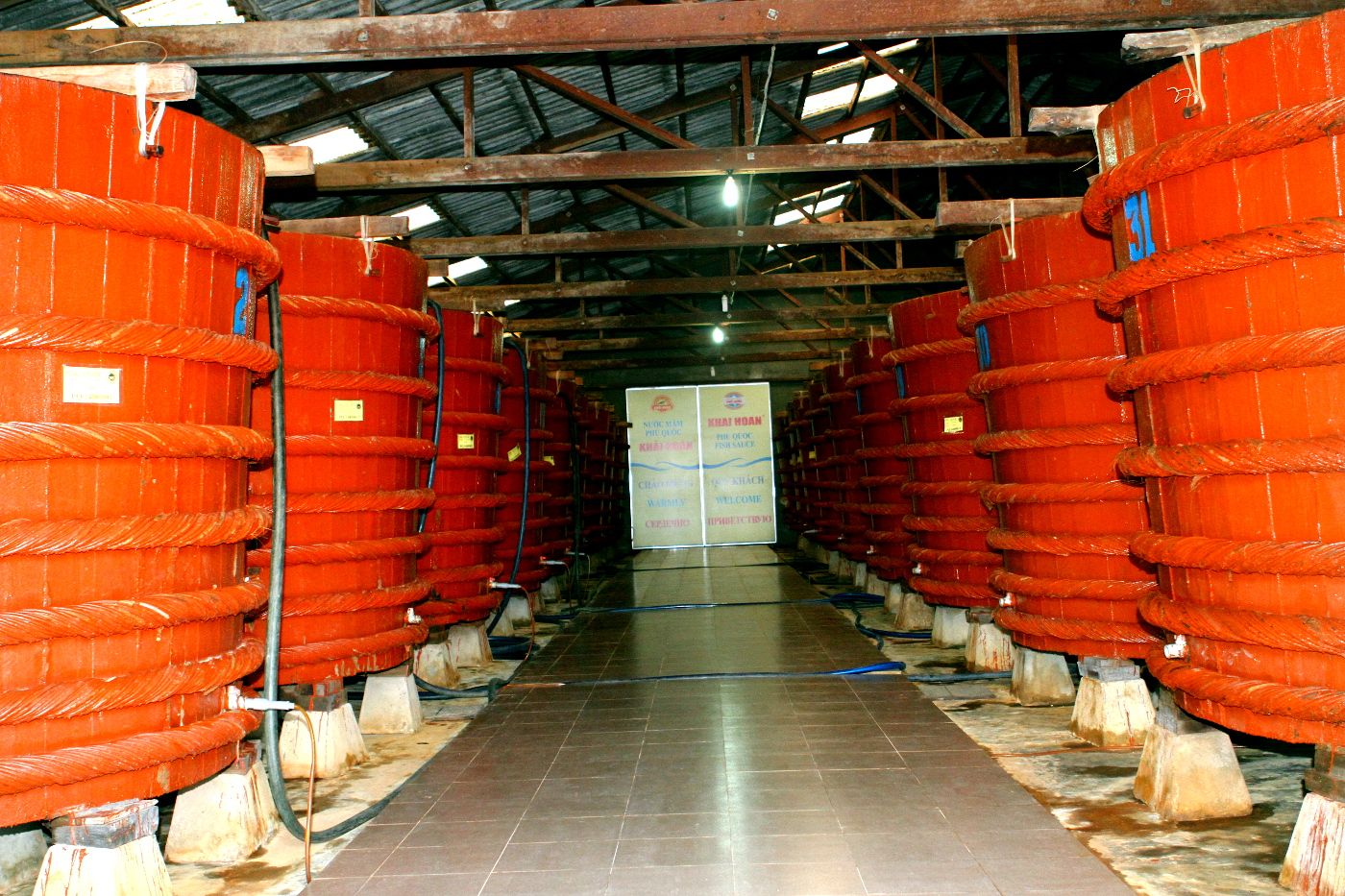 Anchovy fish sauce멸치액젓The clear amber liquid drawn from salted, fermented anchovies. A jeotgal in liquid form, it is the savory backbone of much southern-style kimchi and a quick seasoning for soups and namul.
 Salted fermented shrimp새우젓Tiny shrimp packed in salt and left to ferment — a jeotgal (salted seafood) that seasons kimchi and stews and accompanies boiled pork with briny, savory depth.
 Garlic마늘Used raw, minced, pickled and roasted, garlic is one of the essential aromatics of Korean food — in seasonings, marinades, kimchi and namul.
 Ginger생강Fresh ginger root, used in small amounts to brighten kimchi paste and marinades and to tame the strong smells of fish and meat.
 Green onion파Korean green onion (pa), from thick-stemmed daepa to slender scallions — chopped into nearly every seasoning sauce, soup and kimchi, and the star of pa-kimchi.
Nutrition
| Calories | 19 kcal |
|---|---|
| Protein | 1.6 g |
| Fat | 0.2 g |
| Carbohydrates | 3.5 g |
| Fiber | 1.5 g |
| Sodium | 360 mg |
Notable forVitamin K · Vitamin A (beta-carotene) · Calcium
From the Korean Food Composition Table entry “Kimchi, Gatkimchi, Prepared with leaf mustard” (per 100 g: 37 kcal, 720 mg sodium, 103 mg calcium, 101 µg vitamin A RAE, 121 µg vitamin K), scaled to the serving size. Homemade batches vary with salting and seasoning. Actual values vary with ingredients, portion size and preparation.
Health Benefits
- Dark leafy green: in the composition table, a serving of gat-kimchi provides about half a day's vitamin K, plus beta-carotene (vitamin A) and calcium.
- Mustard compounds: like other members of the cabbage family, leaf mustard contains glucosinolates such as sinigrin, the sulfur compounds behind its sharp bite. They are a subject of active research, but eating gat-kimchi should not be considered a way to prevent or treat disease.
- Keeps well: Korean references describe kimchi made from Dolsan mustard as keeping especially well.
Regional Variations
- Yeosu Dolsan (Jeolla): green Dolsan mustard briefly salted, then tossed with a glutinous rice porridge blended with chili, garlic, ginger and anchovy jeotgal, often with salted shrimp, green onions and shredded carrot.
- Gatssam-kimchi (Jeolla): large purple mustard leaves, with Haenam mustard especially prized, are layered unsalted with white julienned aromatics, chili threads, sesame and pine nuts in anchovy sauce, then used to wrap rice.
- Jeongseon (Gangwon): made with red mustard, rubbed in brine and salted under a layer of radish greens, then seasoned and finished with sesame oil.
Pairings
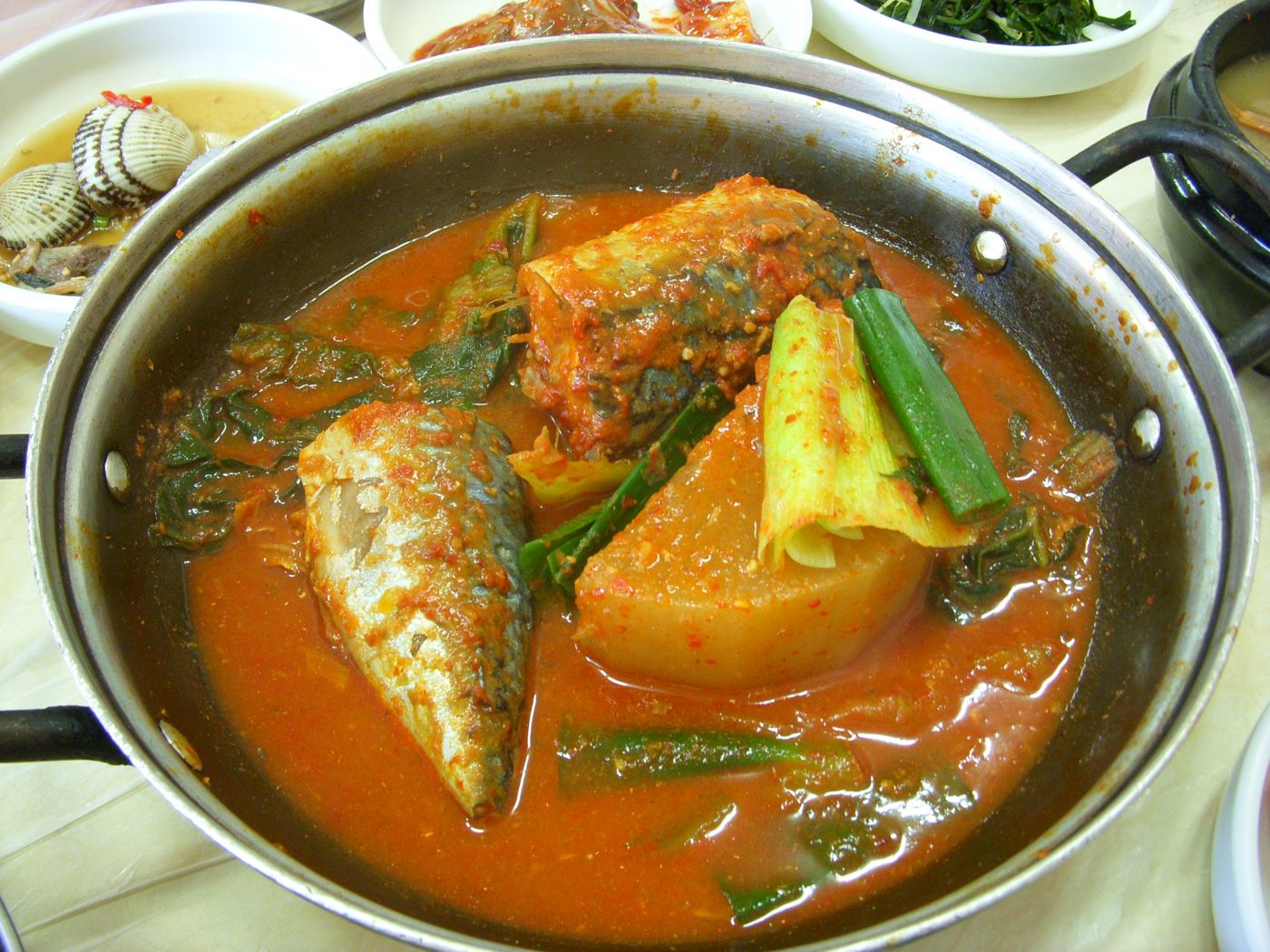 Godeungeo Jorim고등어조림Mackerel braised on a bed of Korean radish in a spicy soy and chili sauce — a warming, rice-friendly dish where the radish is often the best part.
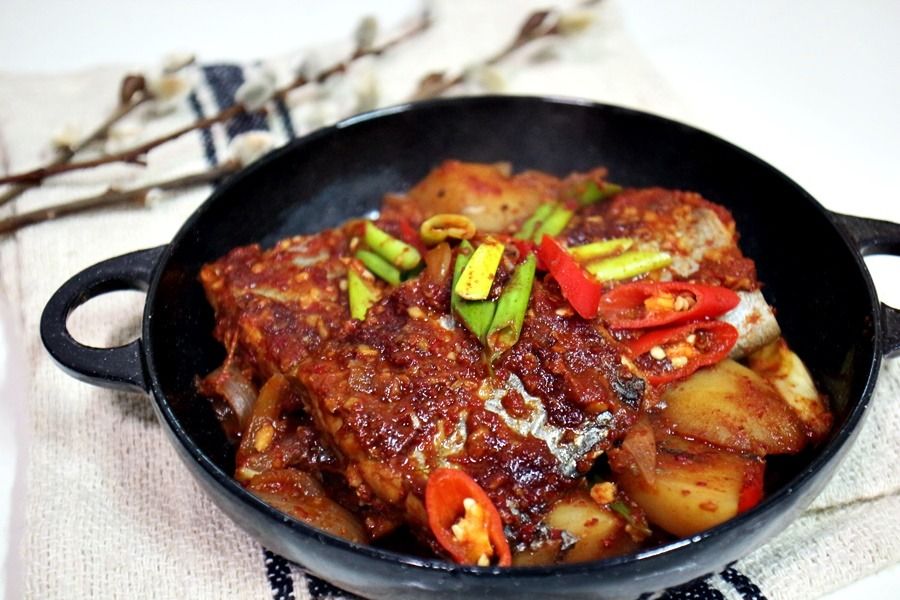 Galchi Jorim갈치조림Silvery hairtail braised with radish in a red, garlicky soy and chili sauce — a Jeju specialty and a favorite across Korea's southern coast.
- Gim Gui (Seasoned Roasted Laver)김구이Sheets of laver brushed with sesame or perilla oil, sprinkled with salt and toasted until crisp — eaten wrapped around spoonfuls of rice.
Sources
- 01Korean Food Composition Table: Kimchi, Gatkimchi, Prepared with leaf mustard — National Institute of Agricultural Sciences
- 02여수돌산갓김치 - 한국민족문화대백과사전 (Encyclopedia of Korean Culture)
- 03갓쌈김치 - 한국민족문화대백과사전 (Encyclopedia of Korean Culture)
- 04갓김치 - 한국민속대백과사전 (Encyclopedia of Korean Folk Culture)
- 05Is my kimchi safe to eat? - Oregon State University Extension Service
Last updated