Regions
Incheon
인천
The port where Korea met the modern world: Chinatown and the jajangmyeon story, chewy jjolmyeon from a noodle factory, and Sinpo Market's spicy dakgangjeong.
Incheon, on the west coast just beyond Seoul, opened as a treaty port in 1883, and much of its food story begins there. Foreign concessions grew up on the slopes of the old harbor, in what is now Jung-gu, and the Encyclopedia of Korean Culture describes the nearby Sinpo-dong area, next to the Japanese concession, as the city's commercial heart in the port-opening era. Three dishes now carry Incheon's name across the country: jajangmyeon, jjolmyeon and dakgangjeong.
Chinatown
The Qing set up their own concession in 1884, a year after Japan. The encyclopedia's entry on Jung-gu places it in today's Seollin-dong, on about 5,000 pyeong (roughly 1.6 hectares), and notes that locals called it Cheonggwan, "the Qing quarter." It survives as Chinatown, which the encyclopedia describes as the only Chinatown in Korea to have kept its line unbroken from that time. Its Chinese restaurants, among them Gonghwachun and Junghwaru, were famous nationwide, and diners came from all over the country for proper Chinese banquet food. Most of the migrants came from Shandong, just across the Yellow Sea, and their cooking became the Korean-Chinese cuisine of the neighborhood junggukjip. See Korean-Chinese food.
Jajangmyeon and its origin story
Jajangmyeon, noodles under a dark sauce of pork, onion and fried black bean paste, descends from Shandong's zhajiangmian. The Encyclopedia of Korean Culture says it was first sold at Gonghwachun, opened in 1905, and that the restaurant's red-brick building was registered as national cultural heritage in 2006. That account is contested. Writing in Incheon Today in 2025, local historian Jeon Yeong-woo notes that Gonghwachun is usually said to have opened in 1912, named "spring of the republic" for the new Chinese Republic; that its real founder is uncertain; that it was a grand banquet house rather than a noodle shop; and that it closed in 1983. The restaurant trading under the name in Chinatown today is unrelated, he adds; the old building now houses a jajangmyeon museum. Treat "birthplace of jajangmyeon" as civic branding with a real core: the dish did grow up in Incheon's Chinese community.
The Korean flavor came later. The encyclopedia credits Wang Song-san, an ethnic Chinese resident, with adding caramel to sweet bean paste in 1948 to create chunjang, and says government campaigns promoting flour foods in the 1960s and 1970s made jajangmyeon an everyday meal.
Jjolmyeon: a happy accident, or not
Jjolmyeon, thick, very chewy wheat noodles tossed with vegetables and a sweet-sour gochujang dressing, is unusual among Korean dishes: its time and place are well documented. Both national encyclopedias date it to Incheon in the early 1970s and give two versions of the story. In one, a worker at Gwangsin Jemyeon, a noodle factory in Jung-gu's Gyeong-dong, fitted the wrong die to the extruder during a rush on naengmyeon orders, and the oversized noodles went free to a nearby snack shop that dressed them with chili sauce. In the other, a noodle maker named Jeong Don-si says he developed the tough noodle deliberately and supplied it to the shop. The folk encyclopedia notes that Gwangsin Jemyeon's sign still claims the first jjolmyeon. Both accounts agree that the dish was popularized by Park Gi-nam of Sinpo Uri Mandu in Sinpo Market, who refined the dough with wheat flour and starch, built a factory in Gimje in 1987 and spread it through a chain. It became a staple of school-gate snack bars. See Korean street food.
Sinpo Market and dakgangjeong
Sinpo International Market, in the old commercial district, is also known for dakgangjeong: fried chicken pieces glazed in a sticky, spicy-sweet sauce. The Encyclopedia of Korean Folk Culture explains that the dish adapts the traditional confection gangjeong, whose syrup coating keeps fried rice dough crisp after it cools, to seasoned fried chicken, which otherwise turns soggy. Families had made it at home for some time; it became a shop food in the early 1990s. The encyclopedia names two famous makers, Sinpo Dakgangjeong in Incheon's Sinpo Market and Manseok Dakgangjeong in Sokcho, both opened in the early 1980s as ordinary fried-chicken shops. Sinpo's style uses large pieces in a chili-oil sauce with real heat; Sokcho's is bite-sized and sweeter. See twigim and frying and Korean fried chicken.
Eating in Incheon
A food walk can link Chinatown, the jajangmyeon museum and Sinpo Market, which sit close together in Jung-gu. Sinpo Uri Mandu's flagship still sells jjolmyeon alongside mandu; Chinatown's restaurants serve jjamppong and tangsuyuk as well as jajangmyeon. See also traditional markets.
Dishes from this region
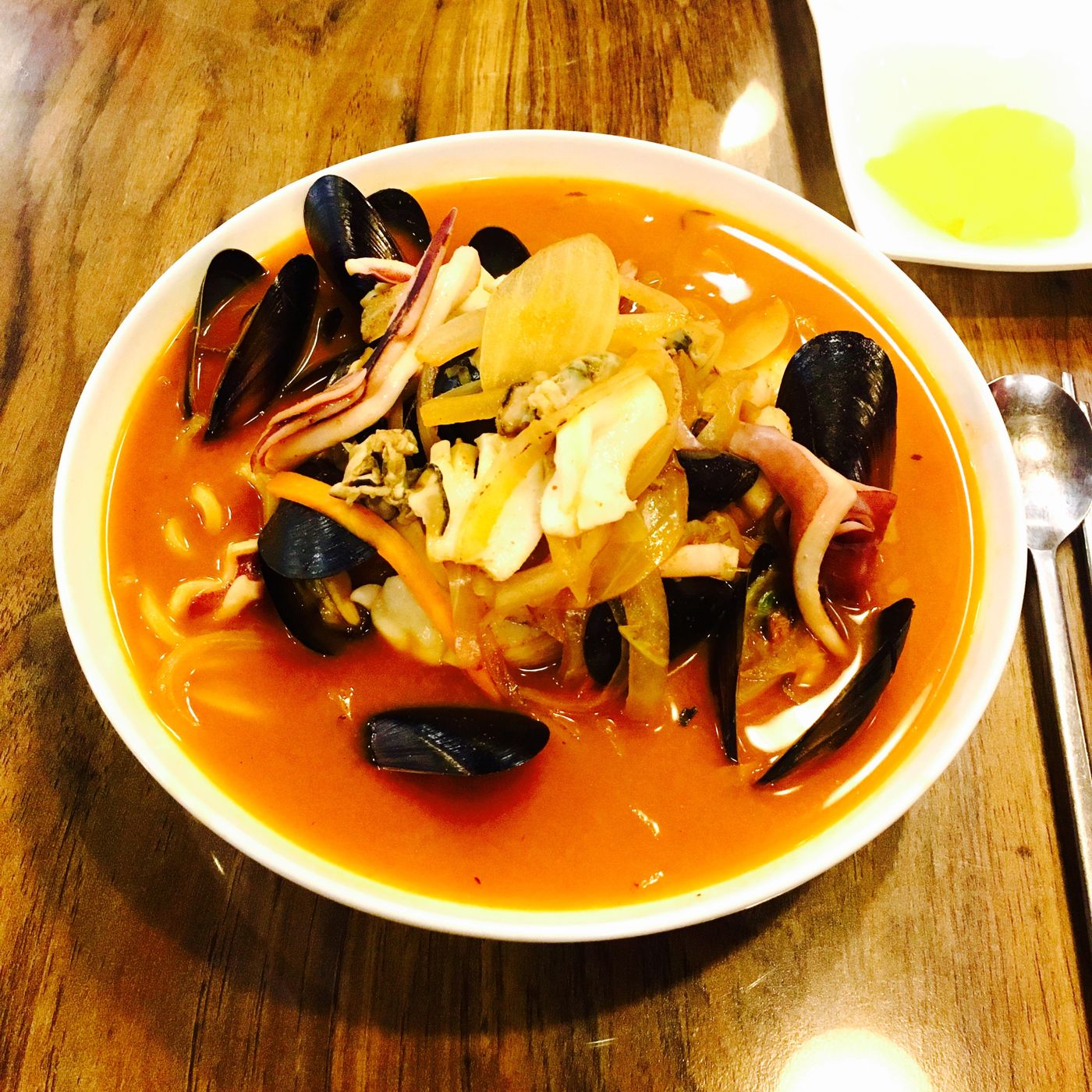 Jjamppong (Spicy Seafood Noodle Soup)짬뽕Thick wheat noodles in a fiery red broth of stir-fried pork, squid, shellfish and vegetables — the Korean-Chinese restaurant's spicy counterpart to jajangmyeon.
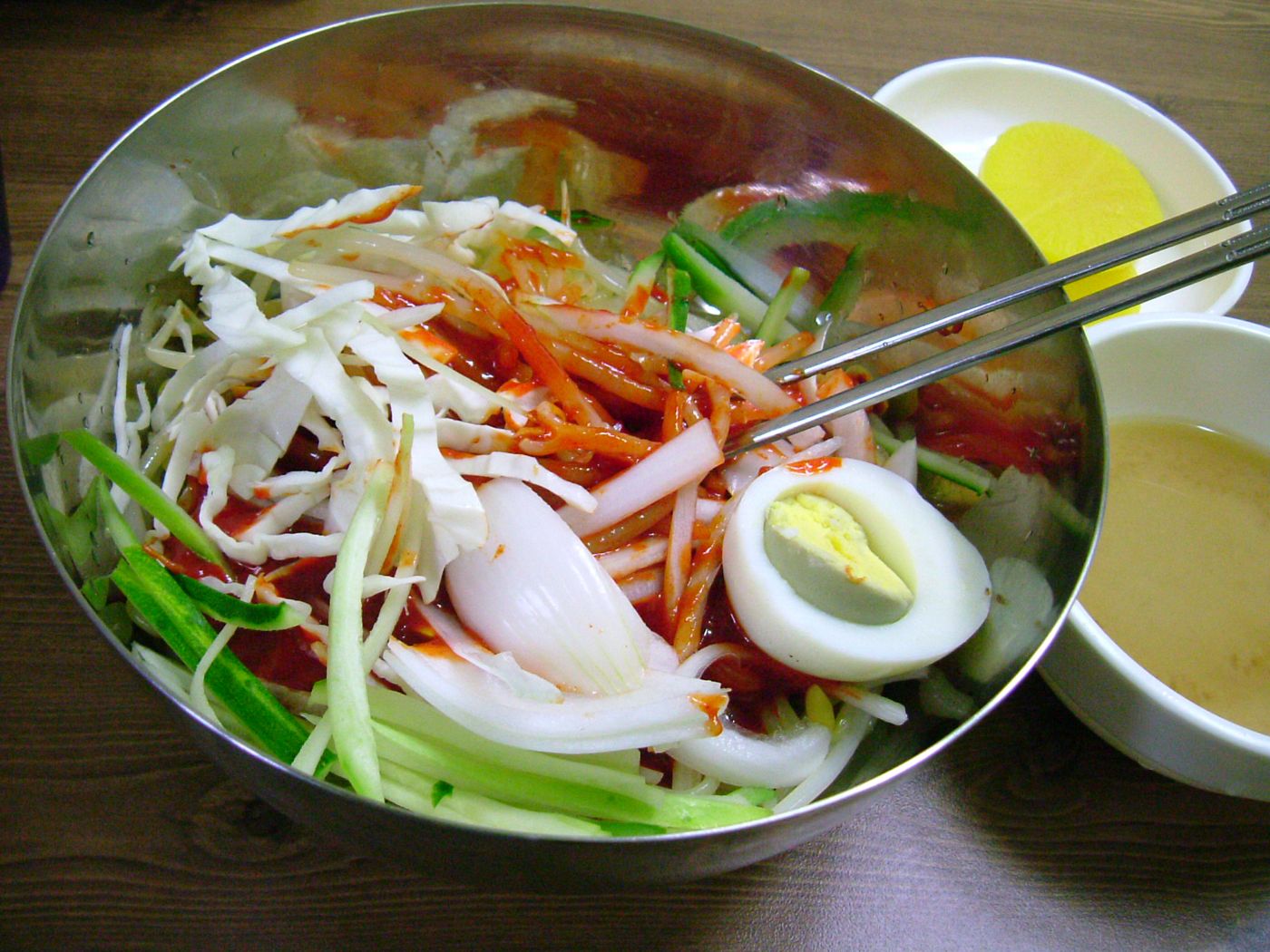 Jjolmyeon (Chewy Spicy Noodles)쫄면Thick, rubbery-chewy wheat noodles tossed cold in a sweet-sour gochujang sauce with cabbage, sprouts and egg — a snack-bar classic invented in 1970s Incheon.
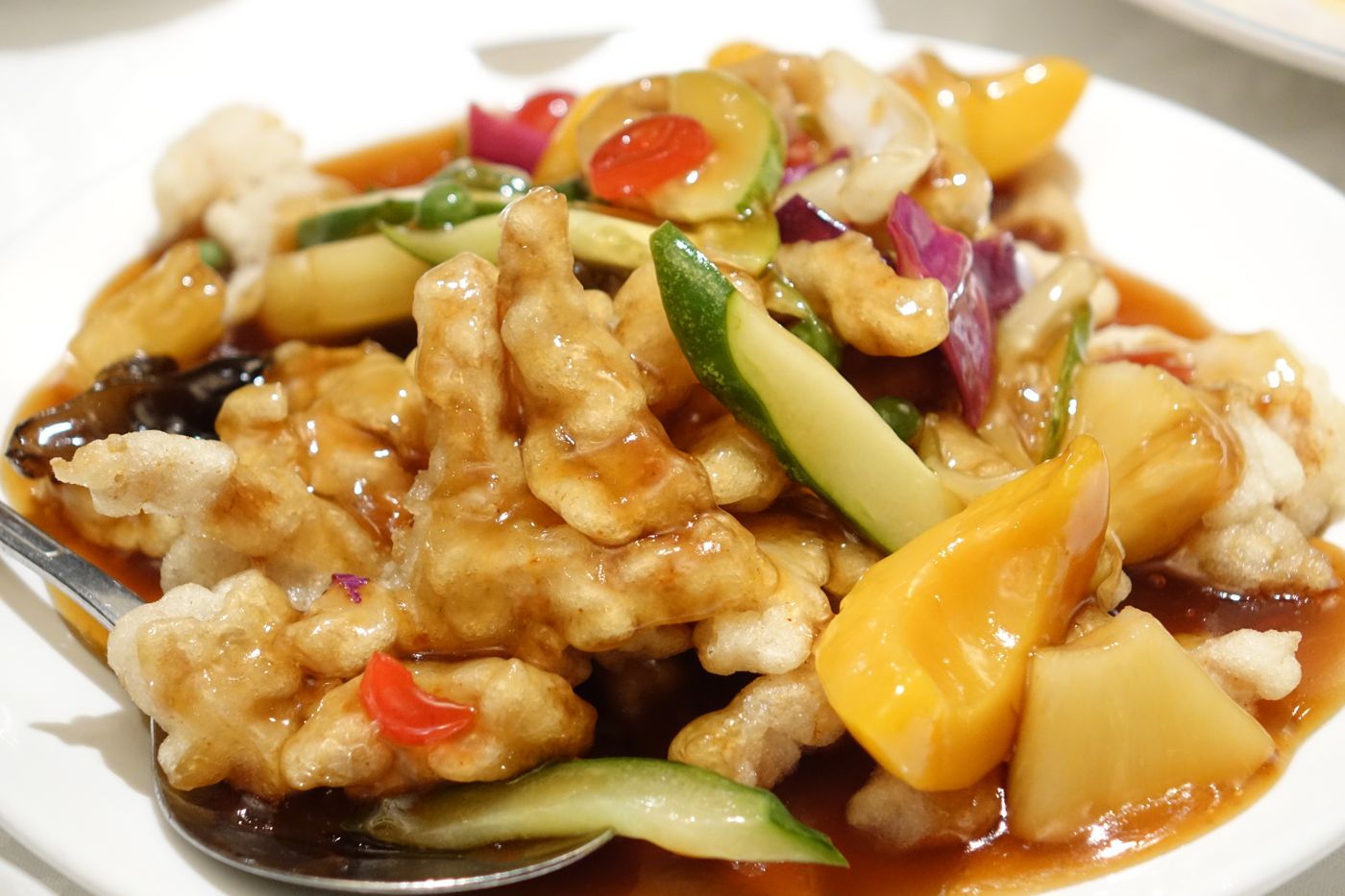 Tangsuyuk (Sweet and Sour Pork)탕수육Strips of pork in a crisp starch batter, fried twice and dressed with a glossy sweet-and-sour vegetable sauce — the shared platter of the Korean-Chinese restaurant.
Sources
- 01인천광역시 중구 (Jung-gu, Incheon) — Encyclopedia of Korean Culture
- 02자장면 (炸醬麵, Jajangmyeon) — Encyclopedia of Korean Culture
- 03[연재] 인천 짜장면과 중국집 (1) 공화춘과 짜장면 (Incheon's jajangmyeon and Chinese restaurants, part 1) — Jeon Yeong-woo, Incheon Today, June 2025
- 04쫄면 (Jjolmyeon) — Encyclopedia of Korean Culture
- 05쫄면 (Jjolmyeon) — Encyclopedia of Korean Folk Culture, National Folk Museum of Korea
- 06닭강정 (Dakgangjeong) — Encyclopedia of Korean Folk Culture, National Folk Museum of Korea