History & Culture
Korean Street Food: Pojangmacha to Bungeoppang
길거리 음식
How tented carts, Chinese-immigrant hotteok, fish-shaped pastries, Busan fishcakes and gochujang tteokbokki became Korea's street food after liberation and the war.
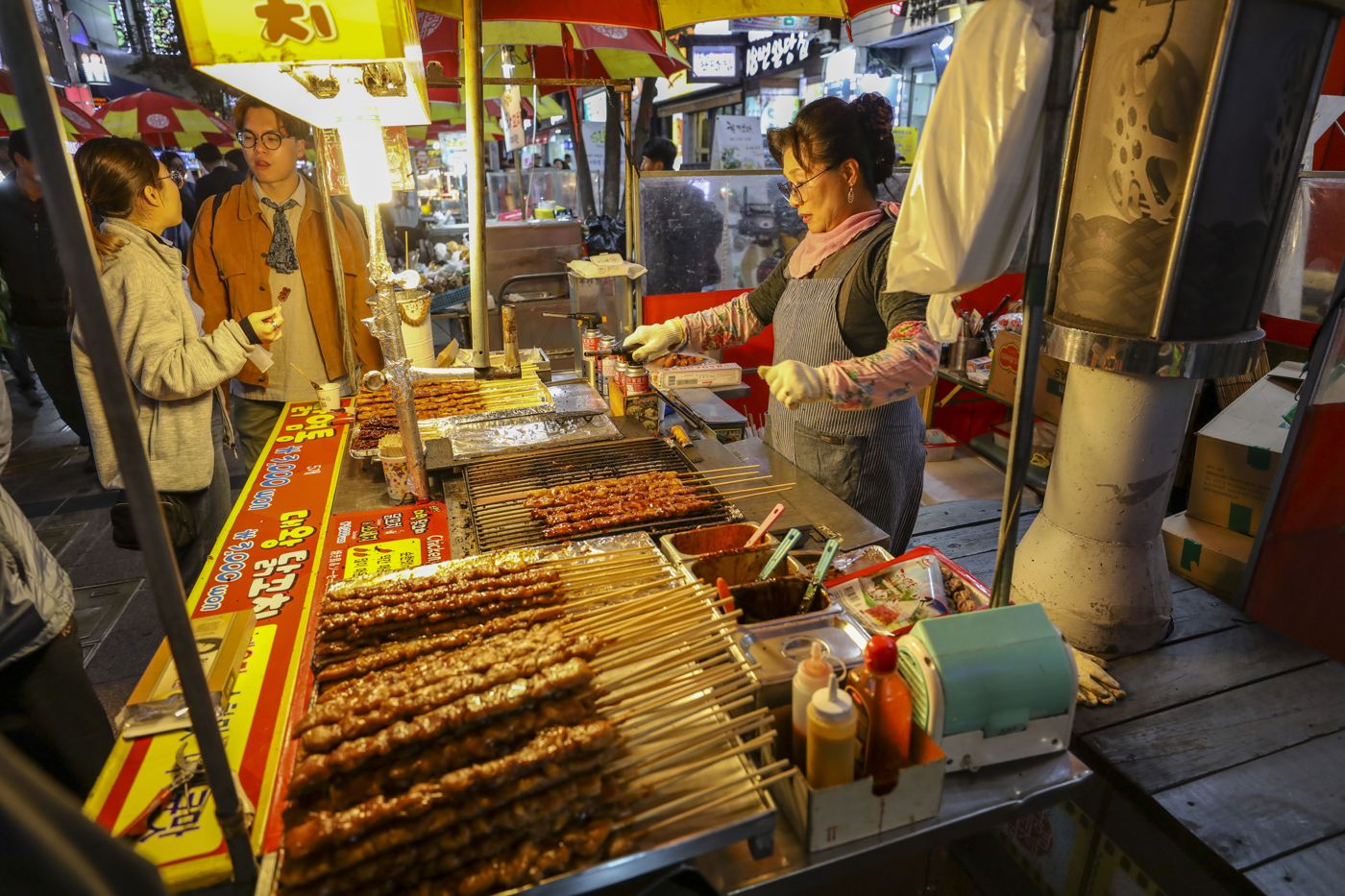 Photo: bryan..., CC BY-SA 2.0, via Wikimedia Commons
Korea's street food is younger than most of the dishes on this site. A handful of foods were sold at market stalls and inns in the Joseon period, but the snacks people now picture, tteokbokki in a red sauce, skewered fishcake in broth, sugar-filled hotteok and fish-shaped pastries, took their present form in the twentieth century. Their history runs through colonial rule, liberation in 1945, the Korean War and the cheap wheat flour that followed.
Pojangmacha: the tented cart
The pojangmacha (포장마차), literally a covered wagon, appeared in cities after liberation as a makeshift drinking stall for workers and students. In the 1950s it was typically a cart with wooden posts at each corner and heavy cotton canvas stretched around it; later the posts became metal and the cloth became vinyl, and carbide lamps gave way to light bulbs, fluorescent tubes and LEDs. Without running water, many stalls slipped a plastic bag over each plate so it could be peeled off rather than washed.
The menu tracked the times. Early carts sold grilled sparrow, chicken feet, liver and tripe, boiled squid and salted grilled saury. After the war, refugees from the North who turned to street trade added cold noodles, sundae, mung-bean pancakes, buckwheat jelly and dumplings, and the refugee years in Busan brought shellfish and sea squirt. Grilled sparrow was the signature dish until a 1972 wildlife-protection law ended it. From the mid-1980s larger stalls with water and electricity appeared, especially south of the river in Seoul, and today many indoor bars recreate the look under the name pocha.
Hotteok: a Chinese-immigrant bread
Hotteok (호떡), the name means roughly foreign cake, arrived with Chinese migrants after an 1882 trade agreement between Joseon and Qing China. A Cantonese-run bakery was operating in Seoul by 1889; the Encyclopedia of Korean Culture counts 17 hotteok shops in 1906, 203 in 1923 and 1,139 across the country by October 1930. The shops were cheap and popular, and they suffered badly in the anti-Chinese riots of 1927 and 1931. Some 500 were still trading in the early 1960s before steamed hoppang buns and environmental rules on charcoal ovens pushed most of them out in the 1970s. The griddled street hotteok filled with cinnamon brown sugar is a Korean adaptation of the immigrant original. In Busan, a version stuffed with seeds and nuts is said to have started on the streets of Nampo-dong in the 1980s.
Bungeoppang and the flour years
Bungeoppang (붕어빵), batter and sweet red-bean paste baked in a fish-shaped iron mold, belongs to a family of molded griddle cakes called pulppang. The molds came from Japan in the 1930s, the oval obanyaki being an early model. The cakes caught on in Seoul and other cities in the 1940s and 1950s and became a mass snack in the 1960s, when American surplus wheat, imported under aid agreements from the mid-1950s, and government campaigns promoting flour and mixed grains made wheat cheap. Wheat had been scarce in Korea for centuries, so the shift is part of the larger story told in food in modern Korea.
Eomuk: the Busan fishcake
Fish paste shaped and cooked into eomuk has roots in Japanese kamaboko. An eighteenth-century Korean manuscript by an interpreter who had eaten it in Japan describes a quite different rolled dish under a borrowed name, but the Japanese style spread only with Japanese residents during colonial rule, including shops in Busan's Bupyeong market. After liberation the first Korean-owned fishcake factory opened in Busan, and the wartime influx of refugees made cheap fried fishcake a staple; several of the city's best-known makers date from the 1950s. Skewers simmering in broth at street carts, and stir-fried eomuk in lunchboxes, both grew from that boom; see Busan.
Tteokbokki: from court dish to red sauce
The older tteokbokki was a refined dish: sliced garaetteok stir-fried with seasoned beef, mushrooms and vegetables in soy sauce, associated with court and upper-class cooking. The red version is usually traced to Ma Bok-rim, who opened a street stall in Seoul's Sindang-dong in 1953 and seasoned the rice cakes with a mix of gochujang and Chinese black bean paste. Her stall drew a local following through the 1960s and press attention by the 1970s, and Sindang-dong became known for tteokbokki restaurants. As with many founding stories, the details come largely from Ma's own account and later press coverage. See the dish itself at tteokbokki.
Street food as a table
Little of this food was invented from scratch. Pojangmacha cooks borrowed from home kitchens, refugees carried regional dishes south, and immigrants adapted their breads to local tastes. Many of the same foods also fill the stalls of Korea's traditional markets.
Sources
- 01포장마차 (Pojangmacha) — Encyclopedia of Korean Culture
- 02호떡 (Hotteok) — Encyclopedia of Korean Culture
- 03풀빵 (Pulppang) — Encyclopedia of Korean Culture
- 04부산어묵 (Busan eomuk) — Encyclopedia of Korean Culture
- 05떡볶이 (Tteokbokki) — Encyclopedia of Korean Culture
- 06신당동 떡볶이 '원조' 마복림 할머니 별세 — Kyunghyang Shinmun (2011)