History & Culture
Junghwa Yori: Korea's Chinese Food
한국식 중화요리
From Shandong migrants in 1880s Incheon to the delivery bowl: how jajangmyeon, jjamppong and tangsuyuk became Korean food, and why their origin stories are still argued over.
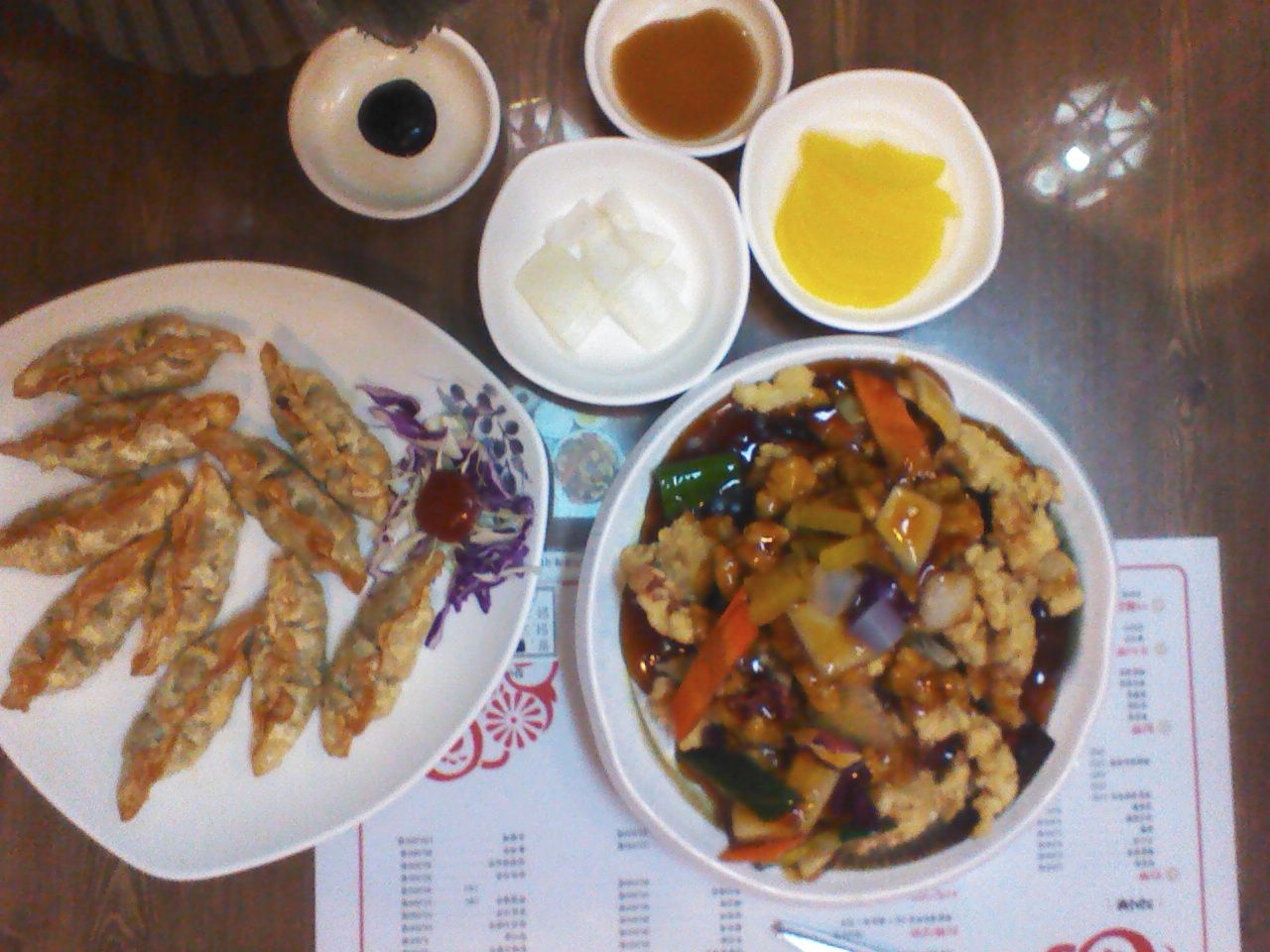 Photo: User:Piotrus, CC BY-SA 3.0, via Wikimedia Commons
Junghwa yori (중화요리), Chinese cooking, means something quite specific in South Korea. It is the food of the neighborhood junggukjip, the Chinese restaurant: black-bean noodles, a red seafood noodle soup, sweet-and-sour pork, and a few plates of yellow pickled radish and raw onion with chunjang for dipping. These dishes came from China, but they were reshaped over more than a century by Chinese cooks feeding Korean customers, and many people now regard them as Korean food in their own right.
Shandong in Incheon
The story begins with politics. During the Imo military mutiny of 1882 the Qing sent some 3,000 troops to Korea under the authority of Li Hongzhang, and around forty merchants came with them to supply the army. The same year a trade agreement between Joseon and the Qing recognized Chinese settlement and trade in the open ports. Incheon had opened as a treaty port in 1883, and in 1884 a Qing concession was laid out in what is now Bukseong-dong, with a consulate, schools, a guild hall and a shrine. A Gyeongin Ilbo history of the community counts 166 Chinese residents in 1883, more than 2,100 by 1893 and about 11,800 by 1910, rising to nearly 68,000 by 1930. Most came from Shandong, just across the Yellow Sea, and they clustered in a few trades, above all tailoring, barbering and restaurants; by 1930 there were roughly 1,600 Chinese eateries across the peninsula. The area they built is today's Incheon Chinatown.
Jajangmyeon and the question of "first"
Jajangmyeon descends from zhajiangmian, Shandong-style noodles topped with fried wheat-and-soybean paste. Korea's version is darker, sweeter and saucier, thanks largely to chunjang. The Encyclopedia of Korean Culture credits an ethnic Chinese producer, Wang Song-san, with developing chunjang in 1948 by adding caramel to the sweet bean paste, which gave the sauce its glossy black color.
Where jajangmyeon was first sold in Korea is harder to settle. The usual answer is Gonghwachun (共和春, "Spring of the Republic") in Incheon's Seollin-dong, whose red-brick building was registered as a cultural heritage in 2006 and reopened as the Jajangmyeon Museum in 2012. Even the opening date is disputed: the Encyclopedia of Korean Culture gives 1905, while the restaurant's own name, which honors the Chinese Republic founded in 1912, points to around that year, the date most other accounts use. A 2023 Incheon Today series argues that Gonghwachun was a grand banquet restaurant, one of the three leading Chinese restaurants in Incheon, rather than a noodle shop, and that the founder's identity is itself uncertain. Noodles with fried bean paste were almost certainly being cooked for dock workers and laborers in the port before any one restaurant can be shown to have sold them. Today's restaurant called Gonghwachun, opened in 2004 under a trademarked name, has no direct link to the original. "First" is best read as a claim about a place that became a symbol.
Jajangmyeon became an everyday food in the 1960s and 1970s, when the government's campaign to stretch rice supplies by promoting wheat flour foods, supplied in part by imported flour, made noodles cheap and encouraged people to eat them. For a time it was the standard treat for graduations and moving days, and it remains a classic delivery order. The dish has its own page: jajangmyeon.
Jjamppong and tangsuyuk
Jjamppong (짬뽕), the spicy seafood noodle soup, has a tangled name. It is usually traced to chaomamian, a Shandong noodle soup of stir-fried vegetables and seafood, cooked by Chinese restaurants in colonial Korea. The Korean name comes from chanpon, a noodle dish created by Chinese cooks in Nagasaki, Japan, which Japanese residents of Korea apparently applied to the similar-looking soup they found there. The original was pale; the red, chili-heavy broth familiar today is generally dated to the early 1970s, as cooks added gochugaru and chili oil for Korean tastes; through the 1960s the dish was still often called junghwa udong.
Tangsuyuk (탕수육), battered and fried pork in a sweet-and-sour sauce, adapts the Shandong dish tangcurou. Korean restaurants typically use a potato or corn starch batter, often fried twice, and the sauce, thickened with starch and full of vegetables and fruit, is either poured over the meat or served on the side. Whether to pour or dip is a lighthearted argument at Korean tables.
A cuisine that changed hands
The community that created this food did not always prosper with it. The 1931 anti-Chinese riots, the Sino-Japanese War and postwar pressures after liberation pushed many ethnic Chinese families to emigrate to Taiwan, the United States and elsewhere. Over time more junggukjip came to be run by Korean owners and cooks. The dishes, meanwhile, spread nationwide and abroad; Korean television has even made Korean-style jajangmyeon familiar in China. Related stories appear in noodles in Korean history, food in modern Korea and Korean food abroad.