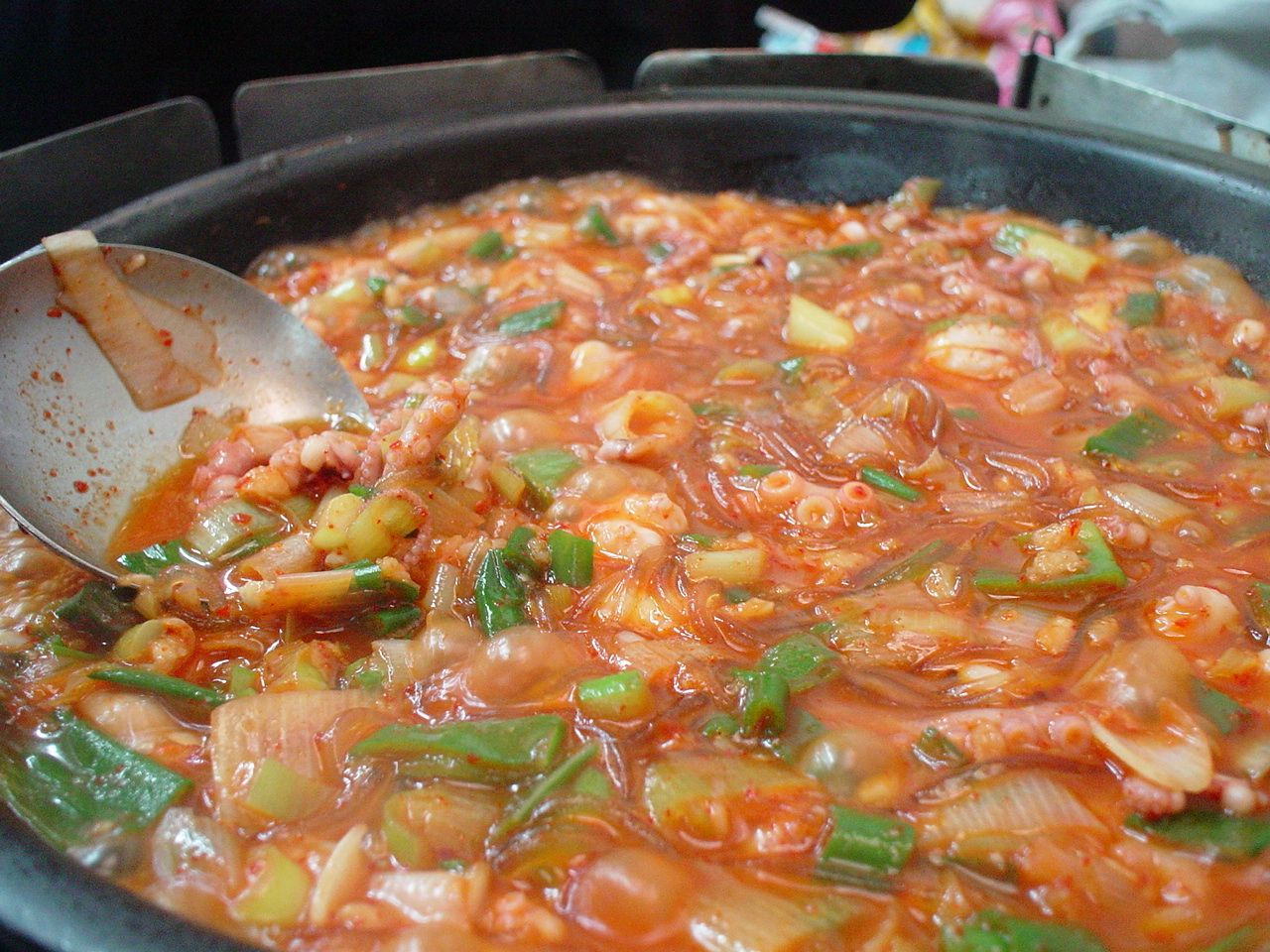
 Photo: shizu k (shezzz) at Flickr, CC BY-SA 2.0, via Wikimedia Commons
Bokkeum · Stir-fried 볶음
Nakji Bokkeum (Spicy Stir-Fried Octopus)
낙지볶음
Romanization: nakji-bokkeum
Long-arm octopus stir-fried fast over high heat with onion and a fiery gochugaru sauce, usually served with rice and a mild soup to calm the heat.
- Serves
- 4
- Prep
- 25 min
- Cook
- 8 min
RegionJeolla · Seoul & Gyeonggi
Jump to recipeRecipe
Ingredients · Serves 4
- 500 gLong-arm octopus (nakji)fresh or thawed; cleaned
- 2 tbsp eachCoarse salt and flourfor rubbing and rinsing
- 150 gOnionabout 1, sliced thick
- 40 gGreen onioncut in 5 cm lengths
- 4 tbspGochugaru
- 2 tbspSoy sauce
- 1 tbspSugar
- 4 clovesGarlicminced
- 1 tspGingergrated
- 1 tbspNeutral oil
- 1 tbspToasted sesame oil
- 1 tspToasted sesame seeds
Method
Technique: Bokkeum: Korean Stir-Frying
Step 1: Clean the octopus: cut off the head sac, empty it, remove the eyes and mouth, and turn out the head if needed. Massage with the coarse salt and flour for 1–2 minutes to release slime, then rinse well under cold water and drain.
Step 2: Cut the arms and body into 5–6 cm pieces. Pat dry.
Step 3: Mix gochugaru, soy sauce, sugar, garlic, ginger and 1 tbsp of water into a thick sauce; let it sit for 5 minutes.
Step 4: Heat a wok or a large frying pan over high heat until very hot. Add the neutral oil and the onion; stir-fry for 1 minute.
Step 5: Add the octopus and sauce, and toss continuously for 2–3 minutes, only until the octopus has just curled and turned opaque. Overcooking makes it tough and rubbery.
Step 6: Add the green onion and sesame oil, toss for 20 seconds, and turn off the heat. Scatter with sesame seeds and serve right away over rice or with a mild soup.
Origin & History
Nakji has long been eaten along Korea's south and west coasts, where the tidal flats are wide. A 2003 Kyunghyang Shinmun series on regional flavors notes that, when transport was poor, families outside coastal areas bought dead octopus strung on straw rope at five-day markets, sold by the score, and cooked it on skewers or stir-fried. Once live octopus began reaching cities in tanks of seawater, the article says, cooks took up many more dishes.
The version Seoul knows best, spicy and stir-fried at high heat, is relatively recent. A Kyunghyang Shinmun report from January 2003 dates the alley's beginnings to the 1960s: octopus restaurants clustered in Seorin-dong, and office workers from nearby Mugyo-dong were regulars, hence the name "Mugyo-dong octopus." One owner there dated her octopus restaurant to 1965, although the same article gives a different founding year (1972) for the restaurant itself, so the exact dates are loose. In the early 1980s, redevelopment and subway construction pushed many of the shops to Cheongjin-dong. The article lists a menu that had stayed the same for about forty years: nakji-bokkeum, clam soup (jogae-tang), potato stew and scallion pancake. A mild soup alongside the fiery stir-fry is the pairing it describes.
Octopus and chili suit each other: the octopus supplies a clean, slightly sweet chew, and the sauce supplies the burn. The Encyclopedia of Korean Culture lists nakji-bokkeum among the standard ways to cook the animal, alongside live sannakji and use as a filling in gimjang kimchi. For the stir-fry's technique, see bokkeum stir-frying.
Key Ingredients
 Long-arm octopus (nakji)낙지A slender octopus with long, thin arms, dug from the tidal mudflats of South Jeolla. Koreans eat it stir-fried with chili, in clear yeonpo-tang, and famously raw as sannakji.
 Yangpa (onion)양파The bulb onion, literally the "Western scallion." A latecomer to Korea, it is now everywhere: sweetening stir-fries and braises, pickled in soy sauce as yangpa-jangajji, and served raw beside grilled meat.
 Green onion파Korean green onion (pa), from thick-stemmed daepa to slender scallions — chopped into nearly every seasoning sauce, soup and kimchi, and the star of pa-kimchi.
 Gochugaru고춧가루Korean red chili powder, made from dried red peppers ground coarse or fine. It gives kimchi, gochujang and countless banchan their color and warmth.
 Soy sauce간장Korean soy sauce, in two main kitchen forms: pale, salty guk-ganjang (soup soy sauce) brewed the traditional way from meju, and darker, sweeter jin-ganjang for braises and marinades.
 Garlic마늘Used raw, minced, pickled and roasted, garlic is one of the essential aromatics of Korean food — in seasonings, marinades, kimchi and namul.
 Ginger생강Fresh ginger root, used in small amounts to brighten kimchi paste and marinades and to tame the strong smells of fish and meat.
 Sesame참깨Toasted sesame seeds and sesame oil (chamgireum) finish countless Korean dishes, adding a nutty aroma and gloss.
Nutrition
| Calories | ~229 kcal |
|---|---|
| Protein | ~21 g |
| Fat | ~10 g |
| Carbohydrates | ~16 g |
| Fiber | ~3 g |
| Sodium | ~787 mg |
Notable forVitamin B12 · Iron · Selenium
Estimated by summing USDA FoodData Central values for raw common octopus (FDC 174218), onion, scallion, red pepper (FDC 170932, standing in for gochugaru), soy sauce, sugar, garlic, ginger, canola and sesame oils and sesame seeds, divided by four. Octopus supplies most of the roughly 25 µg vitamin B12, 6.6 mg iron and 56 µg selenium per serving. The salt and flour used to clean the octopus are not counted. Rice is not included. Actual values vary with ingredients, portion size and preparation.
Health Benefits
- Lean protein: octopus is high in protein and low in fat. USDA lists raw common octopus at about 15 g protein and 1 g fat per 100 g.
- Minerals and B12: the same entry shows iron (5.3 mg per 100 g), selenium (about 45 µg) and a large amount of vitamin B12 (20 µg).
- Traditional vigor food: the Encyclopedia of Korean Culture cites an older text that says nakji restores vitality; that is a traditional view rather than a tested claim.
Regional Variations
- Seoul (Mugyo-dong) style: very spicy, cooked in small batches and served with clam soup, as in the Seorin-dong and Cheongjin-dong alley.
- Mud-flat nakji: the 2003 Kyunghyang series says hand-caught Muan mud-flat octopus has a deeper flavor than the rock-dwelling octopus of Yeosu, and that thin-armed young sebal-nakji are caught from late October.
- With cured pork: one alley restaurant in the January 2003 report was popular for a bacon-and-sausage octopus dish.
- With noodles: the July 2003 series names octopus stir-fried with ramen (nakji ramyeon-bokkeum) and octopus with thin somyeon noodles among the many ways cooks combine nakji with other foods.
Pairings
 Gyeran Jjim (Steamed Egg)계란찜Eggs whisked with water or broth and gently steamed into a silky, savory custard, often seasoned with salted shrimp and served bubbling hot.
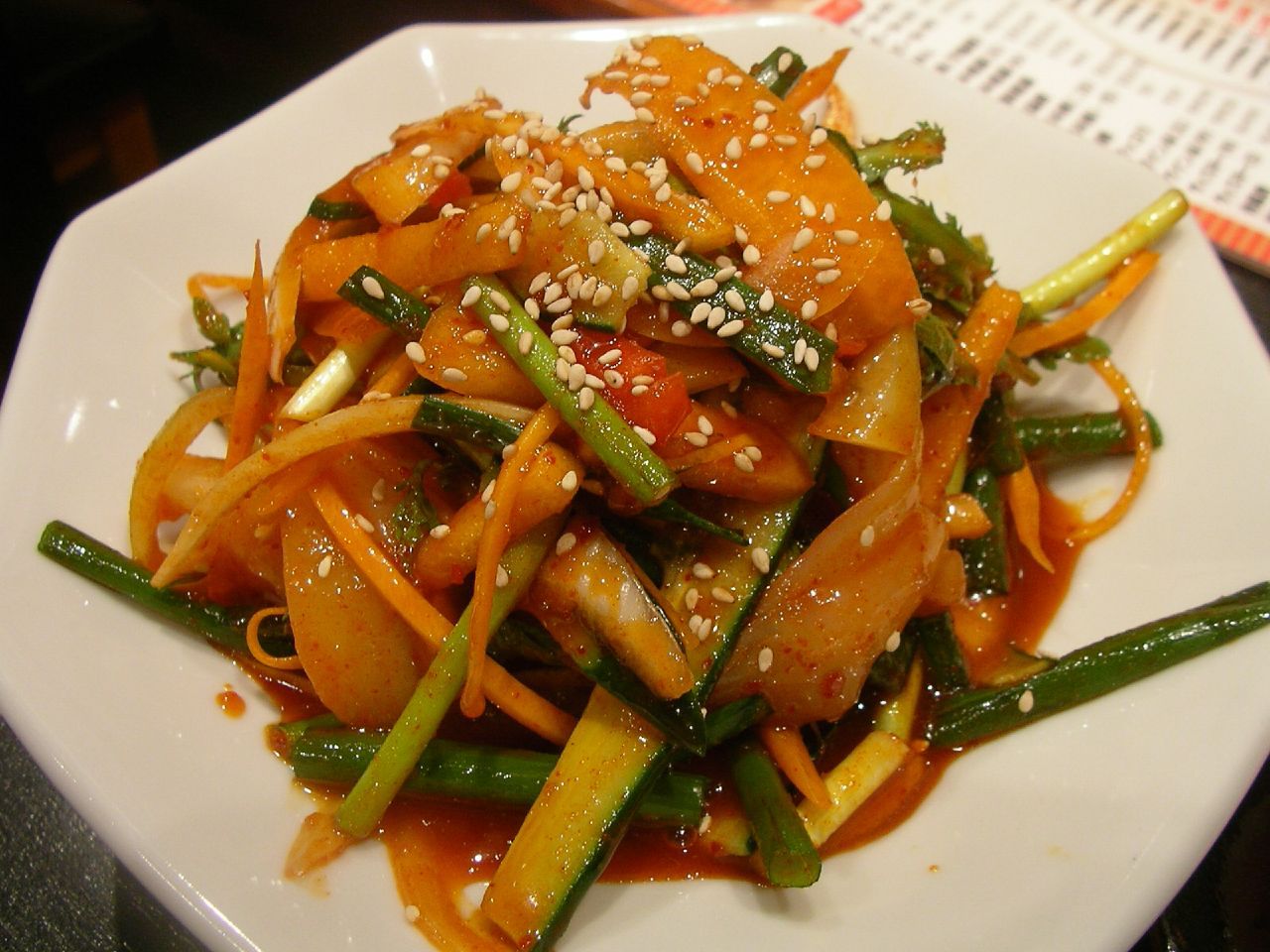 Oi Muchim오이무침Thin-sliced cucumber, briefly salted and tossed with chili flakes, vinegar and garlic — a cool, crunchy quick salad made in minutes, especially in summer.
 Kongnamul Muchim콩나물무침Soybean sprouts cooked under a lid until just tender, then tossed with garlic, green onion and sesame oil — crisp, nutty and on tables across Korea.
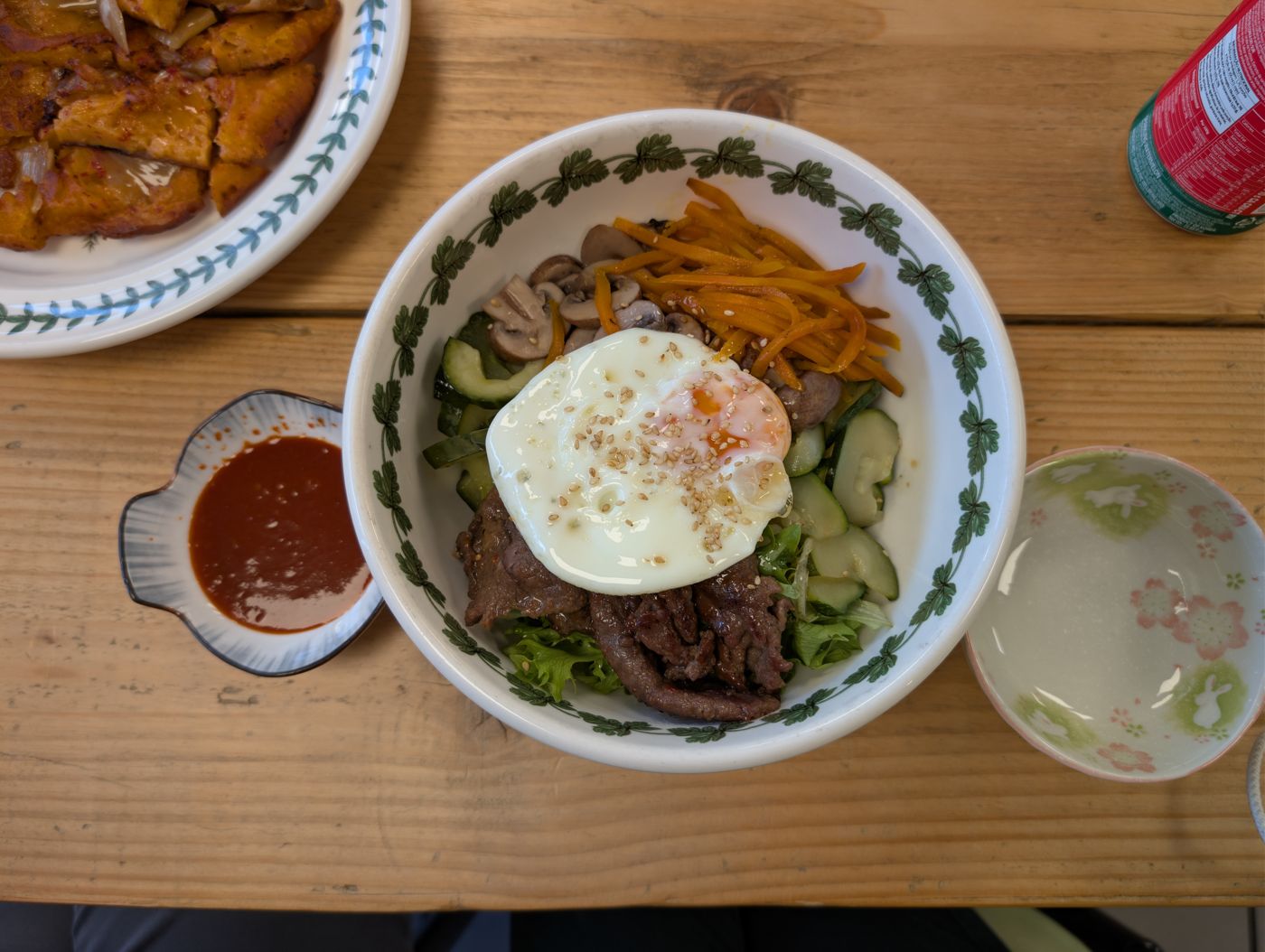 Bibimbap (Mixed Rice with Namul)비빔밥A bowl of rice topped with seasoned namul, beef and egg, mixed at the table with chili paste and sesame oil — banchan gathered into a single meal.
Sources
- 01熱나게 '매운맛' 좀 보시죠 (Let's get some spicy heat) — Kyunghyang Shinmun, Jan. 15, 2003
- 02[한국의 맛](33) 무안 뻘낙지 (Muan mud-flat octopus) — Kyunghyang Shinmun, July 3, 2003
- 03낙지 (Long-arm octopus) — Encyclopedia of Korean Culture
- 04Mollusks, octopus, common, raw (FDC 174218) — USDA FoodData Central
- 05Food Allergies — U.S. Food and Drug Administration
Last updated