Jeotgal · Salted seafood 젓갈
Salted Clams
조개젓
Romanization: jogae-jeot
Small shucked clams salted in their own boiled juices for a few weeks, then dressed with chili and green onion — an early-summer rice companion.
- Serves
- 30
- Prep
- 40 min
- Cook
- 10 min
RegionJeolla · Gyeongsang · Chungcheong
Jump to recipeRecipe
Ingredients · Serves 30
- 500 gFresh shucked small clam meat (bajirak or similar)from a reputable seafood seller; very fresh
- 100 gCoarse sea salt (cheonilyeom), non-iodizedabout 20% of the clam weight; divided
- 2 Fresh green and red chiliesfinely chopped, for serving
- 1 tbspGochugaru (Korean chili flakes)for serving
- 1 stalkGreen onionfinely chopped, for serving
- 1 tspGarlicminced, for serving
- 1 tspToasted sesame seedscrushed, for serving
Method
Technique: Making Jeotgal
Step 1: Rinse the clam meat briefly in cold salted water, picking out any shell or grit. Sprinkle with about 1 tbsp of the salt, toss gently and set in a sieve over a bowl in the refrigerator for 1 hour to collect the juices.
Step 2: Bring the collected clam juice to a boil in a small pot, skimming off the foam, then let it cool completely.
Step 3: Mix the drained clams with the remaining salt, pack into a clean glass jar, and pour over the cooled clam juice. Press a piece of plastic wrap onto the surface and seal tightly.
Step 4: Refrigerate (4°C or below) for 2–4 weeks, until the clams have firmed and taste savory and slightly sweet. Do not stir the jar while it ripens.
Step 5: To serve, take out what you need with a clean spoon, rinse briefly if very salty, and chop coarsely. Mix with the chilies, gochugaru, green onion, garlic and sesame.
Step 6: Keep the jar refrigerated and eat the plain jeotgal within about 2 months, and any seasoned portion within a few days. Discard if it smells putrid, the liquid turns cloudy and foul, or mold appears.
Origin & History
Jogae-jeot is made from the shucked meat of small clams — Manila clams (bajirak), hard clams, and other bivalves — salted and left to ripen. The Encyclopedia of Korean Culture suggests that salting shellfish may reach back to the Neolithic, when shellfish were central to the diet and lidded pots suitable for fermentation were already in use, though it presents this as inference. On firmer ground, the 12th-century Gaoli tujing, an account of Goryeo by the Song envoy Xu Jing, records that Koreans of every rank ate jeotgal made from shellfish.
Twentieth-century cookbooks give the method most cooks still follow. Joseon musang sinsik yori jebeop (1924) calls it haphae, and Bang Sin-yeong's Joseon yori jebeop distinguishes a drier jeon-jogaejeot from a wetter mul-jogaejeot, both seasoned just before eating. The clam meat is lightly salted and drained to collect its liquor; the liquor is boiled, skimmed and cooled, then poured back over the salted clams in a sealed crock.
The folk encyclopedia describes it as a summer preserve, made in early summer when clams are at their tastiest and ripened for only two weeks to a month — about three weeks brings out the characteristic savor. It credits the clam's glycogen and succinic acid for a sweetness and depth that set it apart from fish jeotgal. Eaten across the country, it is especially popular in North Jeolla and South Gyeongsang, dressed with chopped chili, chili powder, green onion, garlic and sesame and spooned over rice.
Key Ingredients
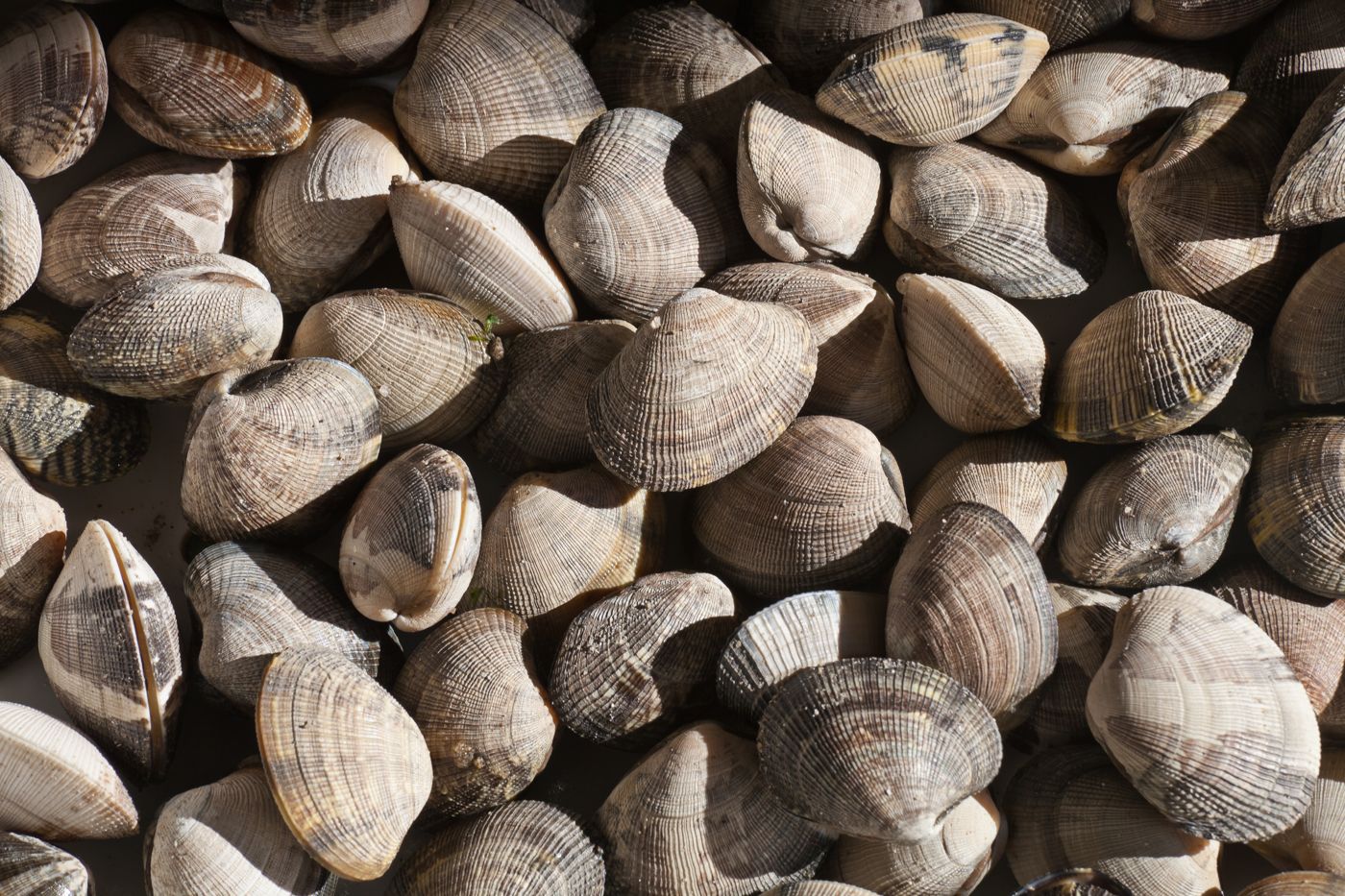 Manila clam (bajirak)바지락Small, ridged tidal-flat clams that give Korean soups and noodle broths their clean, sweet depth. Bajirak are the clams of bajirak-kalguksu, the west coast's clam noodle soup.
 Sun-Dried Sea Salt천일염Coarse sea salt made by evaporating seawater with sun and wind in tidal-flat salt pans, most of it from Sinan County off Korea's southwest coast. It is the everyday salt for salting cabbage and making jang.
- Korean Chili Peppers (Fresh)고추Fresh Korean chili peppers, eaten green (putgochu) or red (hong-gochu): from the fiery cheongyang-gochu to the small, wrinkled, mild kkwari-gochu that is braised and stir-fried as banchan.
 Gochugaru고춧가루Korean red chili powder, made from dried red peppers ground coarse or fine. It gives kimchi, gochujang and countless banchan their color and warmth.
 Green onion파Korean green onion (pa), from thick-stemmed daepa to slender scallions — chopped into nearly every seasoning sauce, soup and kimchi, and the star of pa-kimchi.
 Garlic마늘Used raw, minced, pickled and roasted, garlic is one of the essential aromatics of Korean food — in seasonings, marinades, kimchi and namul.
 Sesame참깨Toasted sesame seeds and sesame oil (chamgireum) finish countless Korean dishes, adding a nutty aroma and gloss.
Nutrition
| Calories | 15 kcal |
|---|---|
| Protein | 1.3 g |
| Fat | 0.3 g |
| Carbohydrates | 1.9 g |
| Fiber | 0.4 g |
| Sodium | 456 mg |
Notable forIron · Selenium
From the Korean MFDS food composition database (K-FIND) entry for seasoned clam jeotgal (조개젓_양념, analyzed restaurant sample; per 100 g: 103 kcal, 8.6 g protein, 12.6 g carbohydrate including 6.5 g sugars, 2.4 g fiber, 3,040 mg sodium, 145 mg calcium, 9.9 mg iron), scaled to the serving size. For comparison, the Korean Food Composition Table lists plain “Clam, Salt-fermented” at 3,797 mg sodium, 12.4 mg iron and 81.7 µg selenium per 100 g. Actual values vary with ingredients, portion size and preparation.
Health Benefits
- Iron: in the database figures a 15 g serving supplies about 1.5 mg of iron; the plain salted clams in the composition table are richer still.
- Selenium and iodine: plain salted clams contain about 82 µg of selenium and 80 µg of iodine per 100 g in the composition table, so even a spoonful contributes.
- Vitamin B12: the Encyclopedia of Korean Culture singles out clam jeotgal as particularly rich in vitamin B12 among jeotgal; neither database used here reports a B12 value for it.
Regional Variations
- North Jeolla and South Gyeongsang: where it is most popular, eaten seasoned as a summer side dish.
- Chungcheong (bajirak-jeot): made specifically from Manila clams, alongside the region's oyster jeotgal (eoriguljeot).
- Jeju: shellfish jeotgal of abalone, small abalone (obunjagi), turban shell, and gunbu chitons scraped from summer rocks.
- Dry or wet: early cookbooks separate a drier style from one kept in plenty of clam liquor.
Pairings
- Kongnamul-bap (Soybean Sprout Rice)콩나물밥Rice steamed over a bed of soybean sprouts, often with a little beef, and eaten with a spoonful of soy-and-scallion sauce — a thrifty one-pot meal from Chungcheong.
- Mu Guk (Beef and Radish Soup)뭇국Thin squares of Korean radish and beef stir-fried in sesame oil, then simmered into a clear, gently sweet broth seasoned with soup soy sauce — a year-round everyday guk.
 Doenjang Jjigae (Soybean Paste Stew)된장찌개A thick, savory stew of fermented soybean paste with tofu, zucchini and whatever the season offers — the everyday pot at the center of the Korean table.
Sources
- 01조개젓_양념 (Seasoned clam jeotgal) — MFDS K-FIND food composition database
- 02Korean Food Composition Table: Clam, Salt-fermented — National Institute of Agricultural Sciences
- 03조개젓 - 한국민족문화대백과사전 (Encyclopedia of Korean Culture)
- 04조개젓 - 한국민속대백과사전 (Encyclopedia of Korean Folk Culture)
- 05An outbreak of hepatitis A associated with salted clams in Busan, Korea — Epidemiology and Health (2022)
- 06People at Risk of Foodborne Illness - U.S. Food and Drug Administration
Last updated