Techniques
Gomyeong: Korean Garnishes
고명
Egg-strip jidan, threads of red chili, pine nuts and mushrooms: how Korean cooks finish a dish with garnishes chosen to show the five traditional colors.
Gomyeong are the small finishing touches laid or scattered over Korean food: fine strips of yellow and white egg, a few threads of red chili, a pinch of pine nuts, a slice of black mushroom. The Encyclopedia of Korean Culture draws a clean line between gomyeong and yangnyeom. Both make food better, but seasoning works on flavor while gomyeong works mainly on the eye, to make a dish look appetizing. Its entry on decorative toppings lists the usual materials: egg garnish, mushrooms, shelled pine nuts, ginkgo nuts, walnuts, chili threads, whole sesame seeds and tiny meatballs. For the seasoning side, see yangnyeom seasoning basics.
Five colors
Gomyeong relies on the natural colors of foods. The encyclopedia explains that cooks traditionally used five: white, yellow, green-blue, red and black, the colors linked to yin-yang and five-elements thought. In that scheme, as the encyclopedia's entry on saekdong (rainbow-striped cloth) sets out, wood is blue-green, fire red, earth yellow, metal white and water black, and the five colors also map onto east, south, center, west and north. These are the obangsaek, the "colors of the five directions." Ideally a dish shows all five, but the encyclopedia notes that one or two are often enough. The Korean Food Promotion Institute points to bibimbap as a dish that holds all five, which is part of why it is sometimes called hwaban, "flower rice."
The encyclopedia's palette:
- White: egg-white sheet cut into strips, hulled sesame toasted pale, pine nuts and the white part of green onion.
- Yellow: egg-yolk sheet.
- Green: water dropwort, squash or cucumber cut into strips.
- Red: threads of dried chili (silgochu) and gochugaru.
- Black: rock tripe (seogi), shiitake and wood ear mushrooms.
Jidan: the egg garnish
The most familiar gomyeong is jidan, a very thin sheet of egg cooked in a pan and cut into fine strips or small squares or diamonds. The standard dictionary records that the word comes from the Chinese jidan, meaning hen's egg. For a two-color garnish, the egg is separated and the white and yolk cooked as separate sheets, giving the pair called hwangbaek jidan. A regional recipe for stuffed cucumber (oiseon) published by the Rural Development Administration's Nongsaro service shows the typical handling: separate the egg, cook each part into a thin sheet, then cut it into fine threads the same length as the mushroom and beef strips it will sit beside. Low heat and a lightly oiled pan keep the sheet tender and unbrowned. For egg dishes in their own right, see gyeran-mari and eggs.
Chili threads, pine nuts and nuts
- Silgochu: dried red chili cut into hair-thin threads. A few strands are enough to bring red to a pale dish; the encyclopedia's recipe for Gaeseong bossam-kimchi, for example, includes them in the filling.
- Pine nuts: shelled pine nuts (silbaek) supply white, used whole or chopped. See jat. Pine nuts are a tree-nut allergen; see allergens in Korean food.
- Other nuts and fruits: ginkgo nuts, walnuts, jujubes and chestnuts, usually sliced or shredded.
Gomyeong, utgi and alssam
The encyclopedia distinguishes gomyeong from utgi. Gomyeong, also called kkumi, occupies part of a dish as decoration: egg garnish, minari chodae (a water-dropwort garnish), mushrooms, pine nuts, ginkgo, walnuts, chili threads, sesame seeds and small meatballs. Utgi covers the whole top. Small fried rice cakes set on a stack of tteok, and alssam, are examples. Alssam is a little half-moon of egg folded around a nugget of seasoned beef; the encyclopedia says it decorates pan-fried fish and meat, the royal hot pot sinseollo and bibimbap.
Using gomyeong at home
The encyclopedia's own example is a bowl of noodles in broth topped with yellow and white egg strips, sautéed squash or green onion, a few chili threads and rock tripe. Garnish just before serving so strips stay crisp and colors stay bright. Cut garnishes to match the size and shape of the main ingredient: fine threads on noodles, small squares or diamonds on soups and platters such as tangpyeongchae. The aim is the restraint the encyclopedia praises, a very Korean way of bringing harmony to the table rather than piling on decoration. For festive dishes where gomyeong matters most, see tteokguk, gujeolpan and royal court cuisine.
Dishes using this technique
- Gaji Jjim (Steamed Stuffed Eggplant)가지찜Short lengths of eggplant slit and packed with seasoned beef and mushroom, steamed until silky and dressed with a light soy sauce — a refined summer banchan.
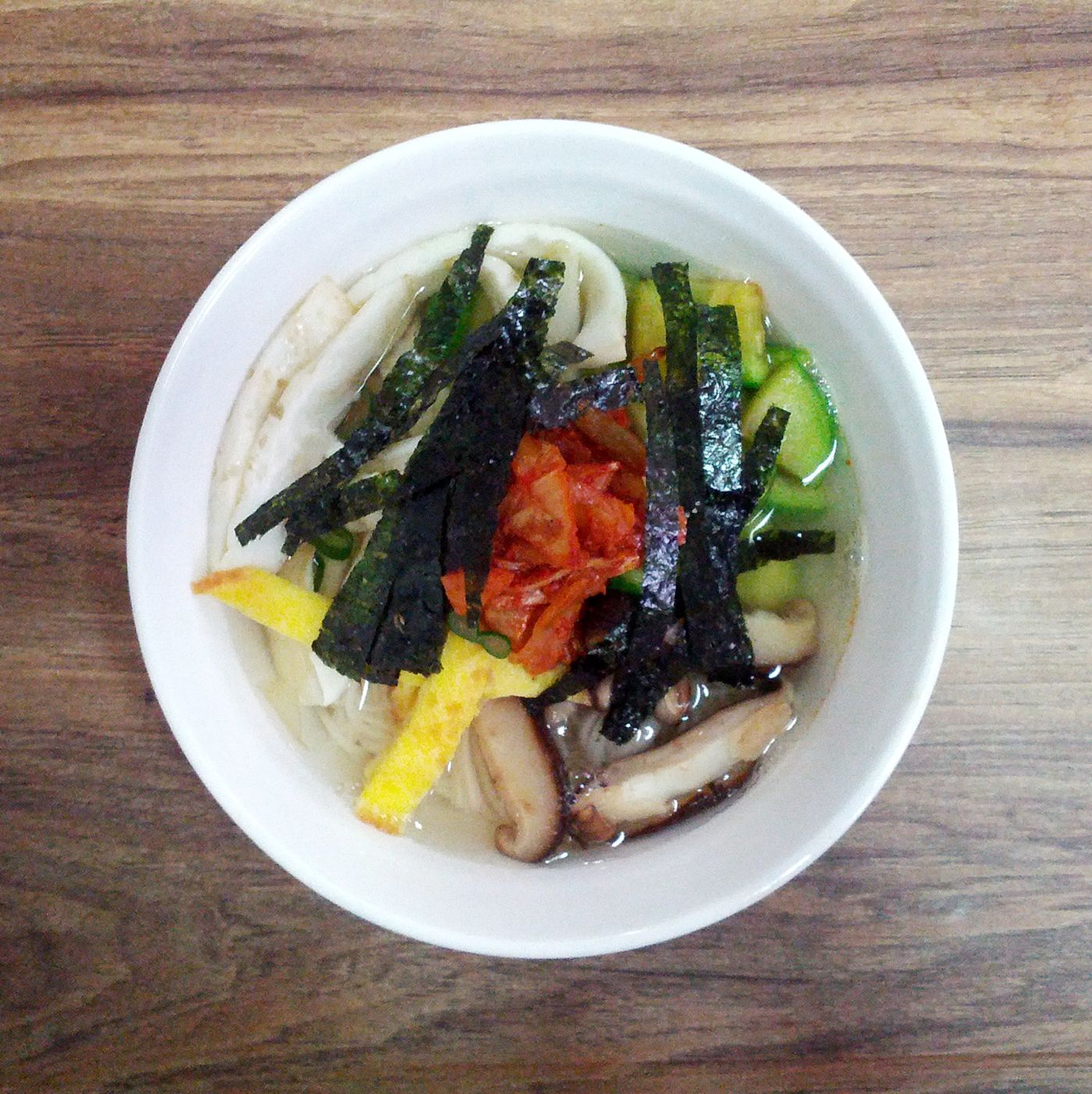 Janchi Guksu (Banquet Noodles)잔치국수Thin wheat noodles in a hot, clear anchovy or beef broth, topped with egg strips, zucchini and kimchi — the long-life noodles served at weddings and birthdays.
Sources
- 01고명 (Gomyeong) — Encyclopedia of Korean Culture
- 02웃기 (Utgi) — Encyclopedia of Korean Culture
- 03알쌈 (Alssam) — Encyclopedia of Korean Culture
- 04색동옷 (Saekdong-ot) — Encyclopedia of Korean Culture
- 05지단 (Jidan) — Standard Korean Language Dictionary, National Institute of Korean Language
- 06어우러짐의 미학으로 빚은 우리 음식, 비빔밥 — Korean Food Promotion Institute (Hansik)