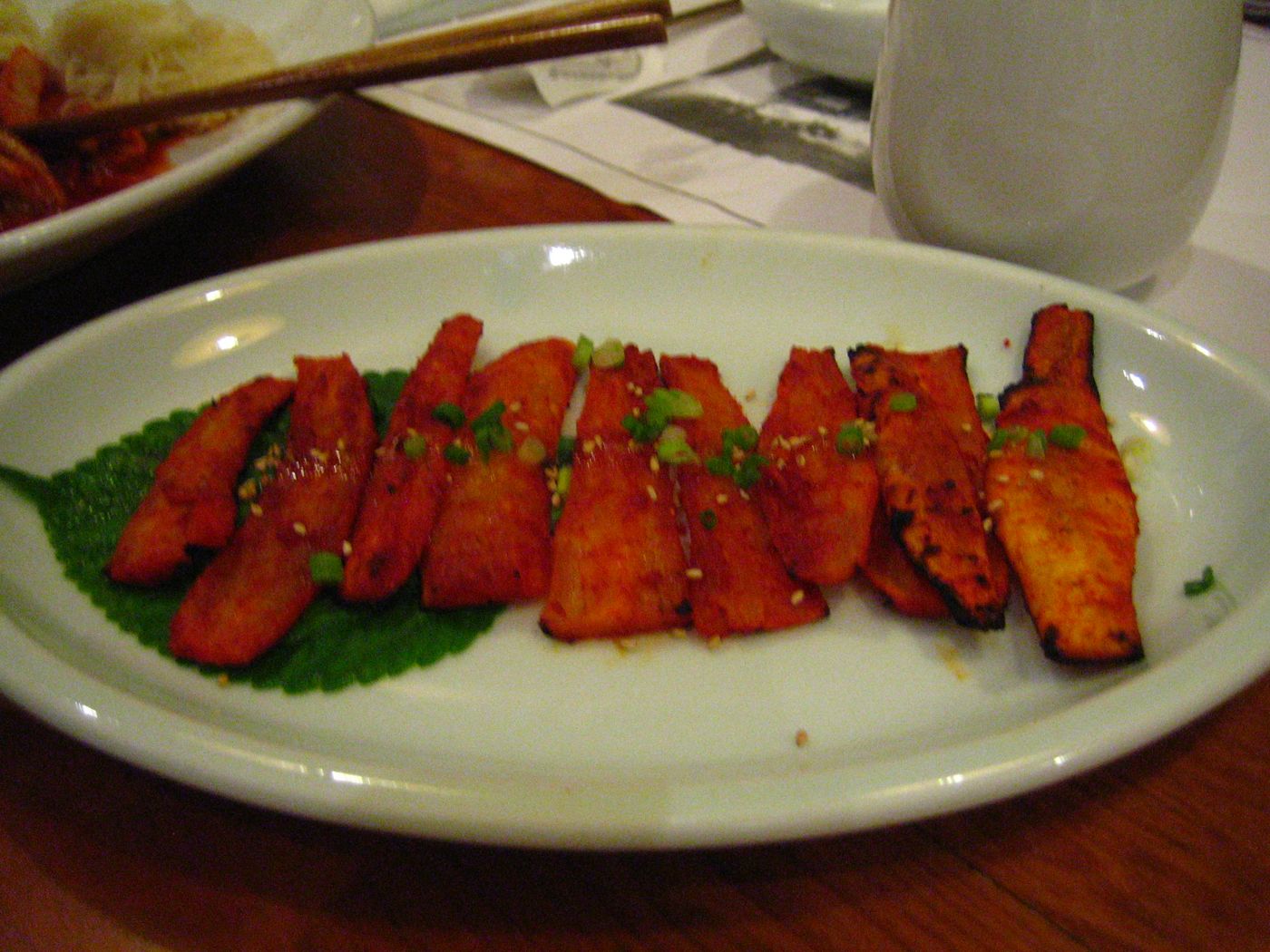
 Photo: ayustety, CC BY-SA 2.0, via Wikimedia Commons
Gui · Grilled 구이
Deodeok Gui (Grilled Seasoned Deodeok)
더덕구이
Romanization: deodeok-gui
Deodeok root pounded flat, brushed with sesame oil and soy, then grilled under a sweet gochujang glaze — chewy, fragrant and slightly bitter, often called meat from the mountains.
- Serves
- 4
- Prep
- 40 min
- Cook
- 10 min
RegionGangwon · Gyeongsang
Jump to recipeRecipe
Ingredients · Serves 4
- 300 gFresh deodeok rootspeeled weight
- 1 tspSaltfor soaking water
- 1 tbspToasted sesame oil (yujang)
- 1 tspSoy sauce (yujang)
- 3 tbspGochujang
- 1 tspGochugaru
- 1 tbspHoney
- 1 tspSoy sauce (glaze)
- 1 tspGarlicminced
- 1 tbspGreen onionfinely chopped
- 1 tspToasted sesame oil (glaze)
- 1 tspNeutral cooking oilfor the pan
- 1 tspToasted sesame seeds
Method
Technique: Grilling Gui, Yangnyeom: Seasoning Basics
Step 1: Wash the deodeok and peel it by scoring a shallow line along each root and turning the skin off with a paring knife; blanching the roots for a few seconds first loosens the skin. Wear gloves — the sap is sticky.
Step 2: Halve thick roots lengthwise, then tap them firmly with a rolling pin or the back of a knife until flattened and slightly split into fibers.
Step 3: Soak the flattened roots in lightly salted cold water for 20–30 minutes to draw out some bitterness. Pat dry.
Step 4: Mix the sesame oil and 1 tsp soy sauce for the yujang and brush it over the deodeok. In a separate bowl, mix the gochujang, gochugaru, honey, remaining soy sauce, garlic, green onion and sesame oil into a glaze.
Step 5: Lightly oil a grill pan or skillet over medium heat and cook the deodeok 1–2 minutes per side, until just tender and lightly marked.
Step 6: Brush the glaze over both sides, lower the heat and grill another 1–2 minutes per side, watching closely so the sugary glaze does not burn.
Step 7: Cut into bite-size pieces if you like, sprinkle with sesame seeds and serve warm.
Origin & History
Deodeok (Codonopsis lanceolata) is a twining perennial of the bellflower family whose thick, wrinkled root looks like doraji or ginseng and oozes a white, sticky sap when cut. The Encyclopedia of Korean Culture notes that the fifteenth-century Hyangyak chaechwi wollyeong and Hyangyak jipseongbang write it with characters read as deodeok, and that the Goryeo dogyeong already remarked that the deodeok served daily at official tables was large, tender and tasty — eaten as food rather than medicine. In China the root is mainly a medicinal herb (sasam in Korean); in Korea it has long been everyday food as well. The Encyclopedia of Korean Folk Culture ranks it among the best-known edible wild plants in Korea.
Grilling is its signature preparation. The late-nineteenth-century cookbook Siuijeonseo gives a recipe called sasam-jeok: deodeok soaked, peeled and tapped flat with a knife, brushed with yujang (sesame oil mixed with soy sauce), grilled on a wire rack, then brushed with a paste of green onion, sesame, oil, honey and chili and grilled again with care not to burn the glaze. Later twentieth-century cookbooks recorded variations, from deodeok skewered with seasoned beef to deodeok buried in gochujang and grilled with oil.
Its fibrous, chewy texture earned deodeok the nickname "meat from the mountains," and its bittersweet aroma makes the grilled root a prized side dish for guests and holiday tables. The Encyclopedia of Korean Folk Culture lists Gangwon's wild mountain deodeok among that province's specialty greens.
Key Ingredients
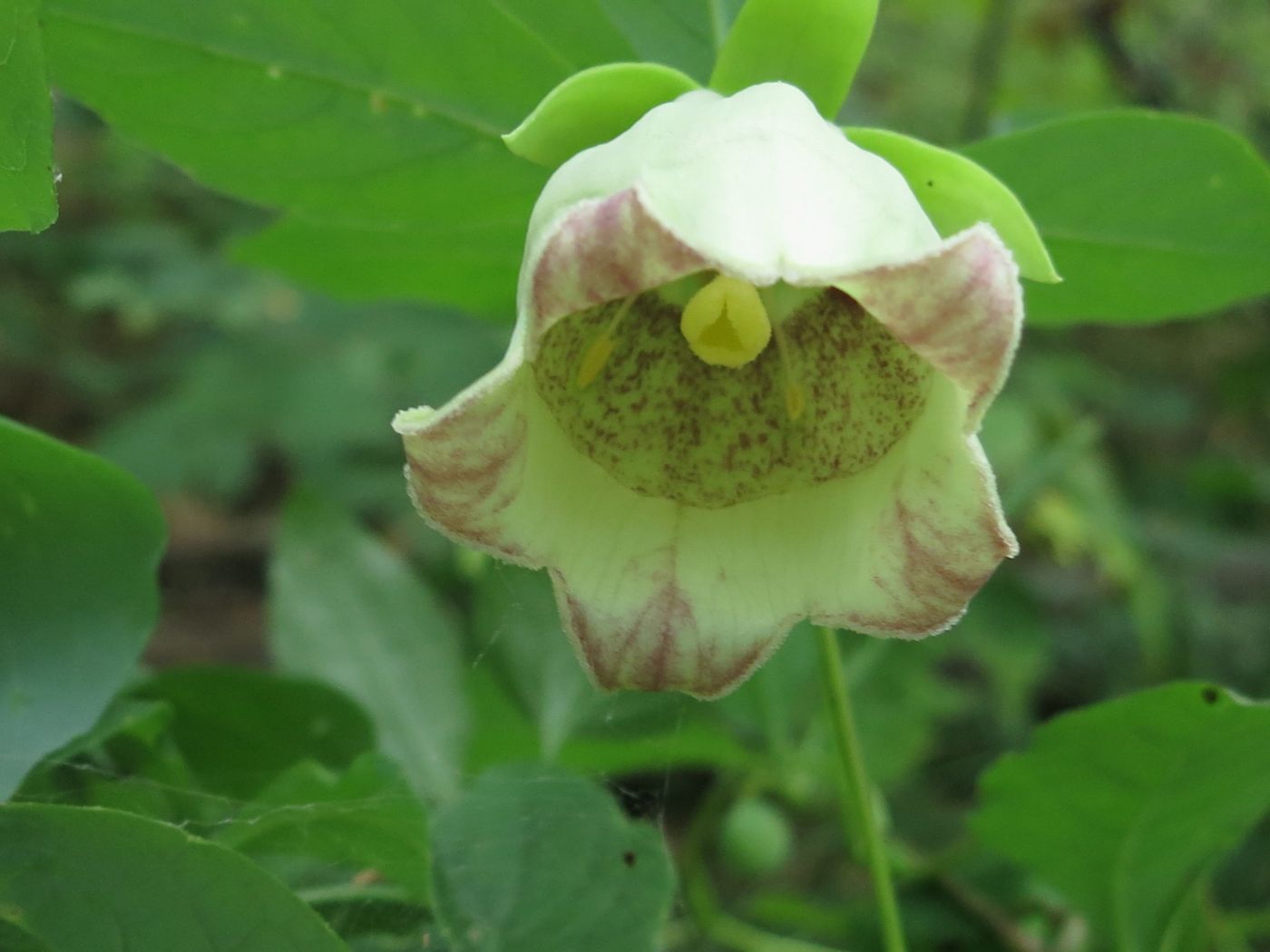 Deodeok (bonnet bellflower root)더덕A gnarled, milky mountain root with a bold, resinous aroma. Pounded flat, brushed with a seasoned glaze and grilled as deodeok-gui, or shredded raw for deodeok-saengchae, it is one of the most savored mountain roots.
- Gochujang고추장Fermented red chili paste — sweet, savory and hot. Made from meju powder, glutinous rice, malt and gochugaru, it is a later addition to Korea's family of jang.
 Gochugaru고춧가루Korean red chili powder, made from dried red peppers ground coarse or fine. It gives kimchi, gochujang and countless banchan their color and warmth.
 Soy sauce간장Korean soy sauce, in two main kitchen forms: pale, salty guk-ganjang (soup soy sauce) brewed the traditional way from meju, and darker, sweeter jin-ganjang for braises and marinades.
 Garlic마늘Used raw, minced, pickled and roasted, garlic is one of the essential aromatics of Korean food — in seasonings, marinades, kimchi and namul.
 Green onion파Korean green onion (pa), from thick-stemmed daepa to slender scallions — chopped into nearly every seasoning sauce, soup and kimchi, and the star of pa-kimchi.
 Sesame참깨Toasted sesame seeds and sesame oil (chamgireum) finish countless Korean dishes, adding a nutty aroma and gloss.
Nutrition
| Calories | ~164 kcal |
|---|---|
| Protein | ~2.8 g |
| Fat | ~6.9 g |
| Carbohydrates | ~25.7 g |
| Fiber | ~3.8 g |
| Sodium | ~461 mg |
Notable forFiber · Manganese
Deodeok uses the Korean Food Composition Table entry “Bonnet bellflower (Deodeok), Root, Raw” (per 100 g: 80 kcal, 17.6 g carbohydrate, 3.7 g fiber, 0.43 mg manganese). Gochujang and soy sauce use Korean table values; gochugaru uses the USDA cayenne entry as a stand-in; honey, garlic, green onion, oils and sesame seeds use USDA FoodData Central. Soaking salt is not counted. Totals divided by four. Gochujang and honey supply roughly half the carbohydrate. Actual values vary with ingredients, portion size and preparation.
Health Benefits
- Fiber: the root supplies dietary fiber, which is behind its satisfying, meaty chew.
- Saponins and other compounds: deodeok contains saponins (lancemasides) and phenolic compounds. A 2026 review of laboratory, animal and limited human studies describes antioxidant and anti-inflammatory activity, but notes that extracts are poorly standardized and clinical evidence is thin.
- Traditional use: Korean medicine has long used the root for coughs and phlegm, and both encyclopedias describe its reputation as a food that rivals ginseng; these are traditional beliefs, not established effects.
Regional Variations
- Two-stage grilling: the classic method — first grilled with yujang, then glazed with gochujang sauce and grilled again.
- Gyeongsangnam-do style: grilled without the first yujang coating, sometimes called deodeok-yangnyeom-gui.
- Deodeok-sanjeok: deodeok and seasoned beef threaded on skewers and grilled together.
- Deodeok-jeonya: halved, pounded deodeok coated in flour and egg and pan-fried like jeon.
- Uncooked relatives: deodeok-saengchae (shredded raw deodeok salad) and gochujang-pickled deodeok jangajji.
Pairings
 Doenjang Jjigae (Soybean Paste Stew)된장찌개A thick, savory stew of fermented soybean paste with tofu, zucchini and whatever the season offers — the everyday pot at the center of the Korean table.
- Doraji Namul도라지나물Shredded bellflower root rubbed with salt to tame its bitterness, then gently stir-fried — the ivory-white member of the three-colored namul.
 Gyeran Jjim (Steamed Egg)계란찜Eggs whisked with water or broth and gently steamed into a silky, savory custard, often seasoned with salted shrimp and served bubbling hot.
Sources
- 01더덕구이 (Deodeok-gui) — Encyclopedia of Korean Folk Culture (National Folk Museum of Korea)
- 02더덕 (Deodeok) — Encyclopedia of Korean Folk Culture (National Folk Museum of Korea)
- 03더덕 (Deodeok) — Encyclopedia of Korean Culture
- 04산나물 (Sannamul, mountain greens) — Encyclopedia of Korean Folk Culture (National Folk Museum of Korea)
- 05Korean Food Composition Table: Bonnet bellflower (Deodeok), Root, Raw — National Institute of Agricultural Sciences
- 06Sanjay, Sood R, Lee HJ. Pharmacological Insights into Codonopsis lanceolata: A Review of Its Potential in Disease Prevention and Therapy. Molecules, 2026
Last updated