Travel
Seoul's Food Alleys
서울의 먹자골목
A guide to four Seoul food alleys and the dishes behind them: tteokbokki in Sindang-dong, jokbal in Jangchung-dong, nogari and draft beer in Euljiro, and pork galbi in Mapo.
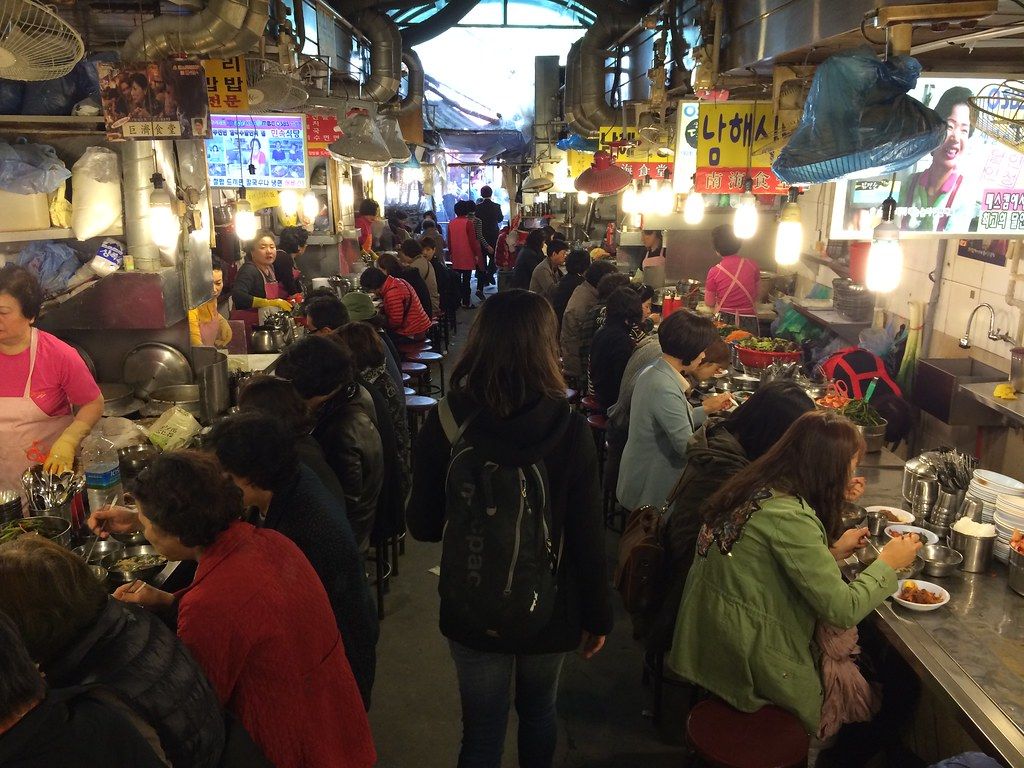
Seoul's food alleys, known as meokja-golmok ("let's eat" alleys), are streets where one dish or style of eating has gathered a dozen restaurants into a single stretch. Each tends to be tied to a particular neighborhood history, which makes them one of the better ways to learn the city. This page is a general guide to four of them and the dishes that made them. It does not recommend individual restaurants, because shops change and several in each alley claim to be the original. For the wider setting, see Seoul-Gyeonggi and Korean street food.
Sindang-dong: tteokbokki town
Sindang-dong is known for a style of tteokbokki cooked at the table in a shallow pan. The Korea JoongAng Daily reports that after the Korean War a woman named Ma Bok-rim began selling tteokbokki there, in a sauce of gochujang and black bean paste, and that more restaurants followed until the neighborhood had a street of tteokbokki shops by the 1980s. A travel-guide listing says the original version was made simply with gochujang, and that eggs, glass noodles, fish cake and instant noodles were added over time, which turns the snack into a full meal. Accounts of the exact date and founder vary, so read the neighborhood's origin story as a popular account.
In practice, you order a base and add what you want: noodles, dumplings, eggs, and fish cake. The pot sits over a burner and keeps simmering as you eat, so the sauce thickens and the flavor gets stronger as the meal goes on.
Jangchung-dong: jokbal street
Jokbal is pig's trotters braised in soy sauce and sliced. The Encyclopedia of Korean Culture traces it to a Hwanghae Province braise and says that refugees from the north who settled in Jangchung-dong after the war built the restaurant version, using a cheap cut. It also records that accounts of the first shop differ, and several shops later called themselves the original. Michelin's guide describes the meat as sliced into three layers, skin, fat and meat, and eaten wrapped in lettuce with garlic and soybean paste or dipped in salted shrimp (saeujeot).
Jokbal is a shared dish, often ordered warm or cold in a medium or large portion. It is a close cousin of bossam, the boiled pork wrap, and sits comfortably in the tradition of anju and drinking culture.
Euljiro: nogari alley
Euljiro's Nogari Alley, near Euljiro 3-ga, was once a cluster of printing shops and tool dealers, according to a Kyunghyang Weekly profile. Its story centers on a draft beer bar that opened in December 1980. The bar first served dried snacks supplied by the brewer; when a 1981 Fair Trade Commission ruling ended that practice, the owner chose nogari, dried young pollack (myeongtae when full-grown), partly because it was cheap and easy to find. The staff flattened and de-boned the fish, grilled it briefly over coal briquettes and served it with a spicy red pepper dip. Neighboring shops turned into similar bars, and in 2015 the Seoul city government listed the alley as a "Seoul Future Heritage" site.
The pairing is simple: chewy, salty grilled pollack and cold draft beer. The alley is also affected by redevelopment in the area, so check current news before building a visit around it.
Mapo: pork galbi
Mapo, on the Han River, was historically a landing for grain and seafood arriving in the capital, according to the Encyclopedia of Korean Culture. The same entry calls Mapo galbi the district's long-famous food, naming seasoned pork ribs grilled over coal briquettes after liberation, along with jumulleok, marinated meat that is stir-fried or grilled. VisitKorea describes the Mapo Food Culture Street as a strip of grilled-meat restaurants with 37 smaller alleys running off it. The sources do not give a founding date for the style, so the history is better understood as a local tradition than a single invention. See korean bbq culture and samgyeopsal-gui for the grilling traditions behind it.
Visiting an alley
- Come hungry and with a group; most of the dishes are meant to be shared.
- Expect a single-dish menu. Ordering is simpler than in a general restaurant; see ordering and paying and dining etiquette.
- Several shops on one street may claim to be the original. Treat that as part of the street's character and choose by the line and the smell.
- Opening hours, prices and even whole blocks change with redevelopment. Check current listings before you go.
Sources
- 01From the 'Gate of the Dead' to lively haunts, Sindang-dong blends the historical and hip — Korea JoongAng Daily
- 02Sindang-dong Tteokbokki Town — ktriptips travel guide
- 03족발 (Jokbal) — Encyclopedia of Korean Culture
- 04Seoul's braised pig trotters — Michelin Guide
- 05내몰릴 위기에 놓인 '백년가게' 을지OB베어 — Kyunghyang Weekly
- 06서울특별시 마포구 (Mapo-gu, Seoul) — Encyclopedia of Korean Culture
- 07마포음식문화거리 (Mapo Food Culture Street) — VisitKorea (Korean)