Travel
Gwangjang Market
광장시장
Seoul's best-known market food alley: where it came from, what the stalls serve, and how to eat your way through bindaetteok, gimbap and more.
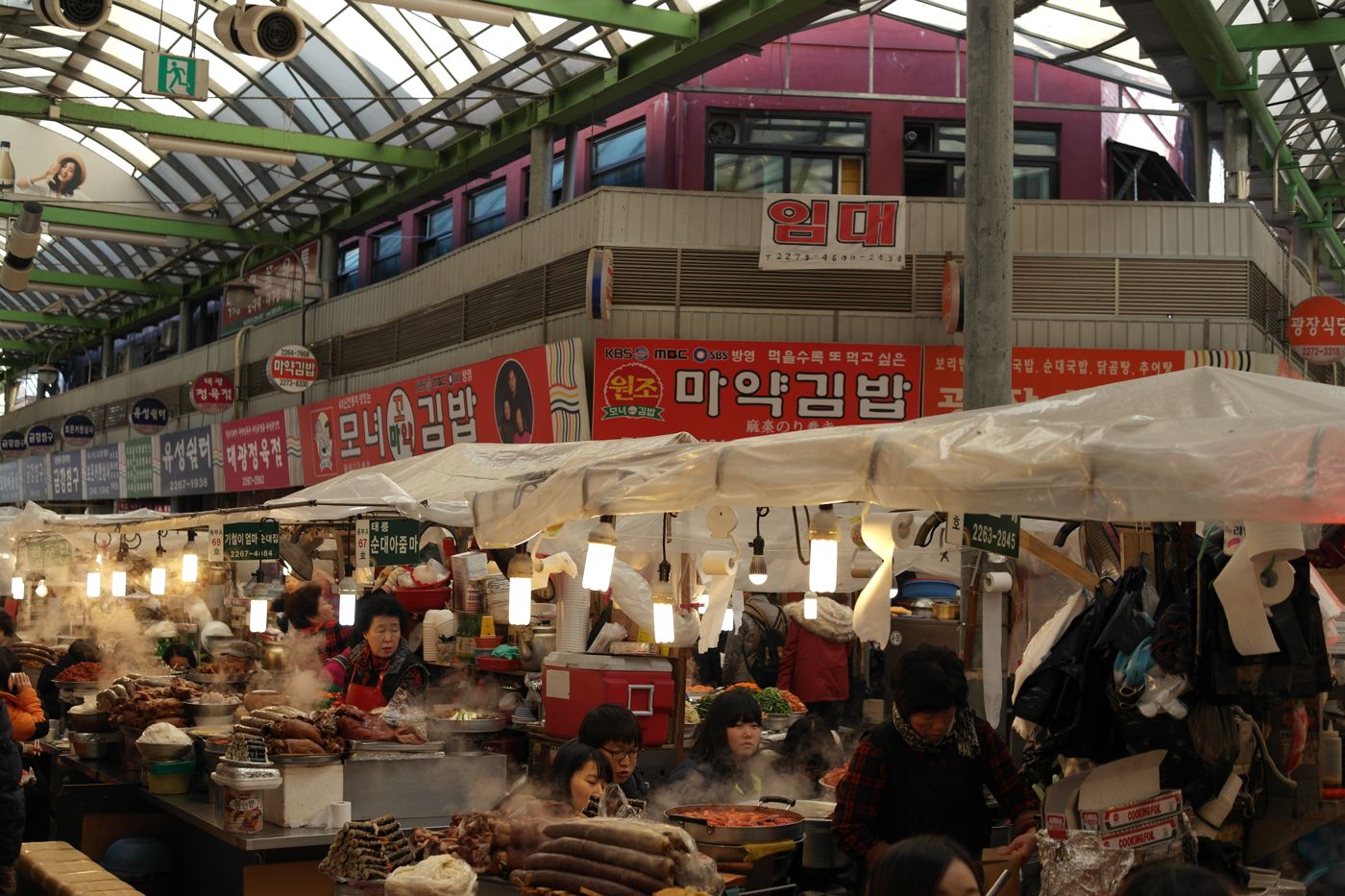 Photo: ChongDae, CC BY-SA 3.0, via Wikimedia Commons
Gwangjang Market in central Seoul is a working textile and grocery market that has become one of the most visited food destinations in Korea. For a reader trying to understand Korean street and market food on the ground, it is a compact, well-documented place to start.
A market with a company behind it
Gwangjang's roots are unusually well recorded. The Encyclopedia of Korean Culture says the Gwangjang Company was founded in July 1905 and describes it as Korea's first privately run market-management company. The founders first planned a new market over the Cheonggyecheon stream, but flooding washed away their building materials, so they moved the project near the old Baeogae market, a major market of the late Joseon period. The market settled on its present site in early March 1909. The same entry says the company is the oldest in Korea still using its original name. The national tourism organization calls Gwangjang the country's first permanent market, in contrast to the periodic five-day markets that met only on set dates. For the wider story of how Korean markets developed, see traditional markets.
The food alley
Most of the market sells fabric, clothing and household goods, with food stalls concentrated in the center. The tourism organization describes the food street as the market's most popular section and says it is open every day of the year; the Korea Herald notes that at busy lunch and dinner times, diners sit wherever a stool is free. Expect shared counters, quick service and a lot of pointing at what the person next to you is eating.
The dishes most often named in official and press descriptions include:
- Bindaetteok: the Korea Herald calls this mung bean pancake the market's local specialty. Ground mung beans are mixed with vegetables and fried in hot oil until golden. See nokdu-bindaetteok for the dish itself.
- Mayak gimbap: Visit Seoul lists a small, popular gimbap whose nickname mayak means "drugs," a joke about how hard it is to stop eating. Ordinary gimbap is the base of the idea.
- Yukhoe: raw seasoned beef, which Visit Seoul lists among the market's food. Raw beef carries real food-safety considerations, so choose busy stalls with high turnover.
- Tteokbokki, eomuk and sundae: the standard Korean street snacks, all listed by Visit Seoul. See tteokbokki, fish cake and sundae.
- Modum-jeon: assorted savory pancakes, listed by Visit Seoul.
Visit Seoul also notes cold noodles, seafood stalls and a side-dish stall known for salted fish and crab. The broader category of this kind of eating is covered in Korean street food.
Eating well here
- Go with a plan to share. Portions suit snacking, so ordering a few plates among two or three people lets you taste more of the alley.
- Expect crowds at peak hours. Seats turn over quickly, and lunch and dinner are the busiest times.
- Mind allergens and raw food. Mung beans, soy, sesame, shellfish and fish all appear widely. The allergens guide explains common hidden ingredients.
- Check hours before you go. Hours differ between the food street and the clothing shops and have varied between sources, so confirm on the official tourism page.
Where it fits
Gwangjang is the easiest introduction to the city's market food, but it is one of several. Seoul's raw-seafood experience is a different world, covered in Noryangjin Fish Market. For southern counterparts see Jagalchi and Seomun Market, and for the capital's wider table, see Seoul and Gyeonggi.