Travel
Five-Day Markets (Oiljang)
오일장
The rotating rural markets that have fed Korean villages for centuries: how the five-day cycle works, what you find at one, and well-known examples such as Jeongseon and Moran.
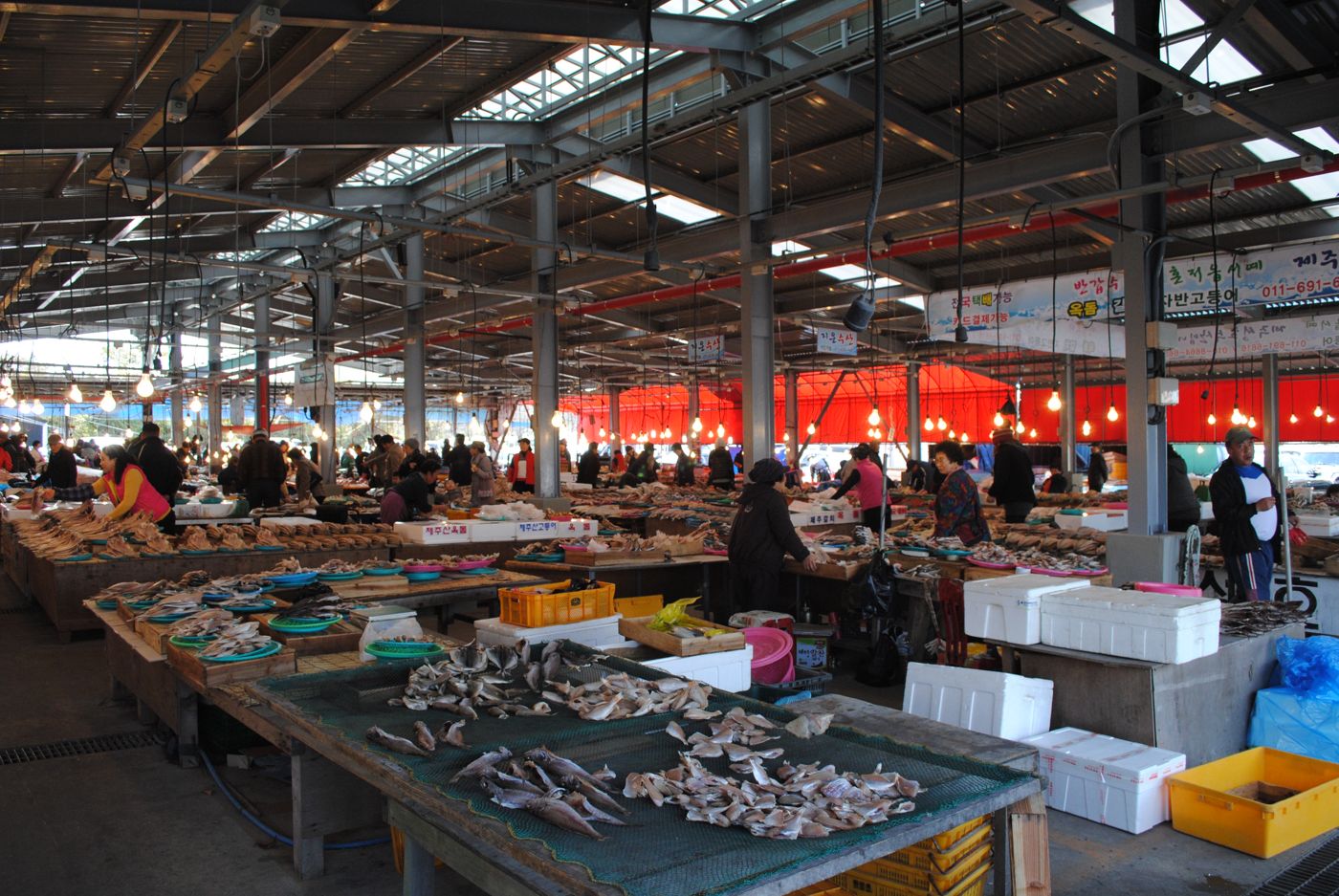 Photo: Jjw, CC BY-SA 4.0, via Wikimedia Commons
An oiljang (오일장) is a periodic market that meets every five days. Before permanent markets and supermarkets, this rotating system was how many Koreans bought and sold food, and today it is one of the best places to see seasonal produce, regional specialties and a living market tradition.
How the system works
The Encyclopedia of Korean Culture says periodic markets began forming on their own in the late fifteenth century in Seoul and the central and southern provinces, and had spread across the country by the early seventeenth. They came to be called five-day markets because the most common pattern was a market that met every five days, roughly six times a month. Farmers, craftspeople and fishers exchanged goods on fixed days and places, and the markets also served as places for news, entertainment and social ties in rural communities. A survey from around 1830 counted 1,052 markets, 905 of them on a five-day cycle, and the entry says what was sold followed local geography: grain and vegetables on inland plains, seafood on the coast, fruit and wild greens in the mountains. For the longer history, see traditional markets.
Neighboring towns kept different calendars. Jeongseon's market runs on dates ending in 2 and 7, Moran's on dates ending in 4 and 9, and Sehwa on Jeju on dates ending in 5 and 0, according to Visit Korea and the Korea Herald. Staggering the days lets traveling vendors work a circuit; Korea.net notes that in Jeju, vendors often travel between markets and attend a different one each day. Because months have different lengths, the gaps are not always exactly five days.
Fewer, but still alive
The Encyclopedia of Korean Culture counts 522 periodic markets still operating in 2006, most of them in North Gyeongsang, South Jeolla and South Gyeongsang. Korea.net says schedules are now commonly posted online, so visitors can plan ahead. Always check the date: a market that meets on the 2nd and 7th is simply not there on the 3rd.
What you find to eat
Korea.net describes five-day markets as selling produce, agricultural goods and everyday items such as clothes, pots and soap, and notes that each area can highlight its own specialty products and foods. The Encyclopedia of Korean Culture describes the old custom of makeshift gukbap stalls feeding peddlers and shoppers at midday, an arrangement that survives in spirit in the soup and noodle stalls of many markets (see dwaeji-gukbap and kalguksu). Seasonal vegetables and wild greens are a natural draw; the seasonal logic is explained in seasonal foods.
Notable examples
- Jeongseon Arirang Market (Gangwon). Visit Korea says it meets on dates ending in 2 and 7, was very active during the coal-mining boom, declined after mining ended, and was revived in part by a tourist train from Seoul that began in 1999. Mountain greens such as gondre are part of the county's food culture; see Jeongseon for more.
- Moran Market (Seongnam, Gyeonggi). The Korea Herald describes it as Gyeonggi Province's biggest traditional market, with its five-day market on dates ending in 4 and 9 and sections for sesame oil, vegetables and herbal medicine. Korea.net calls it the largest of Korea's five-day markets, with more than 1,200 vendors. Both are older reports, so treat scale figures as approximate.
- Sehwa Market (Jeju). Visit Korea lists it on dates ending in 5 and 0, a reminder that the system runs across the island as well as the mainland.
Visiting well
- Arrive in the morning. Hours vary by stall, and markets are generally livelier earlier in the day.
- Bring cash and a bag. Many stalls are small and informal.
- Ask before buying unfamiliar items. Vendors will often explain how to prepare an unfamiliar vegetable.
- Check allergens. Dried fish, sesame and soy products are common; see the allergens guide.
The big permanent markets such as Gwangjang and Seomun belong to the same market tradition, which is why a visit to a five-day market still teaches so much about how Koreans shop and eat.
Sources
- 01정기시장 (Periodic markets) — Encyclopedia of Korean Culture
- 02Jeongseon 5-day Market / Jeongseon Arirang Market — VISITKOREA
- 03[Markets & Merchants] Moran Market has everything you need — The Korea Herald
- 04Traditional markets are window into the lifestyle of the people — Korea.net
- 05Sehwa Fifth-day Market (세화민속오일시장) — VISITKOREA