Travel
Noryangjin Fish Market
노량진수산시장
Seoul's largest fish market: how buying seafood at a stall and having a nearby restaurant prepare it works, and why the 2016 move to a new building caused a long dispute.
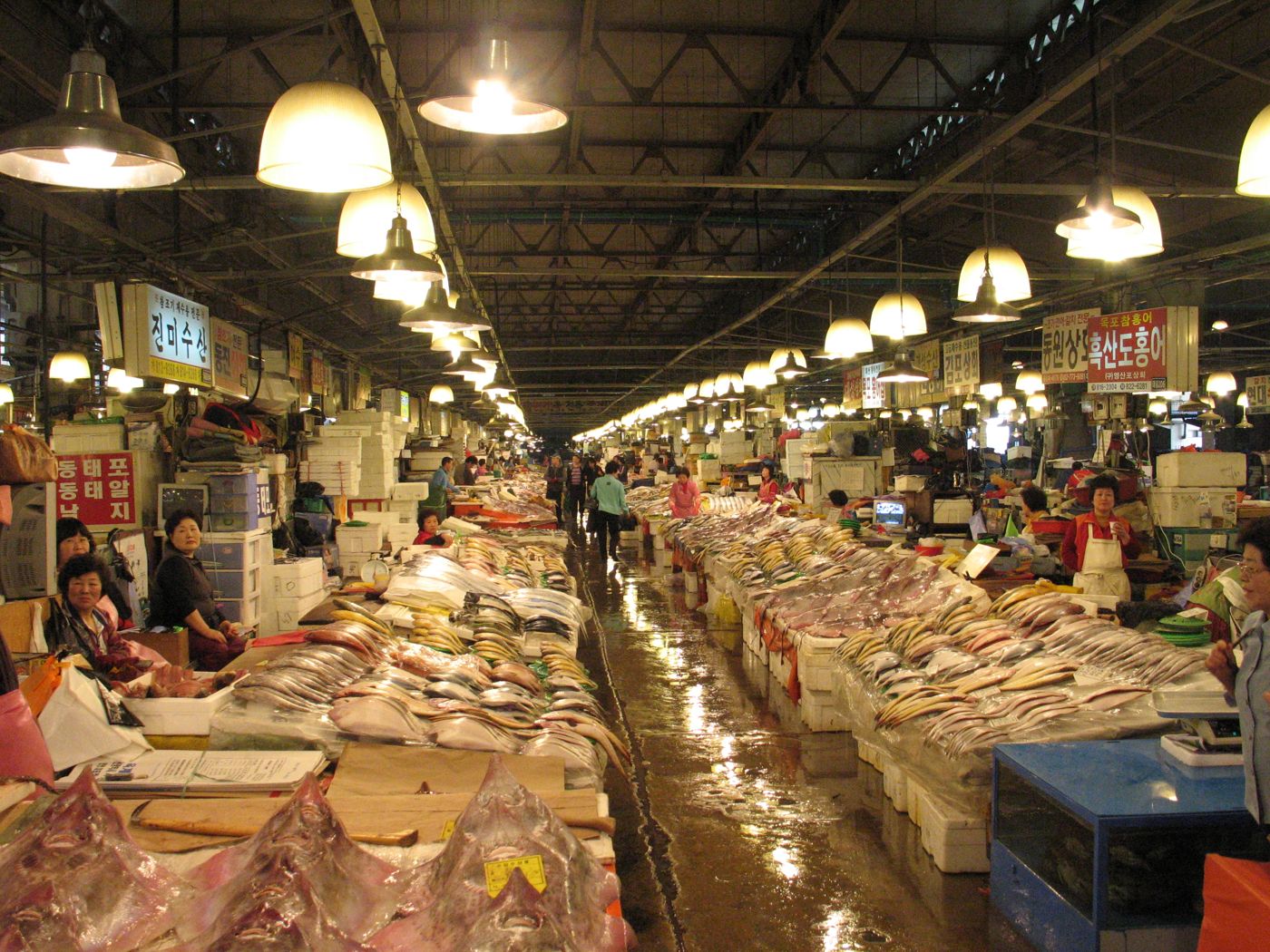 Photo: Gaël Chardon, CC BY-SA 2.0, via Wikimedia Commons
Noryangjin Fisheries Wholesale Market in Seoul's Dongjak district is the capital's largest fish market. It is a working wholesale hub first and a visitor attraction second, and that shapes how you eat there.
History and scale
Visit Korea says the market opened in 1927 near Seoul Station and moved to its present site in Noryangjin in 1971. The Korea Herald gives its early name as Gyeongseong Susan. Visit Korea reports roughly 250 to 300 tons of seafood traded a day, and the Korea Herald describes more than 830 varieties of seafood sold across more than 700 shops. Both are tourism-office and press descriptions, so treat the numbers as indicative rather than exact. Wholesale trade, including the early-morning live-fish auction, runs through the night, while the market as a whole is open around the clock according to Visit Seoul.
How buying and eating works
The core idea is simple. You choose seafood from a stall and pay the seller for it. Visit Seoul explains that nearby restaurants will slice fish you bought at the market into hoe (raw fish), and that you pay the fishmonger for the fish and the restaurant separately for side dishes, vegetables or sauces. The Korea Herald adds that many restaurants in the market will prepare raw seafood or cook what you bought.
Practically, that means:
- Prices move daily. Visit Korea and Visit Seoul both point visitors to the market's website, which posts prices by type of fish. Visit Korea says general retail prices run higher than auction prices.
- Ask before you commit. Confirm the weight, the price and the restaurant's preparation charge before the fish is cut, since you are effectively making two purchases.
- Know what you are buying. Live fish, shellfish, squid, abalone and crab are all common. For how raw fish is cut and eaten at the table, see hoe culture and preparing hoe.
Seafood bought here can also be cooked rather than eaten raw. Korean seafood meals usually come with rice and small side dishes; see the balanced Korean meal for how those pieces are meant to fit together.
The move to the new building
Noryangjin's recent history is dominated by a long dispute over its building. The Korea Times reports that Suhyup, the fisheries cooperative federation that manages the market, opened an eight-story building next to the old one in March 2016, citing safety concerns about the aging old building. Many vendors resisted, arguing that the new stalls were too small and that rents were two to three times higher. Suhyup said it had held many rounds of negotiations, while vendors said the project went ahead without their consent. In November 2018 Suhyup cut power and water to the old building to press the remaining merchants to move, and 127 of 258 remaining vendors then agreed to relocate.
For a visitor, the practical result is that the market has more than one building and you may see older and newer sections. The conflict is also a reminder that traditional markets are livelihoods, and that rebuilding them is a social as well as a physical project. Opponents argued that the old market's traditions, which helped it earn a Seoul Future Heritage listing in 2013, would be lost.
Eating safely
Raw seafood is a normal part of Korean eating, but the usual cautions apply: choose fresh, well-chilled fish from busy stalls, and take extra care if you are pregnant, immunocompromised or have a shellfish allergy. The allergens guide and seafood, omega-3 and mercury pages give general background. For another market food experience in Seoul, begin with Gwangjang Market; for Busan's equivalent, see Jagalchi.