Techniques
Preparing Hoe: Raw and Lightly Cooked Seafood
회 손질
Saenghoe sliced raw, sukhoe blanched, mulhoe in an icy chili broth: how Korean cooks prepare fish and seafood for hoe, and the food-safety rules that come with eating it raw.
Hoe is the Korean family of dishes built on raw or barely cooked meat and seafood, sliced and eaten with a sharp dipping sauce. The Encyclopedia of Korean Culture divides it into two branches: saenghoe, made from raw ingredients, such as sliced fish and yukhoe (raw beef), and sukhoe, quickly cooked in hot water. Vegetables can be hoe too: young dureup shoots blanched and dipped in chili sauce count, as do thin slices of autumn pine mushroom. For the history and social life of hoe, see hoe culture.
Saenghoe: raw fish
The encyclopedia's basic method is simple: take out the bones, remove the skin and cut the white flesh into small pieces. Traditional favorites included sea bream, croaker, carp, pufferfish and oysters, with clams and oysters eaten as they are. The nineteenth-century Siuijeonseo describes croaker skinned, sliced thin, then cut along the grain into fine strips, brushed with oil and served with mustard and vinegared chili paste.
The sauce has changed over time. The encyclopedia notes that before chili peppers spread, hoe was usually eaten with mustard sauce; today the default is chogochujang, gochujang sharpened with vinegar. See chili peppers in Korea. For eating hoe wrapped in leaves, see making ssam and wraps.
Mulhoe: hoe in cold broth
Mulhoe turns sliced raw fish into a one-bowl meal. The Korea Tourism Organization's account of Pohang's version calls it fishermen's fast food: busy crews sliced fish straight from the catch, added gochujang seasoning and water, and mixed. White-fleshed fish such as flounder, olive flounder and greenling are typical, sometimes with squid or sea cucumber, together with shredded vegetables, sesame oil and cold water or half-frozen broth; rice or noodles can go into the bowl. See Pohang.
Sukhoe and eochae: blanched seafood
Sukhoe means hoe that has been lightly cooked. The encyclopedia quotes the Onghui japji: hoe properly means raw fish and meat, but ingredients that are boiled or blanched and then sliced are called hoe too. Tripe, for example, was dipped briefly in hot water and cut into leaf shapes.
The grandest form is eochae. White fish such as croaker, flatfish, sea bream, cod or mullet is cut small, dusted with starch and dipped in boiling water for a moment, so the coating turns silky. The Gyuhap chongseo describes blanching each ingredient separately in a sieve, fish, organ meats, shrimp, sea cucumber, cucumber, minari, mushrooms and egg, then arranging them in five colors, and recommends it from the third to the seventh month, warning that it is too cold for chilly weather. The encyclopedia suggests one reason cooked hoe is so common in court and household records: before modern transport, cooking was a safer way to eat fish that might have spoiled on the road. Octopus and squid are still commonly eaten blanched; see muneo.
Fermented hoe
Southwestern Korea has its own tradition: skate left to ferment until it smells of ammonia. The encyclopedia describes cooks around Mokpo leaving fresh skate in a jar overnight, then slicing it and tossing it with minari in seasoned chili paste. See hongeo-hoe-muchim.
Eating raw seafood safely
Raw seafood always carries some risk, and official advice is cautious:
- Freezing and parasites: The U.S. Food and Drug Administration says cooking is safest, but anyone who eats raw fish should choose fish that has been frozen first, because freezing kills parasites. It warns that freezing does not kill all harmful germs.
- Vibrio in warm months: Korea's Ministry of Food and Drug Safety (MFDS) warns that Vibrio parahaemolyticus, a seawater bacterium, causes food poisoning mostly from June to October, through raw or undercooked fish and shellfish, sliced raw fish and seafood dishes. Its advice: buy fresh, refrigerate at 5°C or below quickly, rinse thawed seafood two or three times under running tap water, and cook when possible (at least 85°C for one minute).
- Separate tools: MFDS also recommends keeping knives and boards for preparing raw fish separate from those used for slicing hoe, and washing and scalding tools after use. The FDA advises the same separation between raw seafood and ready-to-eat food.
- Higher-risk eaters: The FDA advises pregnant women, young children, older adults and people with weakened immune systems to avoid raw or undercooked fish and shellfish. See food safety at home and seafood, omega-3s and mercury.
Dishes using this technique
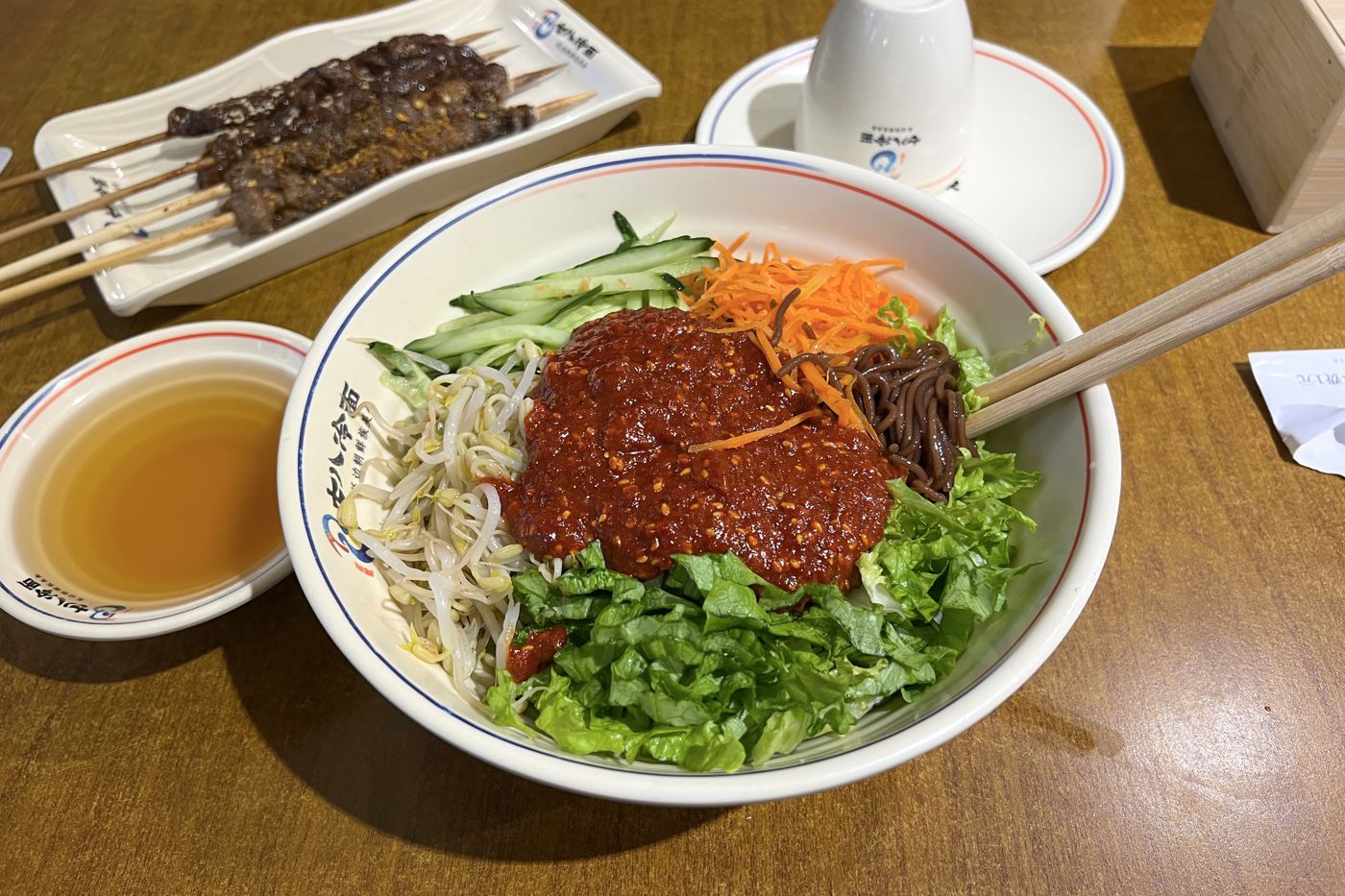 Bibim-naengmyeon (Spicy Mixed Cold Noodles)비빔냉면Chewy starch noodles tossed in a sweet, vinegary chili sauce, topped with cucumber, pear and egg — the Hamheung tradition of hoe-naengmyeon, carried south by refugees.
- Spicy Skate Salad홍어회무침Strips of raw or lightly fermented skate, firmed in vinegar and tossed with minari, radish and a sweet-sour gochujang dressing — Jeolla's feast-day salad.
Sources
- 01회 (Hoe) — Encyclopedia of Korean Culture
- 02숙회 (Sukhoe) — Encyclopedia of Korean Culture
- 03어채 (Eochae) — Encyclopedia of Korean Culture
- 04어부들의 패스트푸드 포항물회와 여름철 보양식 포항회국수 — Korea Tourism Organization (대한민국 구석구석)
- 05Selecting and Serving Fresh and Frozen Seafood Safely — U.S. Food and Drug Administration
- 06여름철, 4가지 식중독의 원인·예방법 — Korea.kr policy news (MFDS guidance, 2019)