Ingredient
Olive flounder (gwangeo)
광어
Romanization: gwangeo
Korea's most-farmed fish and the default choice for raw-fish hoe: a large, left-eyed flatfish raised mostly in shore tanks on Jeju and around Wando, prized for firm, clean white flesh.
Flavor
Clean, mild and faintly sweet, with firm, slightly springy white flesh that slices thin for hoe.
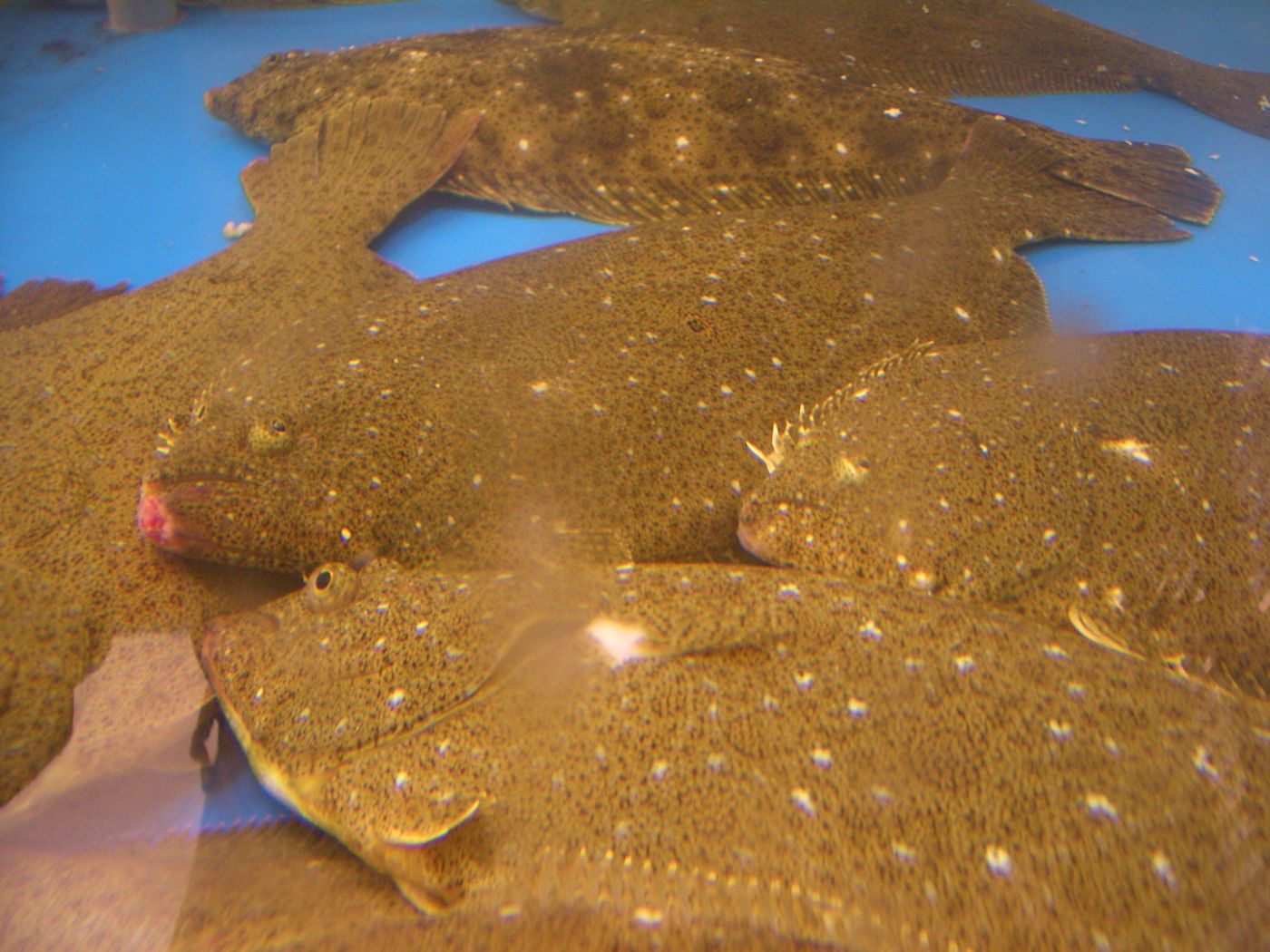 Photo: User:Vmenkov, CC BY-SA 3.0, via Wikimedia Commons
Origin & History
Gwangeo ("broad fish") is the everyday name for neopchi, the olive flounder (Paralichthys olivaceus). The Encyclopedia of Korean Culture lists gwangeo as the most widely used of its Sino-Korean names and describes an oval, flattened fish with both eyes on the left side of the head. That detail separates it from the gajami flatfishes, whose eyes sit on the right. Joseon writers already knew it: Seo Yu-gu's fisheries treatise noted that it came from the East and South Seas, looked like a flounder but grew twice as large, and was boned, opened and sun-dried by fishermen, with fatty, chewy fish judged far better than lean ones. Korean idiom also has its fun with the fish: to be beaten "until you're a flounder" is to be beaten flat.
What made gwangeo ubiquitous was aquaculture. According to the National Institute of Fisheries Science, mass farming techniques were developed in the 1980s; output stayed under 10,000 tons in the early 1990s, took off in the late 1990s, passed 50,000 tons in 2009 and has hovered around 40,000 tons since, about 43,800 tons in 2020. In that year Korea had 516 flounder farms, 254 of them on Jeju and 148 in the Wando area of South Jeolla, and Jeju alone produced roughly half the national supply. Most fish are grown in land-based tanks fed by pumped seawater, and about 2,000 tons a year is exported.
Where Joseon fishermen dried it, Koreans today mostly eat gwangeo raw: the encyclopedia notes that it is now enjoyed above all as gwangeo-hoe, thinly sliced raw fish, and because the fish is farmed it is available all year.
Nutrition
| Calories | 125 kcal |
|---|---|
| Protein | 22.36 g |
| Fat | 3.28 g |
| Carbohydrates | 0 g |
| Fiber | 0 g |
| Sodium | 49 mg |
Notable forPotassium (465 mg) · Phosphorus (274 mg) · Vitamin D (4.32 µg) · Vitamin B12 (1.06 µg)
Values copied from the Korean Food Composition Table (Rural Development Administration / National Institute of Crop Science) for this exact food, per 100 g edible portion. Blank fields in the table are shown as not reported. Actual values vary with ingredients, portion size and preparation.
Health Benefits
- Lean, high-quality protein: Raw olive flounder has over 22 g of protein and about 3 g of fat per 100 g in the Korean table, with potassium, phosphorus, vitamin D and vitamin B12.
- Kudoa in raw flounder: The parasite Kudoa septempunctata, found in some farmed olive flounder, has been linked to short-lived vomiting and diarrhea after eating raw fish; a 2023 Korean study confirmed it in patients and in flounder sashimi from an outbreak.
- Raw-fish precautions: The FDA says thorough cooking is safest, notes freezing kills parasites, and advises pregnant women, young children, older adults and people with weakened immunity to avoid raw fish such as hoe.
- Fish allergy: Fish is one of the nine major food allergens under U.S. law.
Informational, not medical advice. Talk to a qualified professional about your own health and diet.
Dishes with Olive flounder (gwangeo)
Dish guides featuring olive flounder (gwangeo) are coming soon.
Sources
- 01넙치 (Olive flounder) — Encyclopedia of Korean Culture
- 02수과원, 제주 넙치 양식장 정보 한 장에 담은 포스터 발간 (Jeju flounder farm poster, 2022) — National Institute of Fisheries Science
- 03주요 양식품목의 가치사슬 연구: 넙치·전복·김 (Value-chain study of major farmed species, 2021) — National Institute of Fisheries Science
- 04Sung GH et al. Molecular detection and genotype analysis of Kudoa septempunctata from food poisoning outbreaks in Korea. Parasites, Hosts and Diseases (2023)
- 05Korean Food Composition Table — Bastard halibut (olive flounder), Raw
- 06Selecting and Serving Fresh and Frozen Seafood Safely — U.S. Food and Drug Administration