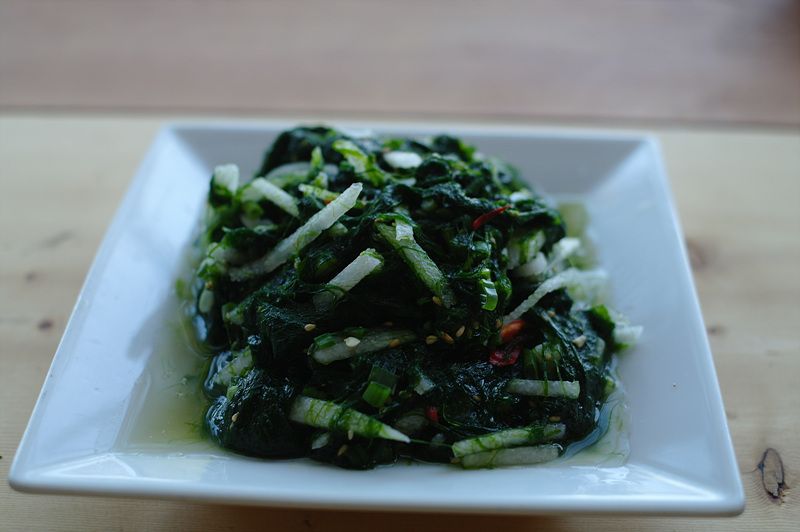
 Photo: 배누리바느질하는농부, CC BY-SA 2.0 kr, via Wikimedia Commons
Muchim · Dressed side dish 무침
Parae Muchim (Green Laver Salad)
파래무침
Romanization: parae-muchim
Fresh green laver rinsed, squeezed and tossed with salted radish in a sweet-sour dressing — a bright, briny winter banchan from Korea's southwest coast.
- Serves
- 4
- Prep
- 25 min
- Cook
- 0 min
RegionJeolla
Jump to recipeRecipe
Ingredients · Serves 4
- 200 gFresh parae (green laver)
- 150 gKorean radishcut into thin matchsticks
- ½ tspFine saltfor salting the radish
- 1 tbspSoy sauce
- 2 tbspVinegar
- 1 tbspSugar
- 1 tspGochugaruoptional
- 1 tspGarlicminced
- 1 tspToasted sesame seeds
Method
Technique: Yangnyeom: Seasoning Basics
Step 1: Put the parae in a large bowl of cold water and swish it gently, lifting it out and changing the water three or four times, until no sand or shell fragments remain at the bottom of the bowl. Pick out any debris by hand.
Step 2: Toss the radish with the salt and leave for 10 minutes, then squeeze out the liquid.
Step 3: Squeeze the parae firmly to remove as much water as possible, then cut it into 4–5 cm lengths with scissors.
Step 4: Mix the soy sauce, vinegar, sugar, gochugaru and garlic until the sugar dissolves.
Step 5: Loosen the parae with your fingers, add the radish and dressing and toss lightly. Sprinkle with sesame seeds.
Step 6: Serve within a day; the parae darkens and softens as it sits in vinegar.
Origin & History
Parae is the collective name for the fine, bright-green seaweeds of the sea lettuce family (Ulvaceae) — hair-thin, tube-shaped or flat-bladed species that cling to rocks and mudflats where fresh water runs into the sea. The Encyclopedia of Korean Folk Culture explains that what most people call parae is gasi-parae, also known in the south as gamtae; nearly all kinds are edible except the coarse galparae, which is used for animal feed. Parae, maesaengi, gamtae and laver (gim) are the four winter seaweeds of the Korean intertidal zone; the first three are green algae, gim a red one.
Jeong Yak-jeon's early-nineteenth-century Jasan eobo describes a green seaweed spreading over rocks under the name haetae — a word the folk-culture encyclopedia argues refers to parae, since the book calls it green, whereas laver was written haeui. Parae grows from late autumn to early summer. It is still mostly gathered by hand from the wild, sometimes by whole villages working together, and it is an important winter income for coastal communities in Wando, Sinan, Muan and Hampyeong, where gim farming is less common. The Encyclopedia of Korean Culture notes that South Jeolla produces the largest share.
Fresh parae was eaten raw on the coast and carried dried to inland and mountain villages, where it was dressed with seasonings as banchan; fishing villages also made it into kimchi. The folk-culture encyclopedia names parae tossed with salted radish as the signature parae dish.
Key Ingredients
- Parae (green laver)파래Fine, bright-green seaweed gathered from tidal rocks and mudflats in winter. Its fresh ocean scent and gentle sweetness star in parae-muchim, often tossed with julienned radish and a vinegary dressing.
 Korean radish무A stout, heavy white radish, often tinged pale green near the top. It is cubed for kkakdugi, left whole in the clear brine of dongchimi, shredded into salads and simmered into broths.
 Soy sauce간장Korean soy sauce, in two main kitchen forms: pale, salty guk-ganjang (soup soy sauce) brewed the traditional way from meju, and darker, sweeter jin-ganjang for braises and marinades.
- Korean Vinegar식초Vinegar in the Korean kitchen, from naturally fermented grain and fruit vinegars, such as persimmon vinegar, to everyday brewed vinegar. It sharpens muchim, pickles and the dipping sauce chogochujang.
 Gochugaru고춧가루Korean red chili powder, made from dried red peppers ground coarse or fine. It gives kimchi, gochujang and countless banchan their color and warmth.
 Garlic마늘Used raw, minced, pickled and roasted, garlic is one of the essential aromatics of Korean food — in seasonings, marinades, kimchi and namul.
 Sesame참깨Toasted sesame seeds and sesame oil (chamgireum) finish countless Korean dishes, adding a nutty aroma and gloss.
Nutrition
| Calories | ~39 kcal |
|---|---|
| Protein | ~2.1 g |
| Fat | ~0.6 g |
| Carbohydrates | ~8 g |
| Fiber | ~1.8 g |
| Sodium | ~379 mg |
Notable forVitamin C · Iron · Magnesium
Parae uses the Korean Food Composition Table entry “Sea lettuce, Raw” (per 100 g: 11 kcal, 2.18 g protein, 36 mg vitamin C, 4.1 mg iron, 48 mg magnesium, 122 mg sodium); iodine is not reported. Radish and soy sauce use Korean table values; the estimate assumes about 1 g of the radish-salting salt is retained after squeezing. Gochugaru uses the USDA cayenne entry as a stand-in; vinegar, sugar, garlic and sesame seeds use USDA FoodData Central. Totals divided by four. Actual values vary with ingredients, portion size and preparation.
Health Benefits
- Very low in calories: a generous serving has about 40 kcal, most of it from the sugar in the dressing.
- Vitamin C and iron: the Korean Food Composition Table lists fresh sea lettuce as a source of vitamin C and iron, along with magnesium and fiber.
- Iodine: like other seaweeds, parae supplies iodine, which the thyroid needs; the amount varies widely.
- Traditionally regarded as healthful: both Korean encyclopedias note parae's reputation for lowering cholesterol; that comes mainly from older and laboratory studies, and evidence in people is limited.
Regional Variations
- With radish and vinegar: the classic version — parae with salted radish strips in a sweet-sour soy or salt dressing.
- Spicy: gochugaru and garlic added for a reddish, more pungent salad.
- With anchovy sauce: the Encyclopedia of Korean Culture notes that young sea lettuce is sometimes dressed simply with anchovy fish sauce.
- Other parae dishes: the folk-culture encyclopedia lists parae pancakes (parae-jeon), a chilled parae salad (parae-naengchae) and parae porridge; inland, dried parae was dressed with seasonings as banchan.
Pairings
- Gim Gui (Seasoned Roasted Laver)김구이Sheets of laver brushed with sesame or perilla oil, sprinkled with salt and toasted until crisp — eaten wrapped around spoonfuls of rice.
 Doenjang Jjigae (Soybean Paste Stew)된장찌개A thick, savory stew of fermented soybean paste with tofu, zucchini and whatever the season offers — the everyday pot at the center of the Korean table.
 Myeolchi Bokkeum멸치볶음Small dried anchovies stir-fried until crisp, then glazed in a sweet soy and garlic syrup — a keeping banchan found in refrigerators across Korea.
Sources
- 01파래 (Parae) — Encyclopedia of Korean Folk Culture (National Folk Museum of Korea)
- 02파래 (Parae) — Encyclopedia of Korean Culture
- 03파래무침 (Parae-muchim) — Urimalsaem (National Institute of Korean Language)
- 04Korean Food Composition Table: Sea lettuce, Raw — National Institute of Agricultural Sciences
- 05Iodine in diet — MedlinePlus Medical Encyclopedia (U.S. National Library of Medicine)
Last updated