Ingredient
Parae (green laver)
파래
Romanization: parae
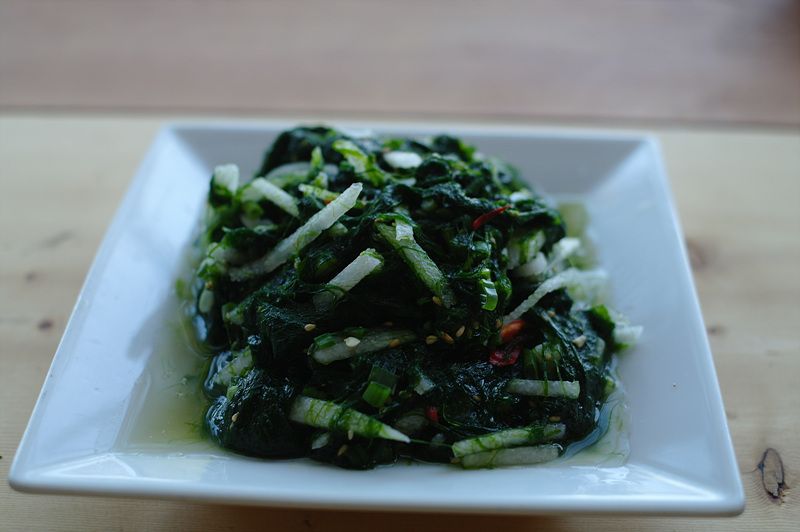
Fine, bright-green seaweed gathered from tidal rocks and mudflats in winter. Its fresh ocean scent and gentle sweetness star in parae-muchim, often tossed with julienned radish and a vinegary dressing.
Flavor
Fresh, briny and green with a distinct oceanic perfume and a subtle sweetness. The fine strands are soft and slippery, with a delicate chew.
Origin & History
Parae is a collective name for the green seaweeds of the sea-lettuce family (Ulvaceae). The hollow, threadlike and flat-bladed species grouped under the name include gasi-parae, galparae, napjak-parae, changja-parae and the silky maesaengi. The Sino-Korean name is cheongtae, "blue-green moss." Most of what Koreans simply call parae is gasi-parae, which in the southwest is also called gamtae, "sweet moss." Coarse galparae is used mainly as animal feed rather than eaten. Parae grows on rocks, posts and even boat hulls, especially in sheltered bays where fresh water flows in. It is one of the hardiest seaweeds, thriving where nutrients are abundant.
In the early nineteenth century, Jeong Yak-jeon's Jasan eobo, a survey of marine life around Heuksando, described a green seaweed that spreads over rocks and tastes sweet. For centuries parae was gathered wild, eaten fresh along the coast, and dried and carried inland, where mountain households seasoned it as a banchan. Fishing villages also made kimchi from it.
Parae grows from late autumn into early summer, and the prized southwestern types are picked from about December to February, before they toughen and fade. It is found on all Korean coasts but is most abundant in South Jeolla Province. In places with little gim farming, such as Wando, Sinan, Muan and Hampyeong, gamtae and maesaengi are a valued winter income. Gathering is done by hand, sometimes as a communal village effort, as on Wando's Gogeumdo, and cleaning the sand out of the harvest takes even longer than picking it.
The best-known dish is parae-muchim: rinsed parae dressed with soy sauce or fish sauce, vinegar, garlic and sesame, often with salted julienned radish. Parae is also pan-fried in batter as parae-jeon, served in cold soups and porridge, toasted and seasoned as dried sheets, and fermented into gamtae-kimchi in the southwest.
Nutrition
| Calories | 11 kcal |
|---|---|
| Protein | 2.18 g |
| Fat | 0.15 g |
| Carbohydrates | 2.95 g |
| Fiber | 2.1 g |
| Sodium | 122 mg |
Notable forIron · Vitamin C · Calcium · Folate
Korean Food Composition Table entry "Sea lettuce, Raw" (파래, 생것): also 4.1 mg iron, 36 mg vitamin C, 55 mg calcium and 29 µg folate per 100 g; vitamin A is not reported. The Table's dried parae entry (파래, 말린것), which is taken from Japan's food composition data, lists about 2,200 µg iodine and 3,900 mg sodium per 100 g. Actual values vary with ingredients, portion size and preparation.
Health Benefits
- Low-calorie sea vegetable: Per the Korean Food Composition Table, fresh parae is very low in calories and a source of iron, vitamin C, calcium, folate and fiber.
- Iodine: Seaweeds can be rich in iodine, and dried seaweed especially so. Adults need about 150 µg a day, and MedlinePlus notes that very high iodine intake can reduce thyroid function. People with thyroid conditions, or those taking thyroid medicine, should ask their doctor about regular seaweed consumption.
- Sodium: Fresh parae is moderately salty from seawater, dried parae much more so, and parae-muchim dressings add more. Rinse it well and season lightly.
- Clean source and thorough washing: Parae grows readily in nutrient-rich and even polluted water, so buy it from reputable sellers and wash it carefully in several changes of water to remove sand and debris.
- Cholesterol claims: Korean references mention that parae may help lower cholesterol, but evidence in people is limited; research is ongoing.
Informational, not medical advice. Talk to a qualified professional about your own health and diet.