Regions
Jeongseon
정선
A Gangwon mountain county where coal gave way to tourism: the Jeongseon five-day market, gondre thistle rice, buckwheat kotdungchigi noodles and corn tadpole noodles.
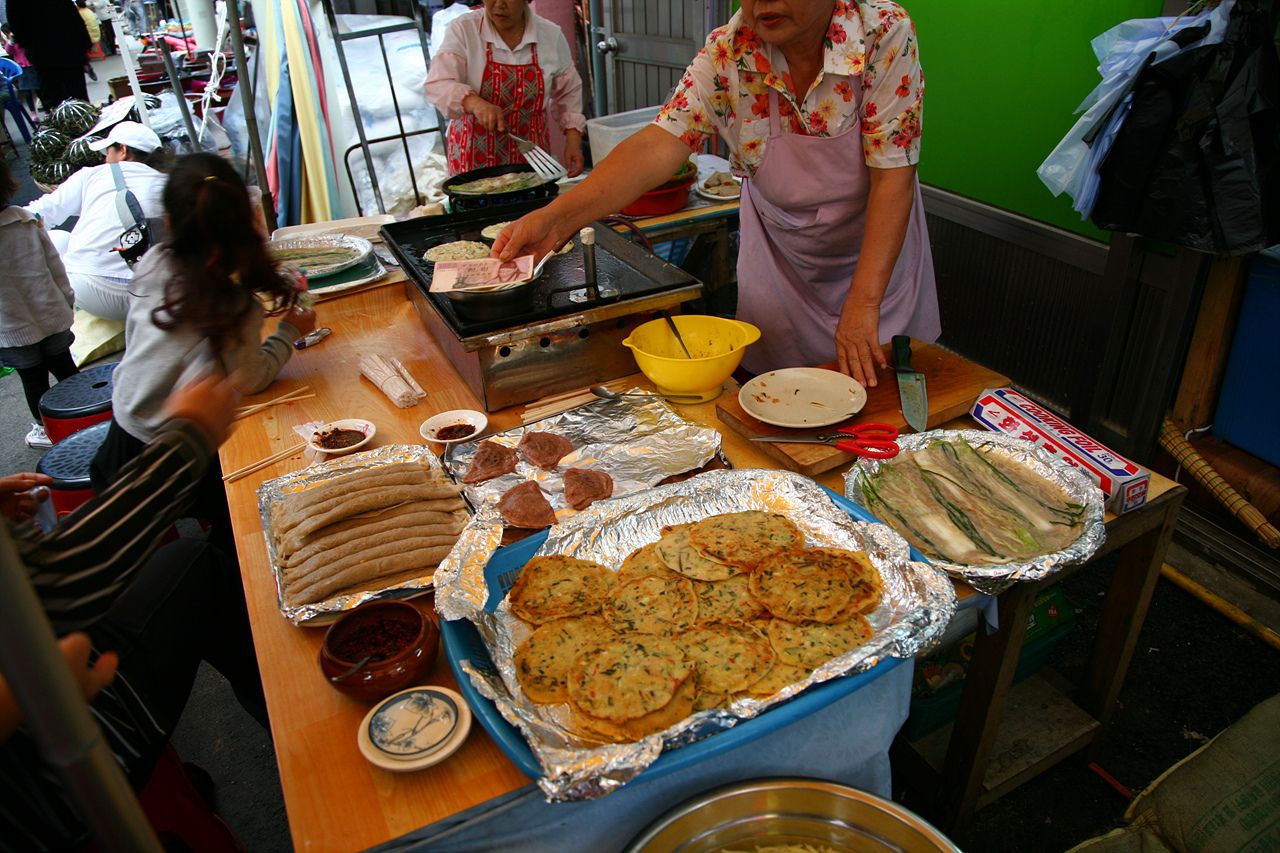 Photo: Junho Jung at Flickr from South Korea, CC BY-SA 3.0, via Wikimedia Commons
Jeongseon County sits deep in the mountains of southern Gangwon, a land of steep valleys along the Joyang River. The Encyclopedia of Korean Culture notes that farmland covers less than a tenth of the county and is overwhelmingly dry fields rather than rice paddies, growing corn, beans, buckwheat and potatoes, with medicinal herbs and, more recently, highland vegetables. Coal mining once swelled the population; when the government rationalized the coal industry from 1989 and mines closed, the county turned to tourism. Its food culture is the cooking of a place where rice was scarce.
The five-day market
The Jeongseon market, officially Jeongseon Arirang Market, is the county's best-known attraction. The Encyclopedia of Korean Folk Culture traces it to the town market recorded in the Dongguk munheon bigo of 1770, which met on days ending in 4 and 9. By 1915 market days had moved to dates ending in 2 and 7, which they remain today. In the colonial period livestock, above all cattle, made up the largest share of trade. A permanent market opened in 1965 during the coal boom.
Its revival came by rail. On March 17, 1999, a special tourist train, the Jeongseon Five-Day Market train (now the Jeongseon Arirang train), made its first run, and from 2007 it also ran on Saturdays, so the market now combines a permanent market, the five-day market and a weekend market. Since 2005, the encyclopedia adds, residents with a permit from the merchants' association can sell their own vegetables, herbs and wild greens inside the market. Stalls sell suritchwi-tteok, a rice cake colored with a wild mountain herb (making tteok), gondre rice and kotdungchigi noodles. Korea.net's 2014 report describes visitors leaving with fistfuls of dried gondre. See traditional markets.
Gondre-bap
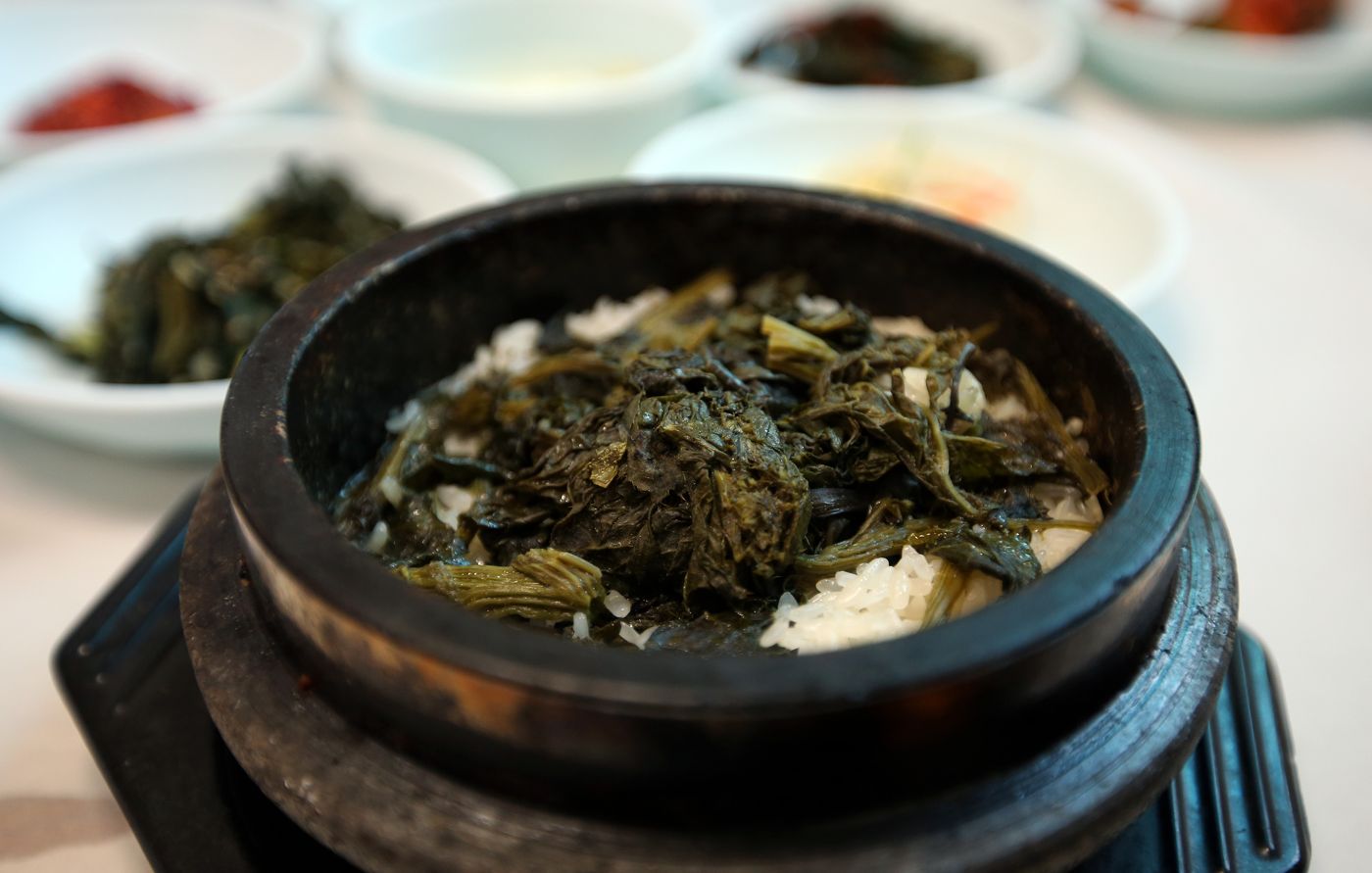
Gondre, Cirsium setidens, is a soft-leaved mountain thistle. Korea.net notes that Jeongseon, with 22 peaks above 1,000 meters, is known for its harvest. The Digital Gangneung Culture Encyclopedia describes how it is prepared: the spring leaves are blanched and dried thoroughly, then soaked for about a day and boiled for about two hours before use, since raw gondre is astringent and discolors. The greens are seasoned with sesame oil and salt, laid over rice and cooked together. Once a famine food stretching scant grain through the lean spring weeks, gondre-bap is now a specialty, eaten with a soy-sauce dressing. See drying and rehydrating vegetables and cooking bap.
Buckwheat: kotdungchigi and jeonbyeong
Buckwheat was the mountain grain. The Encyclopedia of Korean Folk Culture explains that before American wheat flour arrived after the Korean War, buckwheat was Korea's main noodle grain; it grows almost anywhere, needs little tending and is ready two or three months after sowing, which made it vital in Gangwon's paddy-poor uplands.
Kotdungchigi (콧등치기), "nose-slapper," is Gangwon's rustic buckwheat noodle. Buckwheat dough has little stretch, so the noodles are rolled out and cut thick enough to hold together in boiling broth, and their springy, stubby ends flick the bridge of your nose as you slurp them, hence the name. The folk encyclopedia records another name, neureun-guk, from rolling the dough out as wide as possible to stretch it among more people. See noodles in Korean history.
Memil-jeonbyeong are thin buckwheat crepes rolled around a filling. The folk encyclopedia notes that in Gangwon the classic filling was native mustard-green kimchi salted over winter, soaked to remove salt and reseasoned; seasoned shredded radish is more common now (soaking and desalting).
Corn and tadpole noodles
Corn fed the mountains too. Korea.net describes olchaengi-guksu, "tadpole noodles," made from a paste of ground corn pressed through a wooden sieve, which shapes it into short drops that look like tadpoles. The noodles are so fragile that diners eat them with a spoon.
Arirang
Jeongseon is also the heartland of Jeongseon Arirang, a folk song the Encyclopedia of Korean Culture describes as still being reworked by singers today; Arirang was inscribed on UNESCO's intangible heritage list in 2012, Korea.net notes. The county's Arirang festival and the market's performances make a visit on market day a full day out.
Sources
- 01정선군 (Jeongseon-gun) — Encyclopedia of Korean Culture
- 02정선아리랑시장 (Jeongseon Arirang Market) — Encyclopedia of Korean Folk Culture, National Folk Museum of Korea
- 03Jeongseon County: from coal to tourism — Korea.net (2014)
- 04곤드레밥 (Gondre-bap) — Digital Gangneung Culture Encyclopedia
- 05메밀콧등치기 (Memil kotdungchigi) — Encyclopedia of Korean Folk Culture, National Folk Museum of Korea
- 06메밀전병 (Memil-jeonbyeong) — Encyclopedia of Korean Folk Culture, National Folk Museum of Korea