History & Culture
Noodles in Korean History
국수의 역사
Why noodles were once a celebration food in wheat-poor Korea, and how naengmyeon, kalguksu, Incheon's jajangmyeon and instant ramyeon each came to the table.
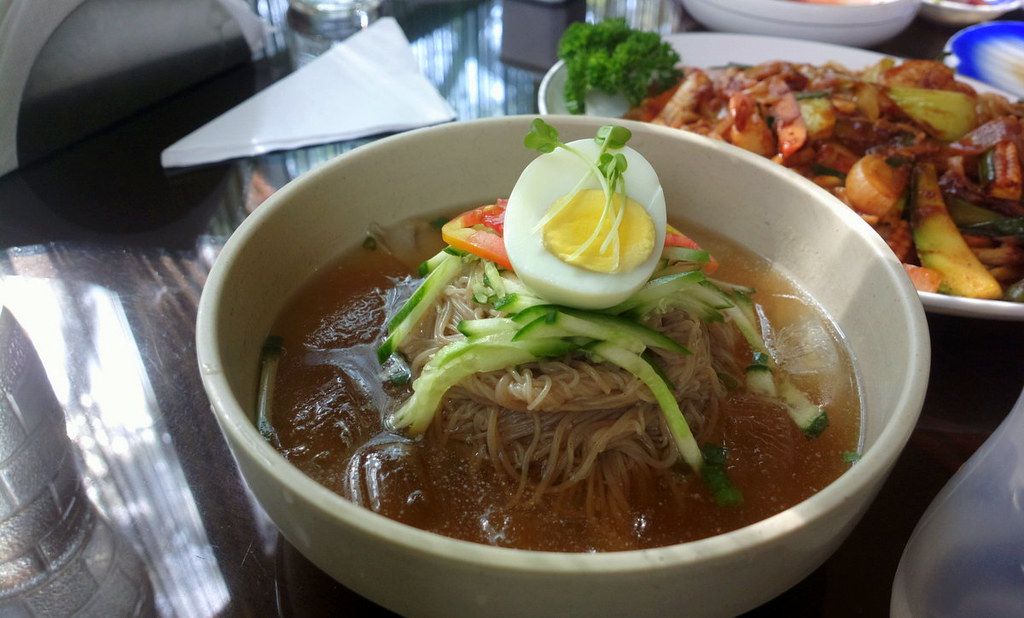 Photo: solarisgirl, CC BY-SA 2.0, via Flickr
Noodles are everyday food in Korea now, but for most of the country's history they were special. Wheat grew poorly in Korea's climate, so noodles were made from buckwheat, starch and whatever flour could be had, and they were served at feasts, on birthdays and at weddings. Their long strands came to stand for a long life, a meaning that survives in the bowl of noodles still served at Korean celebrations.
Scarce wheat, festive noodles
The first clear references come from Goryeo. A Chinese envoy who visited in 1123 wrote in his account, the Gaoli tujing, that noodles were the best of the dozen or so dishes served, and that wheat was so scarce and costly, much of it imported from northern China, that people ate it only on ceremonial occasions. Goryeo records also mention noodles used in rites and noodles made and sold by Buddhist temples. What those noodles were like is unknown.
Joseon cookbooks, discussed in Joseon cookbooks, give real recipes, and they confirm that Korean noodles were not mainly wheat. An eighteenth-century encyclopedia remarks that while noodles are properly made from wheat, Koreans make them from buckwheat. Seventeenth-century texts describe pressing dough through holes punched in a gourd; later texts describe a wooden noodle press, the guksu-teul, and noodle shops sold coils of pressed noodles. Rotary presses and dried wheat noodles spread in the early twentieth century, and after 1945 imported wheat made wheat noodles common.
Janchi-guksu: the celebration bowl
Guksu-jangguk, also called onmyeon and today usually janchi-guksu (feast noodles), is noodles in hot, clear beef broth, traditionally made from brisket, topped with egg-strip garnish, shredded mushroom, chili threads and green vegetables in five colors. Because the strands are long, the dish carries a wish for longevity, and the Encyclopedia of Korean Culture calls it especially important as wedding food; a bowl was also customarily placed on the first-birthday table and the ancestral table. At a sixtieth-birthday banquet, a noodle table set in front of the honoree let guests eat while the tall display table behind stayed untouched; see life ritual foods.
Naengmyeon: a northern winter dish
Cold noodles appear in several nineteenth-century texts, including a seasonal almanac that lists them as a winter specialty: buckwheat noodles in chilled meat broth or dongchimi brine. Buckwheat grows well in the cold north, so naengmyeon became a hallmark of the northern provinces. Pyongyang naengmyeon was served in broth with radish water kimchi; Hamhung's version used chewy potato-starch noodles dressed with spicy raw fish; Jinju in the south had its own beef-broth style. Refugees from the North carried the dish across the country after the Korean War, and it gradually became a summer food. See mul-naengmyeon.
Kalguksu: knife-cut noodles
Hand-cut noodles appear in Eumsik dimibang (c. 1670) as jeolmyeon, made mostly from buckwheat with wheat flour as a binder, because wheat was too precious to use alone. Twentieth-century cookbooks give wheat-flour versions rinsed and served in clear broth. The familiar modern kalguksu, simmered directly in anchovy, chicken or beef broth so that the starch thickens the soup, belongs to the era of cheap flour. Wheat noodles were also an early-summer seasonal food, made when the new wheat was harvested.
Jajangmyeon: Incheon's Chinese noodle
Jajangmyeon, wheat noodles under a sauce of pork, onion and fried black bean paste (chunjang), descends from zhajiangmian of China's Shandong Peninsula. Chinese migrants settled in Incheon after the port opened in 1883, and the area around them became today's Chinatown. Korean accounts usually credit Gonghwachun, a restaurant the Encyclopedia of Korean Culture dates to 1905, with first selling the dish. That claim rests largely on restaurant and local tradition and is hard to document independently. Gonghwachun closed in the early 1980s, and its brick building was registered as a cultural heritage site in 2006. Korean chunjang, sweetened with caramel, was developed in 1948, and the government's flour campaigns of the 1960s and 1970s made jajangmyeon a cheap, everyday meal.
Instant ramyeon
Instant fried noodles were invented in Japan in the late 1950s. Samyang Foods made Korea's first in 1963, and by the mid-1970s annual production passed a billion packs. Cup noodles followed in the 1980s. Instant ramyeon's role in the postwar diet is covered in food in modern Korea, and its sodium content in sodium in Korean food.