History & Culture
Korean Tea Culture: From Temple Tea to Darye
한국의 차 문화
How green tea arrived with Silla, flourished in Goryeo's temples and court, faded under Joseon, was revived by the monk Cho Ui, and lives on in Boseong, Hadong and the many herbal cha.
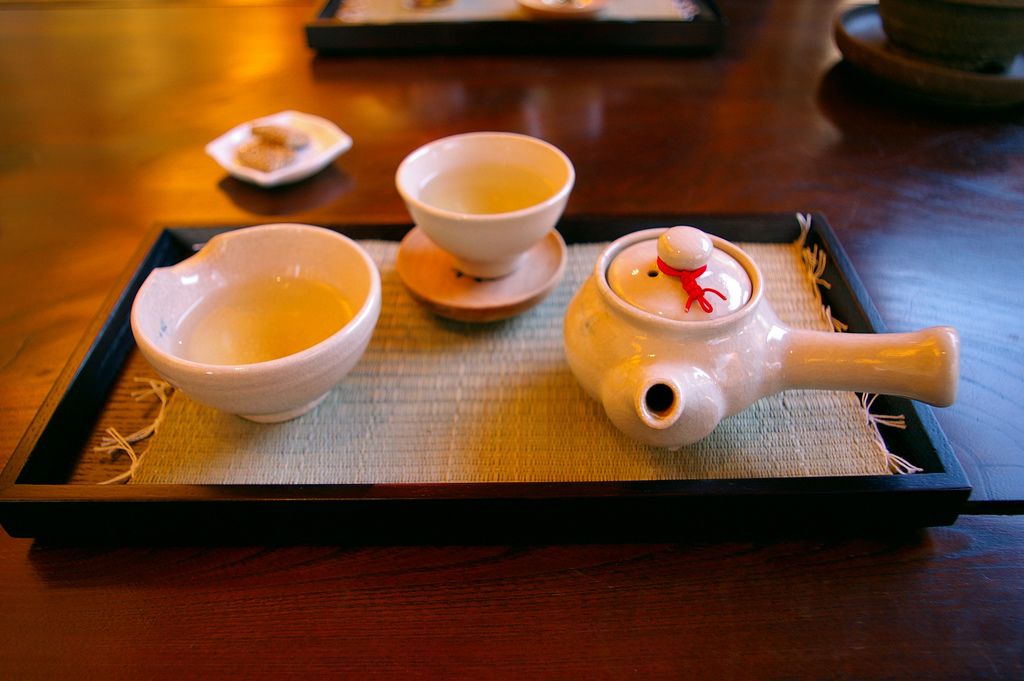 Photo: Ride Around the World, CC BY 2.0, via Wikimedia Commons
In Korean, cha (차) covers far more than the leaf of Camellia sinensis. Barley, jujube, citron and ginger are all brewed or steeped and served as "tea." But the story of tea in the narrow sense, green tea, is one of the longer threads in Korean food history: it rose with Buddhism, became a court ceremony, nearly disappeared, and was deliberately revived. This page follows that thread; the herbal and fruit drinks have their own page, traditional Korean teas.
Silla and Goryeo: tea, temples and the court
The Encyclopedia of Korean Culture dates tea in Korea to at least the seventh century, in the reign of Queen Seondeok of Silla, but it credits its spread to the year 828. That year an envoy named Daeryeom returned from Tang China with tea seeds, and King Heungdeok had them planted on Jirisan. The mountain's warm, misty southern slopes became the center of Korean tea growing. The chronicle names only the mountain, not a precise spot; the Hwagae valley in Hadong presents itself today as that birthplace.
Tea reached its height in the Goryeo dynasty (918–1392), when Buddhism was the state religion. According to the Encyclopedia, a court office called the dabang (다방) handled royal tea, and formal tea offerings were part of great state festivals such as Yeondeunghoe and Palgwanhoe. Monasteries kept tea villages to supply their needs, literati wrote tea poems, and the fashion for tea is often linked to the refinement of Goryeo celadon, prized for its tea bowls.
Joseon: decline and survival
Under the Confucian Joseon dynasty (1392–1910) tea faded along with Buddhist institutions. The Encyclopedia notes that by the sixteenth century even the court drank little tea, and records a Chinese general asking why Koreans did not drink it. Tea never vanished entirely: temples kept growing and roasting it, and some literati held on to Goryeo habits. The court also kept a formal tea rite, darye (다례, 茶禮). The Annals-based Sillok Wiki describes court darye at three kinds of occasion: receiving foreign envoys, celebratory banquets and ancestral offerings. It notes that state and court rites were usually called darye, while household versions were called charye, the word that still names the ancestral table set at New Year and Chuseok, though tea itself has long since left most of those tables (see jesa food). In the eighteenth century, when King Yeongjo banned alcohol, tea took wine's place at some court banquets, giving the ceremony new weight (see royal banquets).
The nineteenth-century revival: Cho Ui and Dasan
The revival is tied to a small circle of friends in the southwest. The scholar Jeong Yak-yong, better known by his pen name Dasan ("tea mountain"), spent eighteen years in exile in Gangjin. The Encyclopedia notes that he drank tea there, wrote a playful verse petition asking a monk for tea leaves, and on leaving formed a tea fellowship, the Dasingye (다신계), with his students.
The monk Uisun (1786–1866), known as Cho Ui (초의), studied poetry and classics with Dasan and later befriended the calligrapher Kim Jeong-hui. A head teacher at Daeheungsa in Haenam, he grew and processed tea and wrote the two works that anchor Korean tea literature: Dasinjeon and Dongdasong (동다송, "Ode to Eastern Tea"). The Encyclopedia says the exact date of Dongdasong is unknown and places it after 1831. Its 31 verses draw heavily on Chinese tea classics, with only about six devoted to Korean tea specifically, yet it is still read as the founding statement of a Korean way of tea.
Modern tea fields: Boseong and Hadong
Large commercial plantations are a twentieth-century development. The Encyclopedia records that plantations were established in Boseong in South Jeolla under colonial rule in the 1910s and 1920s, and that interest in tea grew again from the 1960s, with major expansion from the late 1970s. Boseong's terraced hillsides are now the best-known tea landscape in the country.
Hadong, in South Gyeongsang on the slopes of Jirisan, represents an older style. Its tea grows on steep ground along the Hwagae stream, often among rocks, and is traditionally roasted by hand in iron pans. In 2017 the FAO designated the Traditional Hadong Tea Agrosystem in Hwagae-myeon as a Globally Important Agricultural Heritage System; FAO notes that Hwagae-myeon supplies most of Hadong's tea and roughly a fifth of national production.
Tea and the Korean table
Green tea is still a quieter presence in Korea than coffee or the grain and fruit cha. A host is as likely to pour roasted barley tea (bori) with a meal, or offer citron tea made from yuja, five-flavor-berry tea from omija or jujube tea from daechu. Tea also shares the table with sweets: hangwa and tteok were long served with it. For other drinks, see traditional beverages; for Buddhist food, temple food.