Ingredient
Omija (Schisandra Berry)
오미자
Romanization: omija
Small red berries of the Schisandra chinensis vine, named ‘five-flavor fruit’ for their sweet, sour, salty, bitter and pungent notes. They are steeped into a ruby tea, syrup and hwachae.
Flavor
Sharply sour first, then sweet, with bitter, salty and peppery notes underneath and a resinous, fruity aroma. Infusions are a vivid pink-red and taste best lightly sweetened and chilled.
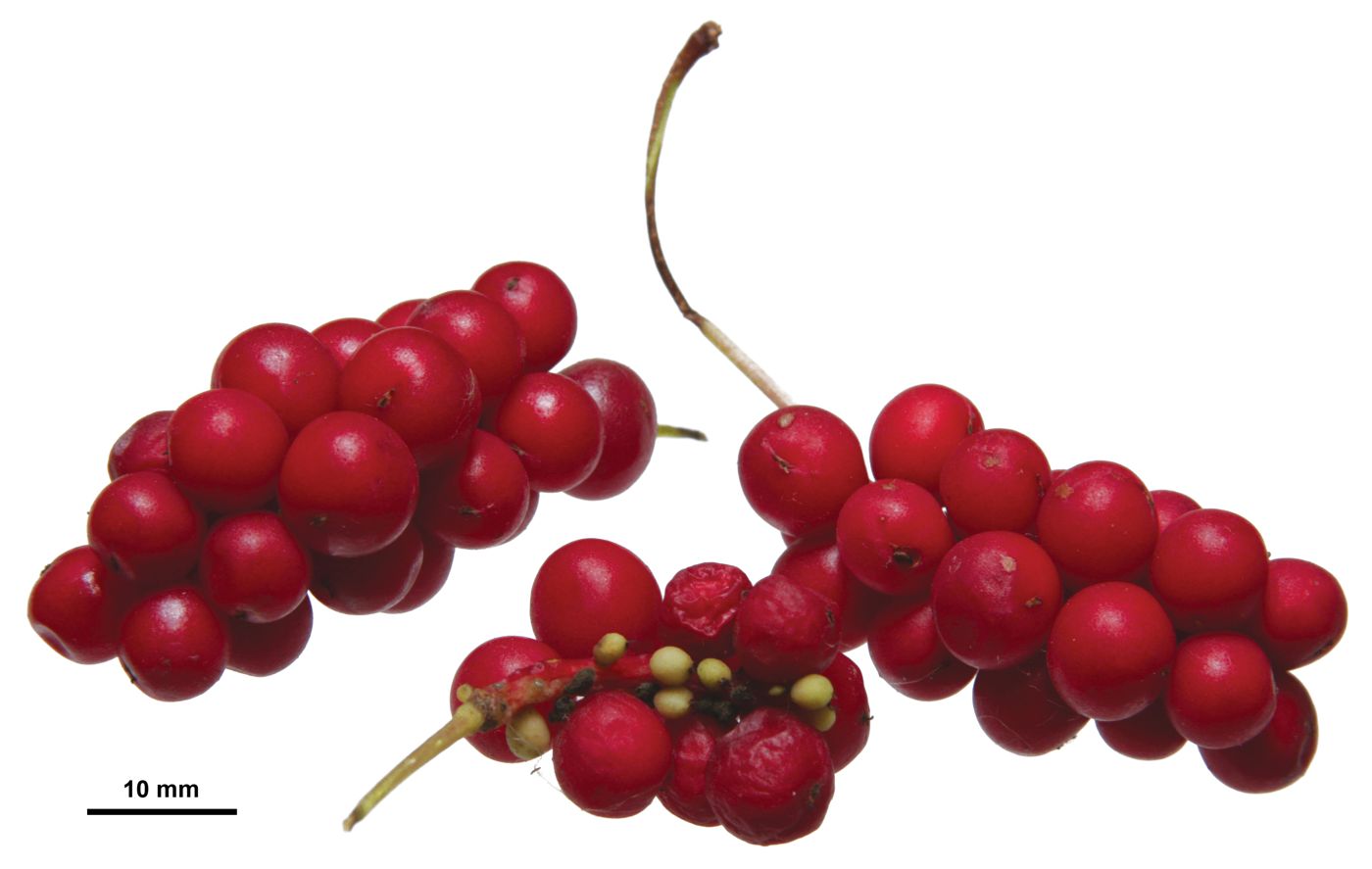 Photo: Vladimir Kosolapov, CC BY 3.0, via Wikimedia Commons
Origin & History
Omija grows wild as a deciduous climbing vine in Korea's mountain valleys, often in thickets on rocky slopes. It flowers in early summer, and its clusters of glossy berries ripen red in August and September. The Encyclopedia of Korean Culture explains the name — o (five), mi (flavor), ja (fruit) — as a nod to the berry's five tastes, of which sourness, from malic and tartaric acids, is by far the strongest.
The berry has a long history in Korean traditional medicine and in home drinks. To make omija-cha, dried berries are simmered slowly in water or ground and stirred into hot water, then sweetened with sugar or honey. The berries are also used to make the deep pink base for omija hwachae, a chilled fruit punch, and are steeped in sugar as omija-cheong or in alcohol for wines.
Most of Korea's omija now comes from cultivated vines. Mungyeong in North Gyeongsang, centered on Dongno-myeon, is the largest producer, with about 1,500 tonnes a year, roughly 45 percent of the national crop, according to Korea.net. The town marks the September harvest with an omija festival.
Nutrition
| Calories | 362 kcal |
|---|---|
| Protein | 8.5 g |
| Fat | 13.5 g |
| Carbohydrates | 61.3 g |
| Fiber | 31.3 g |
| Sodium | 4 mg |
Notable forDietary fiber · Potassium
Values from the Korean Food Composition Table (RDA, 2024 data) for dried berries, which list about 1,362 mg potassium per 100 g. Dried berries are steeped rather than eaten in quantity, so a cup of tea delivers only a small fraction of these amounts. Omija-cheong (오미자청, 2018 data): 226 kcal and about 50 g sugars per 100 g. Actual values vary with ingredients, portion size and preparation.
Health Benefits
- Lignans: Schisandra berries contain lignans that are studied in the laboratory and in animals for antioxidant and liver-protective effects. Memorial Sloan Kettering Cancer Center notes that human studies are too small to draw conclusions.
- Traditional use: Omija has a long history in Korean traditional medicine and summer drinks; traditional uses are not proven treatments.
- Drug interactions: According to Memorial Sloan Kettering, schisandra may affect how the body handles drugs processed by CYP3A4/3A5 enzymes and P-glycoprotein, and it raised blood levels of the transplant drug tacrolimus in liver-transplant patients. Talk with a clinician before taking concentrated omija products or supplements alongside medication.
- Sugar in syrups: Omija-cheong and sweetened omija drinks are high in sugar; the Korean table lists about 50 g sugars per 100 g of syrup.
Informational, not medical advice. Talk to a qualified professional about your own health and diet.
Sources
- 01오미자 (Omija) — Encyclopedia of Korean Culture
- 02오미자차 (Omija-cha) — Encyclopedia of Korean Culture
- 03[한국의 먹거리 축제⑤] 다섯 가지 맛의 비밀, ‘문경 오미자 축제’ (Mungyeong Omija Festival) — Korea.net
- 04Schisandra — Memorial Sloan Kettering Cancer Center (About Herbs)
- 05Korean Food Composition Table (National Standard Food Composition Table) search — Rural Development Administration