Regions
Boseong
보성
A South Jeolla county of terraced green tea on misty hills and, in its seaside town of Beolgyo, the cockles of Yeoja Bay's rich mudflats.
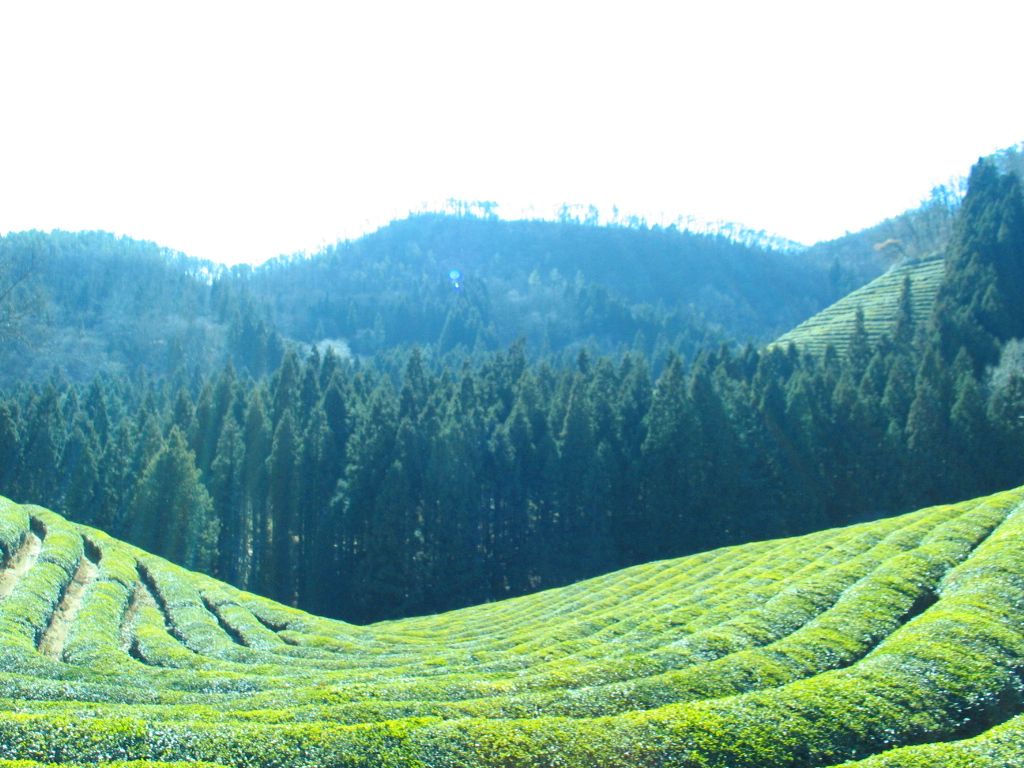 Photo: Cho's, CC BY-SA 3.0, via Wikimedia Commons
Boseong County lies on the southern coast of South Jeolla, mostly mountains and low hills with a narrow shoreline on Deungnyang Bay and, in the east, the tidal flats around the town of Beolgyo. The Encyclopedia of Korean Culture describes a mild, wet climate, one of the rainiest in Korea, and names tea and woven yongmunseok mats as the county's longstanding specialties. Two foods define it now: green tea and cockles.
The tea fields
Boseong's hillside plantations are the best-known image of Korean tea, but their history is modern. The Encyclopedia of Korean Culture records that in 1939, under Japanese colonial rule, Japanese tea specialists chose Boseong as Korea's best site for growing black tea, and in 1940 about 29.7 hectares were sown with seed of a tea variety the encyclopedia calls Benihomare, imported from India. Tea plants want warmth and plenty of rain, the encyclopedia explains; Boseong falls a little short on rainfall, but sitting where continental and maritime climates meet, it gets frequent fog that keeps the leaves moist.
Expansion began in 1957 and accelerated in the late 1970s and early 1980s as demand for green tea grew. The county's tourism site says the Daehan Dawon plantation, the best-known estate, began cultivation in 1957 and calls it Korea's oldest tea field; its terraces cover some 1.5 million pyeong (about 500 hectares) according to the county. The encyclopedia describes Boseong-eup's estate as the largest tea field in the country. The county also states that Boseong produces about 37 percent of Korea's tea and that Boseong green tea was registered as the nation's first geographical indication, a protected regional name. These are the county's own figures; production shares shift from year to year.
Tea culture here is festive as well as agricultural. The Boseong Dahyang Festival began in 1975 as the county's first civic day and has grown, the encyclopedia says, into Korea's largest tea festival, held each May with a tea-spirit rite, tea ceremonies, leaf-picking and tea-making sessions and a national student tea-etiquette contest. For the wider story of tea in Korea, see Korean tea culture and traditional Korean teas.
Beolgyo and its cockles
Beolgyo, in the county's southeast, faces the mudflats of Yeoja Bay, shared with Yeosu and Suncheon. Its fame is kkomak, the granular ark cockle (Tegillarca granosa). The Encyclopedia of Korean Culture describes a small, thick-shelled clam with deep radiating ribs and reddish flesh that lives in soft mud in the sheltered intertidal zones of the west and south coasts and spawns in July and August. Old sources prize it: the folk encyclopedia notes that the early-nineteenth-century Jasan eobo calls the flesh yellow and sweet, and that the fifteenth-century gazetteer Dongguk yeoji seungnam lists cockles among the local products of Boseong.
Beolgyo has a special place in that geography. The encyclopedia's entry on kkomak-hoe names Boseong Bay and Suncheon Bay as the main producing areas and says Beolgyo produces so many cockles that they are set out at every large feast and ancestral rite. The county's tourism site credits Yeoja Bay's sand-free, sticky, unpolluted and nutrient-rich mud, and passes on the local saying that cockles taste best when the azaleas bloom. Its claim that Beolgyo cockles were one of eight dishes on the king's table is local branding rather than documented history. A cockle festival is held each late autumn.
Literature helped too. The folk encyclopedia notes that older texts spelled the name gomak, and that Jo Jung-rae's popular 1980s novel Taebaek Mountains, set partly in Beolgyo, made the word kkomak familiar nationwide; the town now has a literary museum devoted to the novel.
Eating cockles
Cockles are scrubbed and soaked in lightly salted water to purge grit, then boiled briefly, stirring in one direction, just until the shells loosen. The folk encyclopedia describes the classic way to serve them: one shell removed, the meat left in the other, and each topped with soy sauce seasoned with chili flakes, green and red chili, garlic, green onion and sesame. Shucked cockles are also tossed with chogochujang and minari. In Beolgyo restaurants, the county says, a cockle set meal brings them boiled, seasoned, in pancakes, in soy-sauce marinade, in doenjang soup and even sweet-and-sour. See kkomak-muchim. Shellfish must be very fresh and properly cooked; see food safety at home.
Sources
- 01보성군 (Boseong-gun) — Encyclopedia of Korean Culture
- 02보성다향대축제 (Boseong Dahyang Festival) — Encyclopedia of Korean Culture
- 03보성특산물: 녹차 (Boseong specialties: green tea) — Boseong County Culture and Tourism
- 04꼬막회 (Kkomak-hoe) — Encyclopedia of Korean Culture
- 05꼬막무침 (Kkomak-muchim) — Encyclopedia of Korean Folk Culture, National Folk Museum of Korea
- 063미 벌교꼬막 (Beolgyo cockles) — Boseong County Culture and Tourism