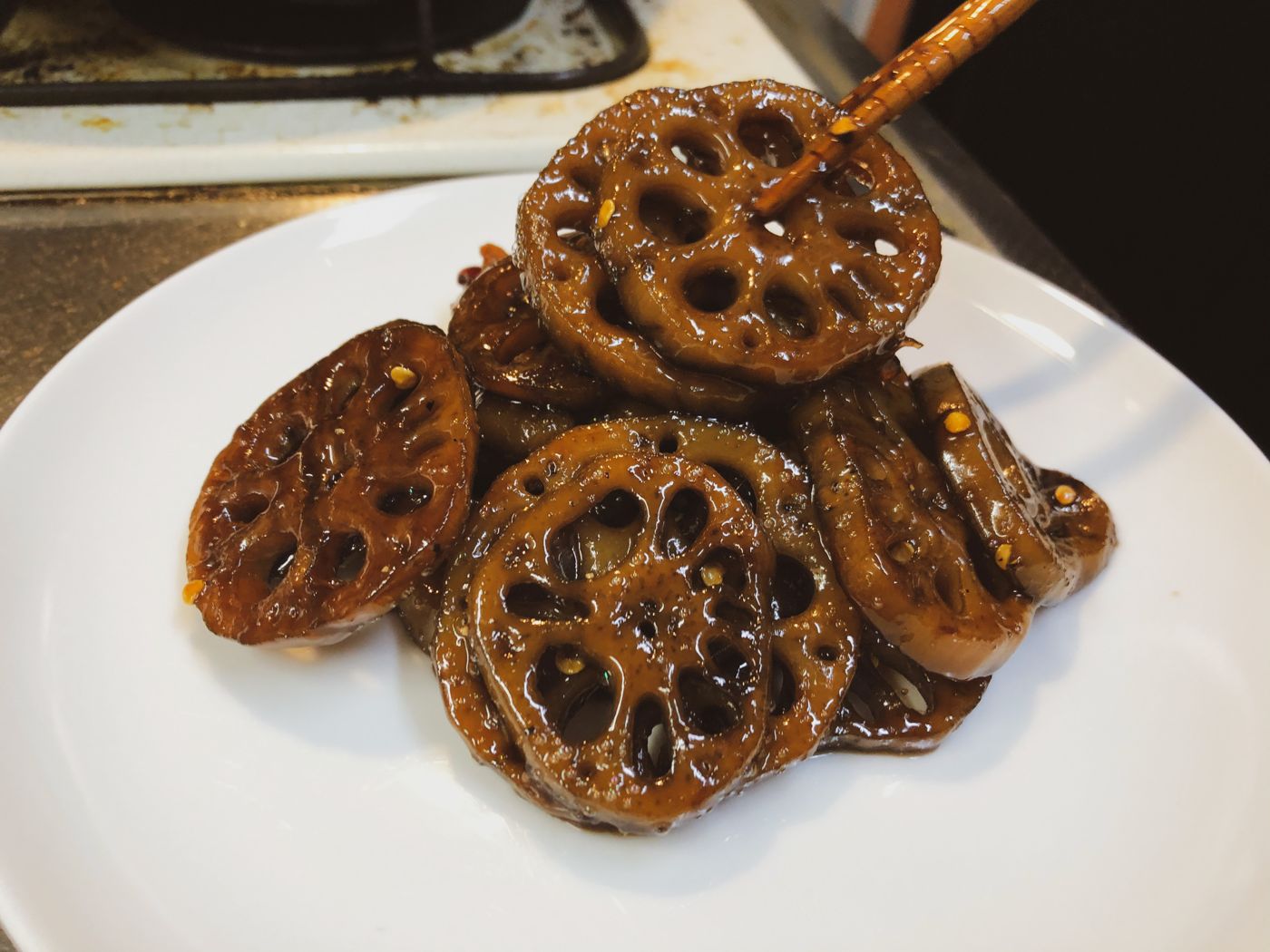
 Photo: EAT&ART TARO, CC BY-SA 4.0, via Wikimedia Commons
Jorim · Braised 조림
Yeongeun Jorim
연근조림
Romanization: yeongeun-jorim
Rounds of lotus root simmered in soy sauce and glazed with syrup until glossy and pleasantly chewy, with a crisp bite and lace-like pattern of holes.
- Serves
- 6
- Prep
- 15 min
- Cook
- 35 min
Recipe
Ingredients · Serves 6
- 400 gLotus rootpeeled and cut into 5 mm rounds
- 1 tbspVinegarfor soaking and blanching
- 1 pieceDashima (dried kelp)about 5 × 5 cm
- 300 mlWater
- 1 tbspNeutral cooking oil
- 3 tbspSoy sauce
- 1 tbspSugar
- 3 tbspMulyeot (rice or corn syrup)
- 1 tspToasted sesame oil
- 1 tbspToasted sesame seeds
Method
Technique: Jorim: Braising in Seasoned Liquid
Step 1: As you slice the lotus root, drop the rounds into a bowl of cold water with half the vinegar to stop them from browning.
Step 2: Bring a pot of water to a boil with the remaining vinegar. Blanch the lotus root for about 5 minutes to remove astringency, then drain and rinse in cold water. Meanwhile, soak the dashima in the 300 ml water.
Step 3: Heat the oil in a wide pan over medium heat and stir-fry the lotus root for 2 minutes.
Step 4: Add the kelp water (with the dashima), soy sauce and sugar. Bring to a boil, then simmer uncovered over medium-low heat for 20–25 minutes, stirring occasionally. Remove the dashima once it softens.
Step 5: When only a few spoonfuls of liquid remain, add the syrup and keep turning the slices over medium heat for 3–5 minutes, until they are glossy and evenly coated.
Step 6: Turn off the heat and toss with the sesame oil and sesame seeds. Serve at room temperature or chilled.
Origin & History
Lotus root (yeongeun) is the swollen underground stem of the lotus, which creeps through pond mud and thickens in autumn. Because the lotus is closely associated with Buddhism, it was widely grown in temple grounds and in ponds, and its root has long been eaten in Korea.
The root is starchy, with a firm, crisp texture and a pattern of air channels that makes every slice look like lace. Cut it and fine, silky threads stretch between the pieces. Traditional Korean uses include braising (jorim), candying the slices in honey or syrup as jeonggwa, and extracting a fine starch.
In yeongeun-jorim, the slices are first blanched — a little vinegar in the water keeps the flesh white — and then simmered in soy sauce until the liquid is nearly gone. A final glaze of syrup gives the dish its shine and its sweet-salty, slightly chewy character.
Key Ingredients
- Lotus root연근The crunchy, lace-patterned rhizome of the lotus plant. Sliced into rounds, it is simmered in soy sauce and syrup until glossy and chewy as yeongeun-jorim.
 Soy sauce간장Korean soy sauce, in two main kitchen forms: pale, salty guk-ganjang (soup soy sauce) brewed the traditional way from meju, and darker, sweeter jin-ganjang for braises and marinades.
 Korean grain syrup물엿A clear, glossy syrup used to sweeten and glaze braised and stir-fried banchan. Its traditional relative, jocheong, is a darker malt syrup made by slowly boiling down saccharified rice.
 Dashima (dried kelp)다시마Thick, dried kelp that gives Korean broths their quiet savory depth. Beyond the stockpot it is fried into crisp twigak, simmered into soy-glazed side dishes and used as a wrap.
 Sesame참깨Toasted sesame seeds and sesame oil (chamgireum) finish countless Korean dishes, adding a nutty aroma and gloss.
Nutrition
| Calories | ~125 kcal |
|---|---|
| Protein | ~2.7 g |
| Fat | ~3.9 g |
| Carbohydrates | ~22 g |
| Fiber | ~3.5 g |
| Sodium | ~470 mg |
Notable forFiber · Vitamin C · Potassium
Estimated by summing USDA FoodData Central values for the raw ingredients (lotus root, raw, FDC 169250; soy sauce, FDC 174277; corn syrup, light, FDC 168837; oil, sugar and sesame) and dividing by six servings. Blanching and braising reduce vitamin C, so the cooked dish likely contains noticeably less than the raw-ingredient total. Actual values vary with ingredients, portion size and preparation.
Health Benefits
- Lotus root is a source of dietary fiber and potassium, and raw lotus root is rich in vitamin C, some of which survives cooking.
- In traditional Korean and East Asian medicine, lotus root has been valued for its astringent qualities, attributed to its tannins; these are traditional beliefs rather than established clinical effects.
- The dish offers a satisfying crunch with little fat.
Regional Variations
- Crisp or chewy: a short braise keeps the lotus root crunchy; a longer, slower one makes it chewy and deeply colored.
- Glaze: mulyeot, rice syrup (jocheong) or honey are used for the final gloss; some cooks add a piece of dashima (kelp) to the braising liquid.
- Jeonggwa: a related, much sweeter preparation candies lotus root slices in syrup or honey as a traditional confection rather than a side dish.
Pairings
 Japchae (Glass Noodles with Vegetables)잡채Chewy sweet potato glass noodles tossed with stir-fried vegetables, mushrooms and beef in soy sauce and sesame oil — Korea's essential celebration dish.
 Sigeumchi Namul시금치나물Spinach blanched for a few seconds, squeezed dry and dressed with garlic, soy sauce and sesame — one of the simplest and most familiar namul.
 Gyeran Mari (Rolled Omelet)계란말이Beaten egg cooked in thin layers and rolled into a soft, striped log, then sliced — a gentle, everyday banchan and a lunchbox classic.