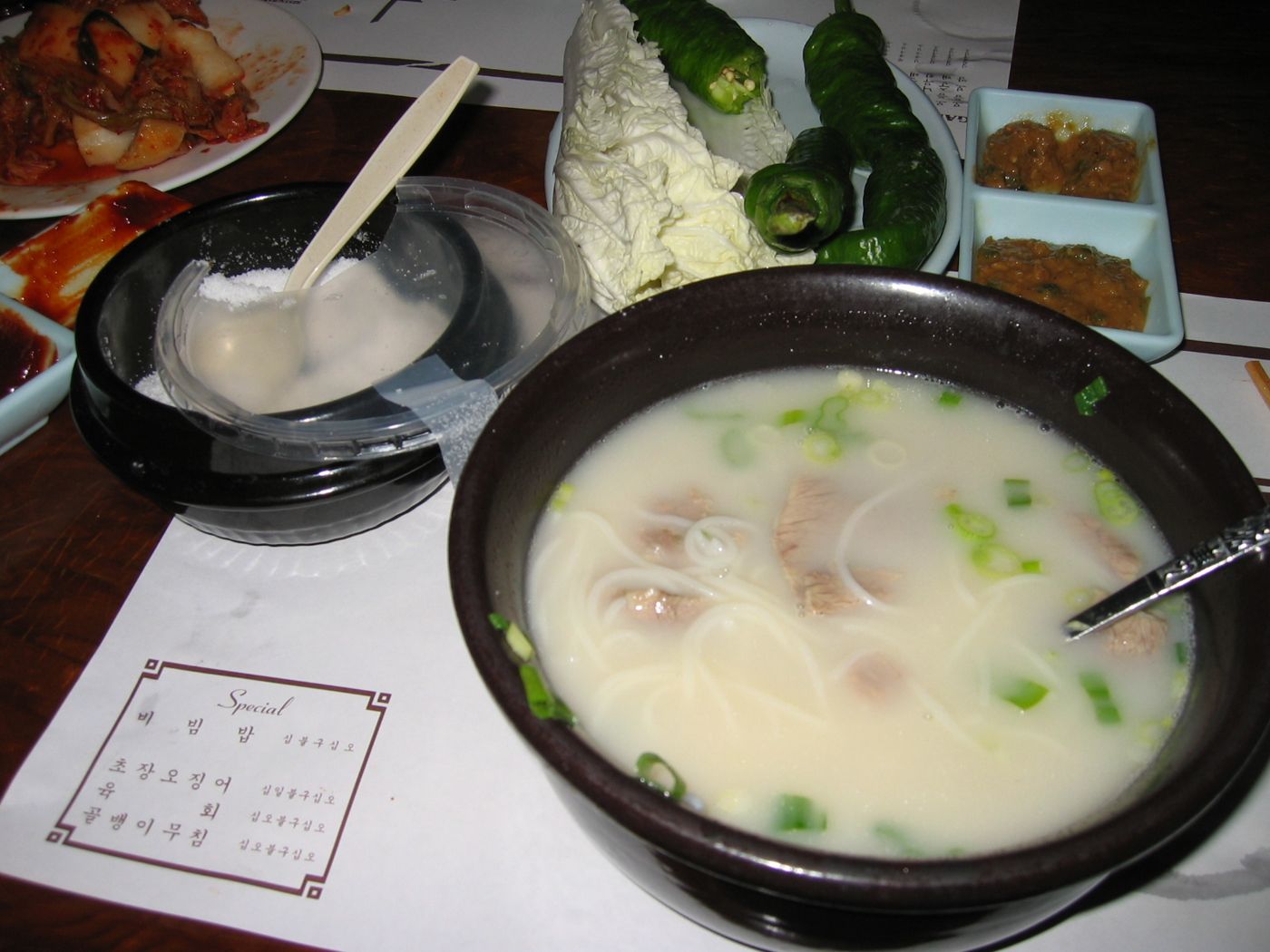
 Photo: Mike Chung, CC BY 2.0, via Wikimedia Commons
Guk & Tang · Soups 국·탕
Seolleongtang (Ox Bone Soup)
설렁탕
Romanization: seolleongtang
Ox bones and beef simmered for hours into a milky-white broth, served unsalted over rice with sliced meat — each diner seasons it at the table.
- Serves
- 6
- Prep
- 150 min
- Cook
- 480 min
RegionSeoul & Gyeonggi
Jump to recipeRecipe
Ingredients · Serves 6
- 2 kgOx leg bones (sagol)cut into pieces
- 600 gBeef brisket (yangji)
- 6 lWaterplus more for topping up
- 4 stalksGreen onionfinely chopped, for serving
- 150 gSomyeon (thin wheat noodles)cooked; optional
- 6 bowlsCooked rice
- to tasteSalt and black pepperat the table
Method
Technique: Making Guk and Jjigae, Making Yuksu: Anchovy-Kelp Stock
Step 1: Soak the bones and brisket in cold water for 2 hours, changing the water once or twice, to draw out the blood.
Step 2: Put the bones in a large stockpot, cover with water and boil hard for 10 minutes. Drain, discard the water and rinse the bones and pot.
Step 3: Return the bones to the pot with 6 liters of fresh water. Bring to a boil, then keep at a steady, rolling simmer for 6–8 hours, topping up with boiling water to keep the bones covered. The vigorous simmer is what turns the broth white.
Step 4: Add the brisket for the last 2 hours. When it is tender, lift it out, wrap it so it doesn't dry out and let it cool, then slice thinly against the grain.
Step 5: Strain the broth. If time allows, chill it overnight and lift off the solid fat; otherwise skim well.
Step 6: To serve, put rice (and noodles, if using) and a few slices of brisket in each bowl, ladle the boiling broth over and scatter with green onion. Set out salt, pepper and kkakdugi for each diner to season the soup.
Origin & History
Seolleongtang is made by simmering ox bones with beef — traditionally head, feet, brisket and offal too — for many hours until the broth turns opaque and white; one written form, 雪濃湯, means "snow-thick soup." It is a Seoul dish through and through. By the 1920s it was a famous cheap meal of the capital: a 1929 magazine essay praised Seoul's seolleongtang as a local specialty worthy of national fame, and the Encyclopedia of Korean Folk Culture notes that Imun Seolleongtang, behind the old Hwashin department store, is the survivor of many renowned shops.
Where the name comes from is a matter of legend. The best-known story ties it to Seonnongdan, the altar in eastern Seoul where Joseon kings honored the god of agriculture and ceremonially plowed a field. One version says the king had the sacrificial ox made into soup for elderly onlookers; another, recorded in Hong Seon-pyo's 1940 Joseon yorihak, says King Sejong was stranded by heavy rain and had the plow ox boiled in plain water for his hungry retinue — seonnong-tang becoming seolleongtang. No contemporary record confirms either story.
A rival theory points to the Mongols. The food historian Lee Seong-u noted that an eighteenth-century Mongolian glossary, Mongeo yuhae, renders plain meat broth (gongtang) as shulu, and argued that Mongol meat cookery arriving in late Goryeo gave Korea both gomtang and the word seolleongtang; he considered the Seonnongdan link a stretch. This too is a hypothesis. The late-nineteenth-century Siuijeonseo does describe a soup of leg bones, shank, knee cartilage, tail and tripe much like today's.

Nutrition
| Calories | ~120 kcal |
|---|---|
| Protein | ~21.3 g |
| Fat | ~2.9 g |
| Carbohydrates | ~1.8 g |
| Fiber | Not reported |
| Sodium | ~110 mg |
Notable forProtein · Selenium · Zinc
Bone broth cannot be estimated reliably from raw ingredients, so these figures are scaled from the MFDS analysis of home-style seolleongtang (per 100 g: 24 kcal, 4.26 g protein, 0.58 g fat, 0.36 g carbohydrate, 1.0 g fiber as reported, 22 mg sodium, 3.91 µg selenium, 0.64 mg zinc) to the database's 500 g serving. Salt added at the table is extra: each ½ tsp (about 3 g) adds roughly 1,160 mg sodium (USDA FDC 173468). The source lists about 5.0 g of fiber per serving, which is implausible for a meat broth, so fiber is shown as not reported. Actual values vary with ingredients, portion size and preparation.
Health Benefits
- As analyzed, the unsalted broth with meat is high in protein and low in fat and calories once the fat is skimmed.
- The MFDS analysis also shows it supplies zinc and selenium.
Regional Variations
- Seolleongtang vs. gomtang: the two have blurred, but seolleongtang traditionally uses more bones (hence the whiter broth) and is left unseasoned, while gomtang leans on meat and offal and is seasoned in the pot.
- Seoul restaurant style: cold rice is put in the bowl and warmed by pouring hot broth over and draining it several times (toryeom), then topped with wheat noodles and sliced meat.
- At the table: salt, black pepper, chopped green onion and chili flakes are added to taste, and many diners pour in a little kkakdugi juice.
Pairings
 Cubed Radish Kimchi깍두기Korean radish cut into neat cubes and tossed with chili, garlic and salted shrimp — crunchy, juicy and a classic partner to rich soups.
 Napa Cabbage Kimchi배추김치Salted napa cabbage layered with a red paste of chili, garlic, ginger and fermented seafood, then left to ripen: the kimchi most people picture first.
Sources
- 01설렁탕 (Seolleongtang) — Encyclopedia of Korean Culture
- 02설렁탕 (Seolleongtang) — Encyclopedia of Korean Folk Culture (한국의식주생활사전)
- 03설렁탕 (Seolleongtang, home-style, analyzed) — MFDS K-FIND food composition database
- 04Salt, table (FDC 173468) — USDA FoodData Central
- 05Sodium reduction — World Health Organization fact sheet
Last updated