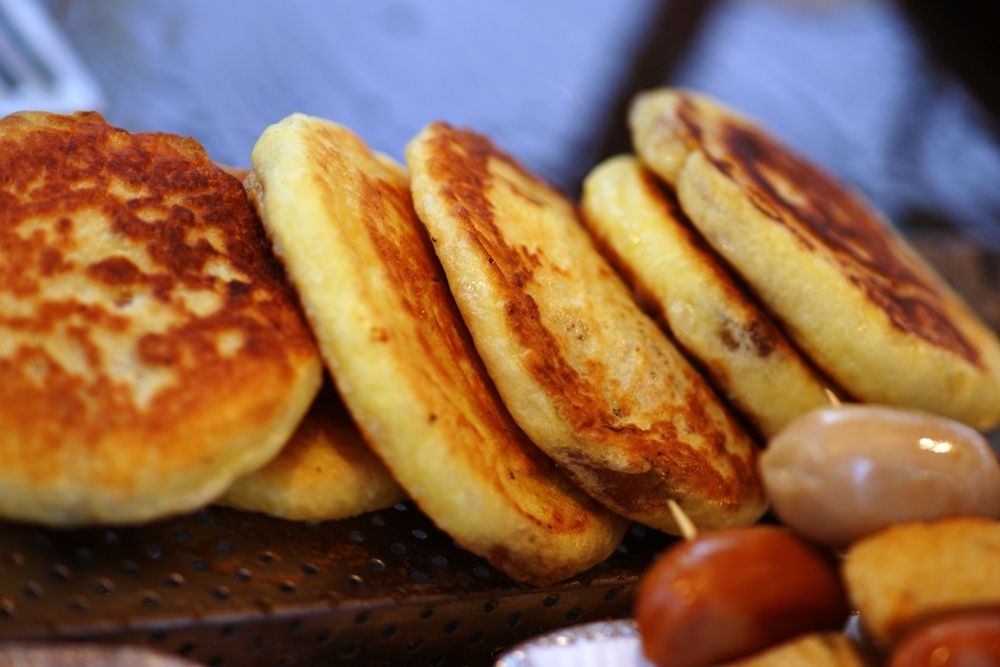
 Photo: Korea.net / Korean Culture and Information Service, CC BY-SA 2.0, via Wikimedia Commons
Tteok & Sweets 떡·과자
Hotteok (Sweet Filled Pancakes)
호떡
Romanization: hotteok
Yeasted dough wrapped around brown sugar, cinnamon and nuts and pressed flat on an oiled griddle — a winter street snack brought to Korea by Chinese immigrants.
- Serves
- 8
- Prep
- 25 min
- Cook
- 25 min
RegionBusan
Jump to recipeRecipe
Ingredients · Serves 8
- 250 gAll-purpose flouror 200 g flour plus 50 g glutinous rice flour for a chewier dough
- 1 tspInstant yeastabout 4 g
- 1 tbspSugarfor the dough
- ½ tspSalt
- 200 mlLukewarm milk or water
- 1 tbspNeutral cooking oilfor the dough, plus about 3 tbsp for frying
- 100 gDark brown sugarfor the filling
- 1 tspGround cinnamonfor the filling
- 3 tbspChopped peanuts, walnuts or sunflower seedsfor the filling
Method
Technique: Jeon: Pan-Frying in Flour and Egg
Step 1: Mix the flour, yeast, sugar and salt in a bowl. Add the milk and 1 tbsp oil and stir into a soft, sticky dough. Cover and leave in a warm place for about 1 hour, until doubled. Punch down and rest 10 minutes more.
Step 2: Mix the brown sugar, cinnamon and nuts for the filling.
Step 3: Oil your hands well. Divide the dough into 8 pieces. Flatten one piece in your palm, put about 1½ tbsp filling in the center, and pull the edges up and pinch them together to seal completely.
Step 4: Heat 1 tbsp oil in a skillet over medium-low heat. Place two or three balls seam side down and cook for about 1 minute, until lightly golden underneath.
Step 5: Flip and press each one flat to about 1 cm with an oiled hotteok press or a wide spatula. Cook 2 minutes until golden, flip again, cover, and cook 1–2 minutes more so the sugar melts. Repeat with the rest, adding oil as needed.
Step 6: Let cool for a minute before eating; the filling is molten. Fold in half on a paper cup or napkin to eat on the go.
Origin & History
Hotteok are discs of soft, yeasted wheat dough filled with brown sugar, cinnamon and often chopped nuts, pressed flat and fried on an oiled griddle until the sugar melts into syrup. Despite the tteok in the name, they are not rice cakes. The Encyclopedia of Korean Culture traces the food to the flatbreads that reached China from Central Asia in the Han dynasty; the ho (胡) refers to those western peoples, and the Encyclopedia of Korean Folk Culture calls the popular idea that it means "Qing Chinese" a folk etymology. The late-Joseon miscellany Songnam japji already explains the word this way.
Hotteok came to Korea with Chinese immigrants after the 1882 trade treaty between Joseon and Qing China. By 1889 a hotteok shop run by a Cantonese immigrant was operating in Seoul; there were 17 by 1906, 203 by 1923, and, according to the Encyclopedia of Korean Culture, 1,139 Chinese-run hotteok shops across the country by October 1930. Cheap and filling, they were popular with ordinary Koreans and with Chinese laborers, and newspapers serialized essays and stories set in them. The shops suffered in the anti-Chinese riots of 1927 and 1931 but thrived through the 1950s and 1960s, when about 500 still operated in the big cities.
Those early hotteok were baked in a clay oven. The folk encyclopedia dates today's griddle-fried style to the 1970s, when mass-produced cooking oil became common, and the Encyclopedia of Korean Culture describes the street hotteok sold now as a Korean adaptation; in Chinese-speaking regions it is distinguished as brown-sugar cake. At the same time, steamed buns (hoppang) and tighter rules on ovens drove most Chinese hotteok shops out of business, leaving a few, such as one in Incheon's Chinatown, to carry on. Hotteok became a fixture of winter street carts and, later, of instant mixes sold with their own press. See Korean street food.
Nutrition
| Calories | 271 kcal |
|---|---|
| Protein | 5.7 g |
| Fat | 4.5 g |
| Carbohydrates | 52 g |
| Fiber | 1.4 g |
| Sodium | 266 mg |
Notable forThiamin
From the Korean Food Composition Table entry “Bread, Hotteok bun, Baked” (호떡; per 100 g: 301 kcal, 57.6 g carbohydrate including 23.5 g sugars, 5.0 g fat, 295 mg sodium, 0.20 mg thiamin), scaled to an assumed 90 g piece. The table describes a baked sample; griddle-fried street hotteok absorb more oil, so fat and calories will be higher. Thiamin likely reflects enriched flour. Actual values vary with ingredients, portion size and preparation.
Health Benefits
- A warm, shareable snack: hotteok is an occasional treat rather than a nutritious food; its pleasures are mainly cultural and seasonal.
- Nut fillings: versions filled with seeds and nuts add some unsaturated fat and minerals, and the seeds help hold the syrup in.
Regional Variations
- Ssiat-hotteok (Busan): fried in plenty of oil, split open and stuffed with peanuts, sunflower and pumpkin seeds; said to have begun on the streets of Nampo-dong in the 1980s.
- Classic brown-sugar hotteok: wheat or wheat-and-glutinous-rice dough with brown sugar and cinnamon, pressed flat on a lightly oiled griddle.
- Vegetable or japchae hotteok: savory fillings of vegetables and glass noodles appear in some regions.
- Baked Chinese-style: a few long-running Chinese bakeries still bake sugar-filled buns in an oven, closer to the original form.
Pairings
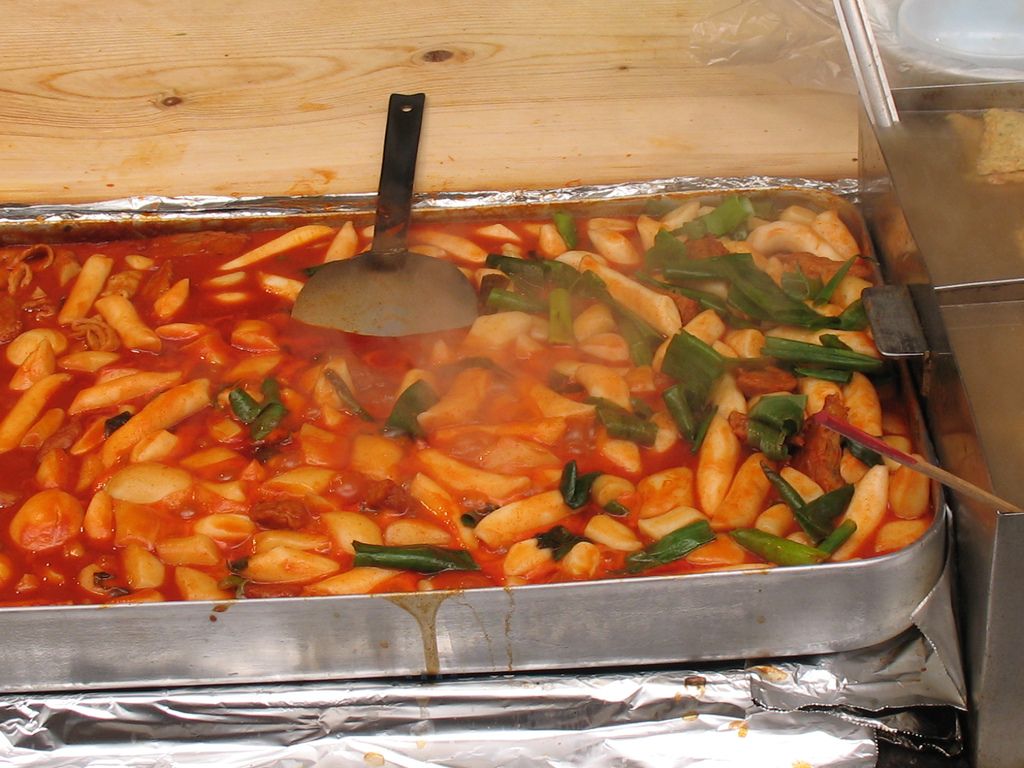 Tteokbokki (Spicy Stir-fried Rice Cakes)떡볶이Chewy rice cakes simmered in a sweet, fiery gochujang sauce with fish cake and green onion — a postwar street snack with roots in a refined soy-sauce court dish.
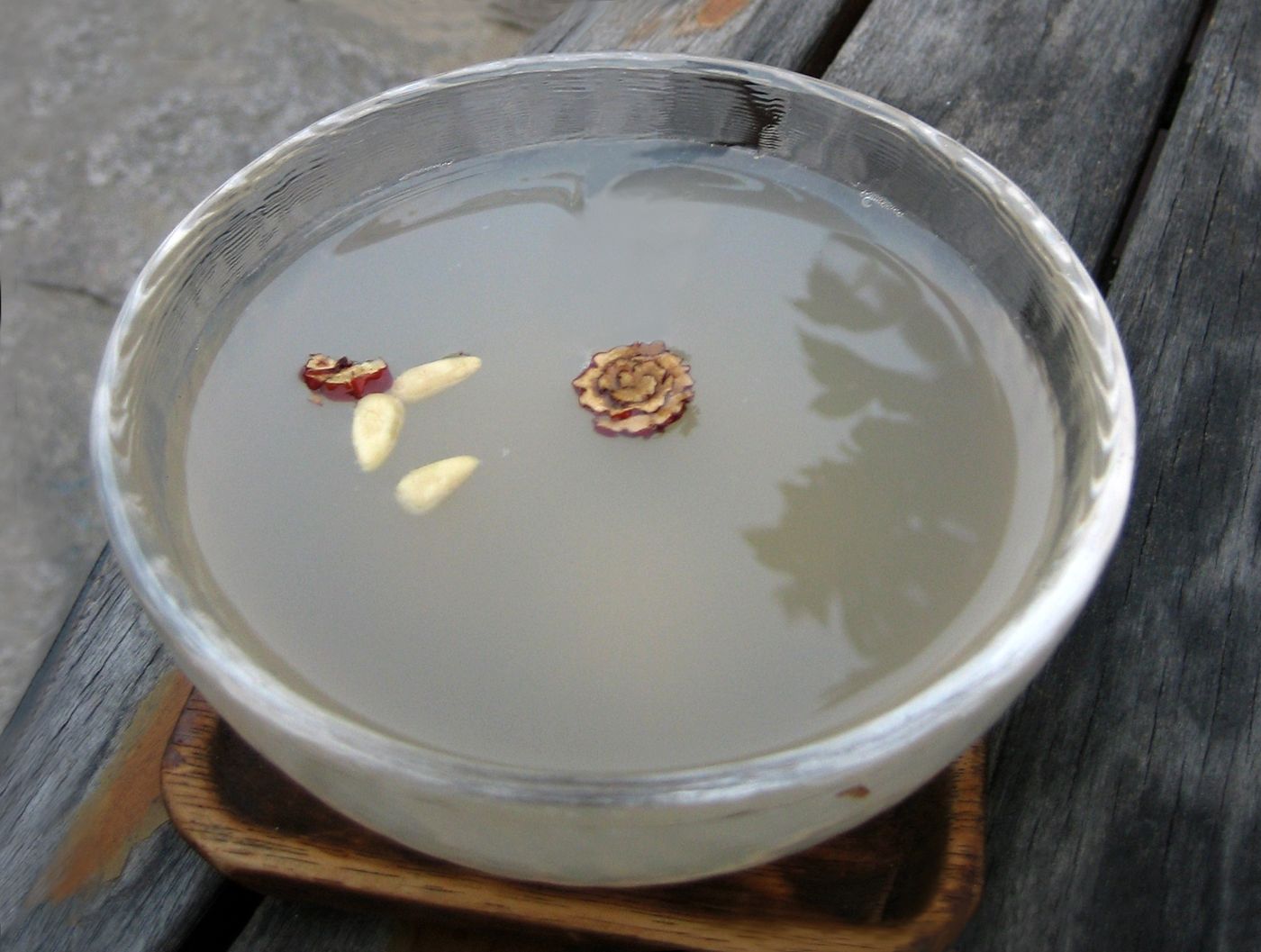 Sikhye (Sweet Malted Rice Drink)식혜Cooked rice steeped in barley-malt water until it sweetens and the grains float, then chilled — the traditional after-feast drink of Korean holidays.
Sources
- 01호떡 (Hotteok) — Encyclopedia of Korean Culture
- 02부산 남포동 씨앗호떡 (Busan Nampo-dong ssiat-hotteok) — Encyclopedia of Korean Culture
- 03호떡 (Hotteok) — Encyclopedia of Korean Folk Culture: Korean Food and Dwelling Life
- 04Bread, Hotteok bun, Baked (A0210290009a) — Korean Food Composition Table
- 05Healthy diet (fact sheet) — World Health Organization
Last updated