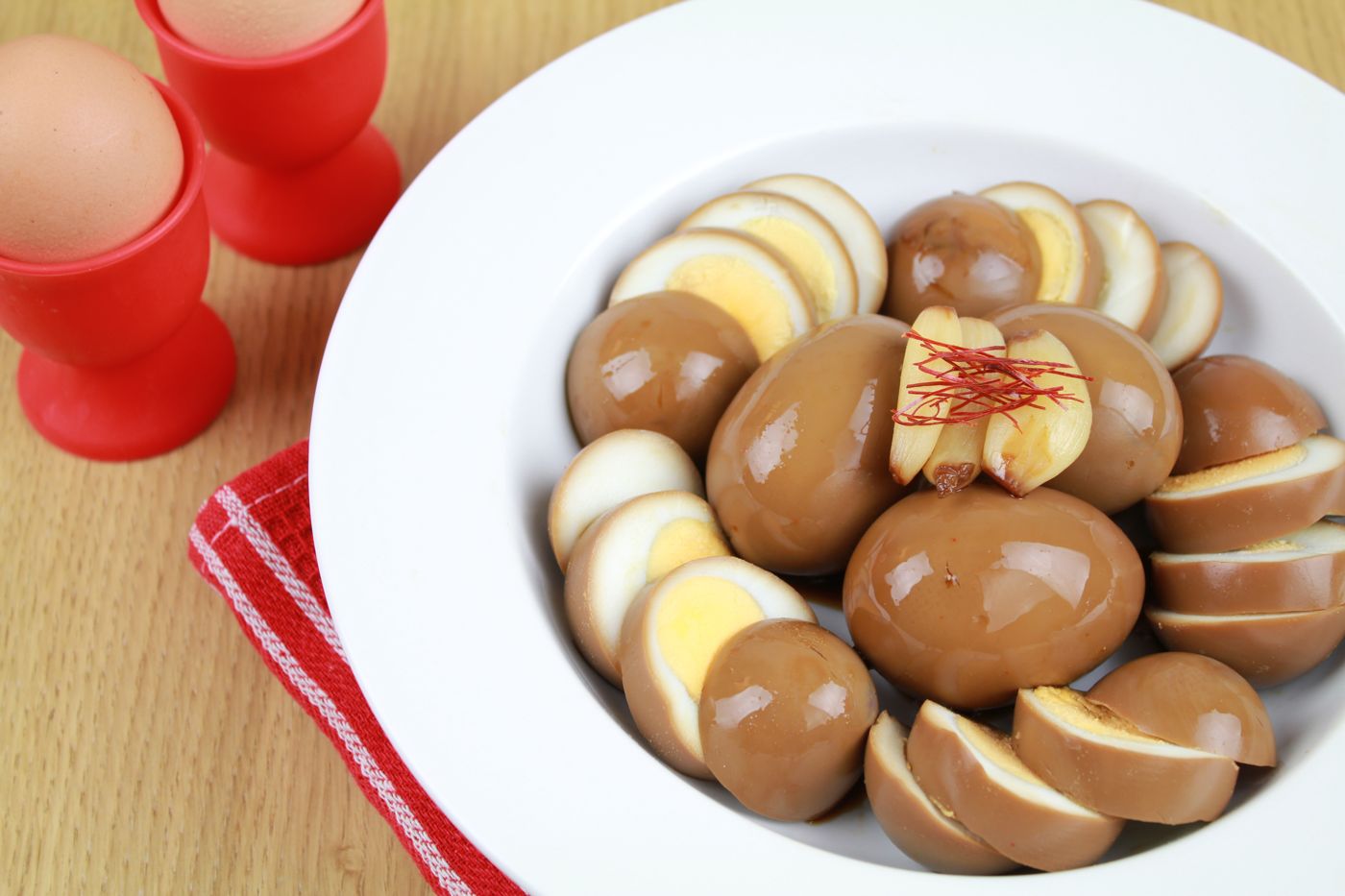
 Photo: Chloe Lim, CC BY 2.0, via Wikimedia Commons
Jorim · Braised 조림
Gyeran Jangjorim (Soy-Braised Eggs)
계란장조림
Romanization: gyeran-jangjorim
Peeled hard-boiled eggs simmered in sweetened soy sauce with garlic and mild peppers until amber — a keep-in-the-fridge banchan for rice and lunchboxes.
- Serves
- 6
- Prep
- 15 min
- Cook
- 30 min
Recipe
Ingredients · Serves 6
- 6 Eggslarge
- 80 mlSoy sauce
- 400 mlWater
- 2 tbspSugar
- 6 clovesGarlicpeeled, whole
- 50 gKkwarigochu or other mild green chiliesoptional, about 6–8
- 1 pieceDashima (kelp)about 5 × 5 cm, optional
Method
Technique: Jorim: Braising in Seasoned Liquid
Step 1: Bring a pot of water to a boil, lower in the eggs and boil for 10–11 minutes for firm yolks. Transfer to cold water, then peel.
Step 2: In a small saucepan, combine the soy sauce, water, sugar, garlic and kelp. Bring to a boil and simmer for 5 minutes; remove the kelp.
Step 3: Add the peeled eggs and simmer over medium-low heat for 15–20 minutes, rolling them every few minutes so they color evenly.
Step 4: Add the peppers (pierced once with a fork) for the last 3–4 minutes, just until they soften.
Step 5: Let the eggs cool in the liquid. Transfer to a clean container with the braising liquid, cover and refrigerate; the color deepens overnight.
Step 6: To serve, halve or slice the eggs and spoon over a little of the liquid. Eat within about a week.
Origin & History
Jangjorim means foods braised down in soy sauce (jang) until well seasoned and able to keep. Beef has always been the classic choice, but the National Folk Museum's encyclopedia notes that chicken, pheasant and pork were also used, and that eggs belong to the family too. The first full recipes appear in the late-nineteenth-century cookbook Siuijeonseo, which braises beef in aged soy sauce until nearly dry and also gives a pheasant jangjorim cooked together with beef and peeled boiled eggs.
Interestingly, that pheasant recipe is the only early cookbook appearance of boiled eggs in jangjorim; later twentieth-century cookbooks leave them out, and the whole garlic and chilies common today are not found in the old texts at all. Sweetening shifted from honey in Siuijeonseo to sugar by the 1934 Ganpyeon Joseon yori jebeop, and over time recipes kept more of the braising liquid instead of reducing it to nothing.
Even so, boiled eggs are now one of the most familiar parts of jangjorim, cooked on their own or alongside beef, and quail eggs (mechurial-jangjorim) are a common variant. The dish is a typical mitbanchan: a side made in a batch, kept in the refrigerator and brought out at meal after meal.
Key Ingredients
 Soy sauce간장Korean soy sauce, in two main kitchen forms: pale, salty guk-ganjang (soup soy sauce) brewed the traditional way from meju, and darker, sweeter jin-ganjang for braises and marinades.
 Garlic마늘Used raw, minced, pickled and roasted, garlic is one of the essential aromatics of Korean food — in seasonings, marinades, kimchi and namul.
- Korean Chili Peppers (Fresh)고추Fresh Korean chili peppers, eaten green (putgochu) or red (hong-gochu): from the fiery cheongyang-gochu to the small, wrinkled, mild kkwari-gochu that is braised and stir-fried as banchan.
 Dashima (dried kelp)다시마Thick, dried kelp that gives Korean broths their quiet savory depth. Beyond the stockpot it is fried into crisp twigak, simmered into soy-glazed side dishes and used as a wrap.
Nutrition
| Calories | ~115 kcal |
|---|---|
| Protein | ~8.6 g |
| Fat | ~4.4 g |
| Carbohydrates | ~9.7 g |
| Fiber | ~0.5 g |
| Sodium | ~798 mg |
Notable forProtein · Selenium · Riboflavin · Folate
Eggs use the Korean Food Composition Table entry “Egg (Dalgyal), Whole, Boiled” (per 100 g: 145 kcal, 13.5 g protein, 36 µg selenium, 0.25 mg riboflavin, 67 µg folate), at about 50 g of edible egg each. Soy sauce uses the Korean table's fermented soy sauce; peppers use the table's shishito entry; sugar and garlic use USDA FoodData Central. Totals divided by six. Sodium and carbohydrate are upper bounds because they assume all the braising liquid and sugar are eaten; in practice much of the liquid is left behind. Actual values vary with ingredients, portion size and preparation.
Health Benefits
- Complete protein: eggs supply all the essential amino acids, and the Korean folk encyclopedia notes their reputation as a near-complete food.
- Selenium, riboflavin and folate: an egg is a good source of selenium and contributes riboflavin, folate and some vitamin D.
- Practical nutrition: a batch of braised eggs keeps for days and adds protein to quick meals and lunchboxes.
Regional Variations
- Egg only: hard-boiled eggs braised with soy sauce, sugar, garlic and often a few mild peppers, as here.
- With beef: eggs added to a pot of beef jangjorim (lean eye of round or shank), so they take on a meatier flavor; see jangjorim.
- Quail eggs: small peeled quail eggs braised the same way — popular in lunchboxes.
- Dry or saucy: Siuijeonseo reduced its jangjorim until almost dry, while later cookbooks preferred to leave the food just covered in liquid — a range home cooks still choose between.
Pairings
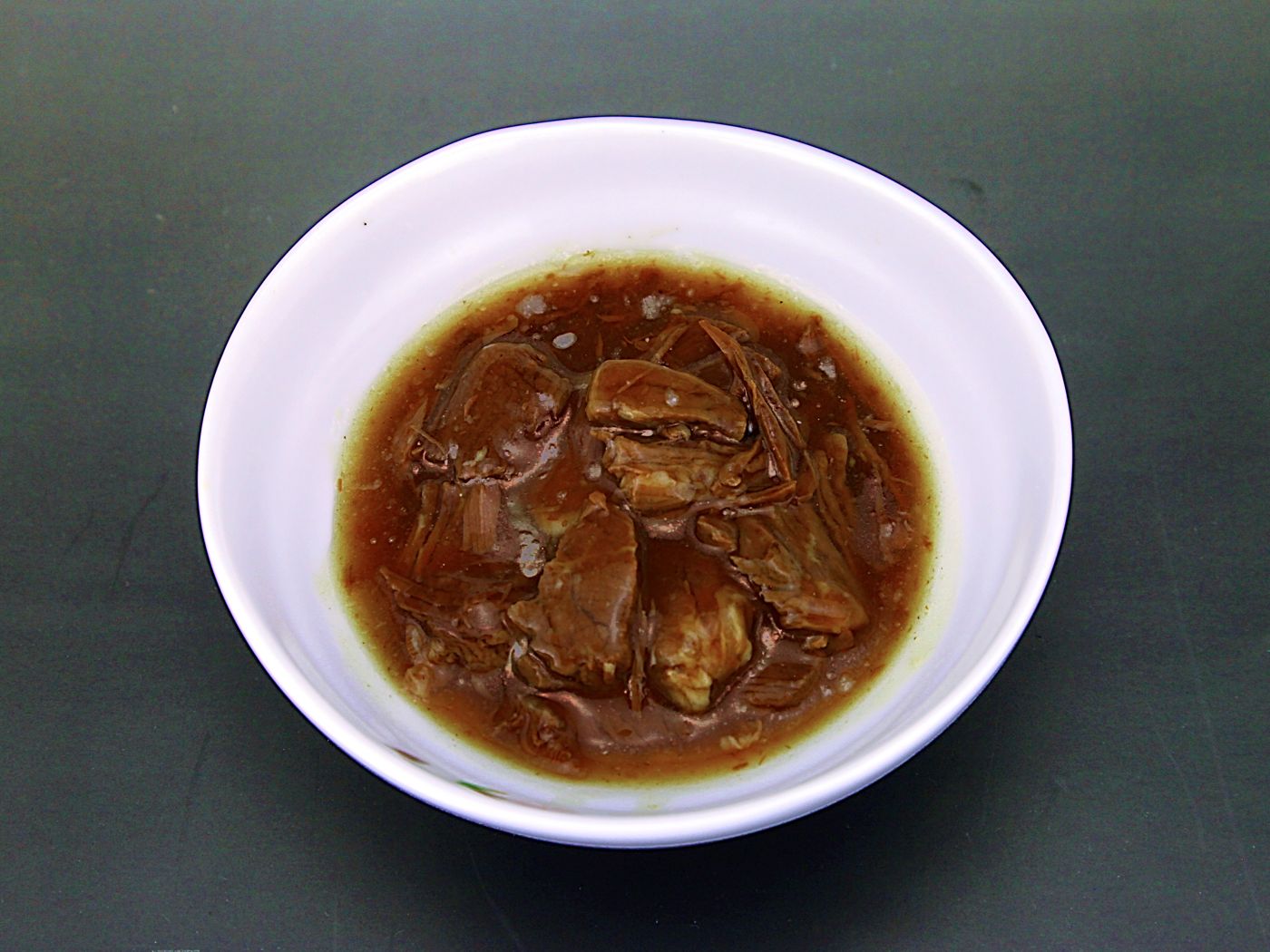 Jangjorim장조림Lean beef simmered in soy sauce until tender, then torn into strands and served in its savory broth, often with eggs, garlic and mild peppers.
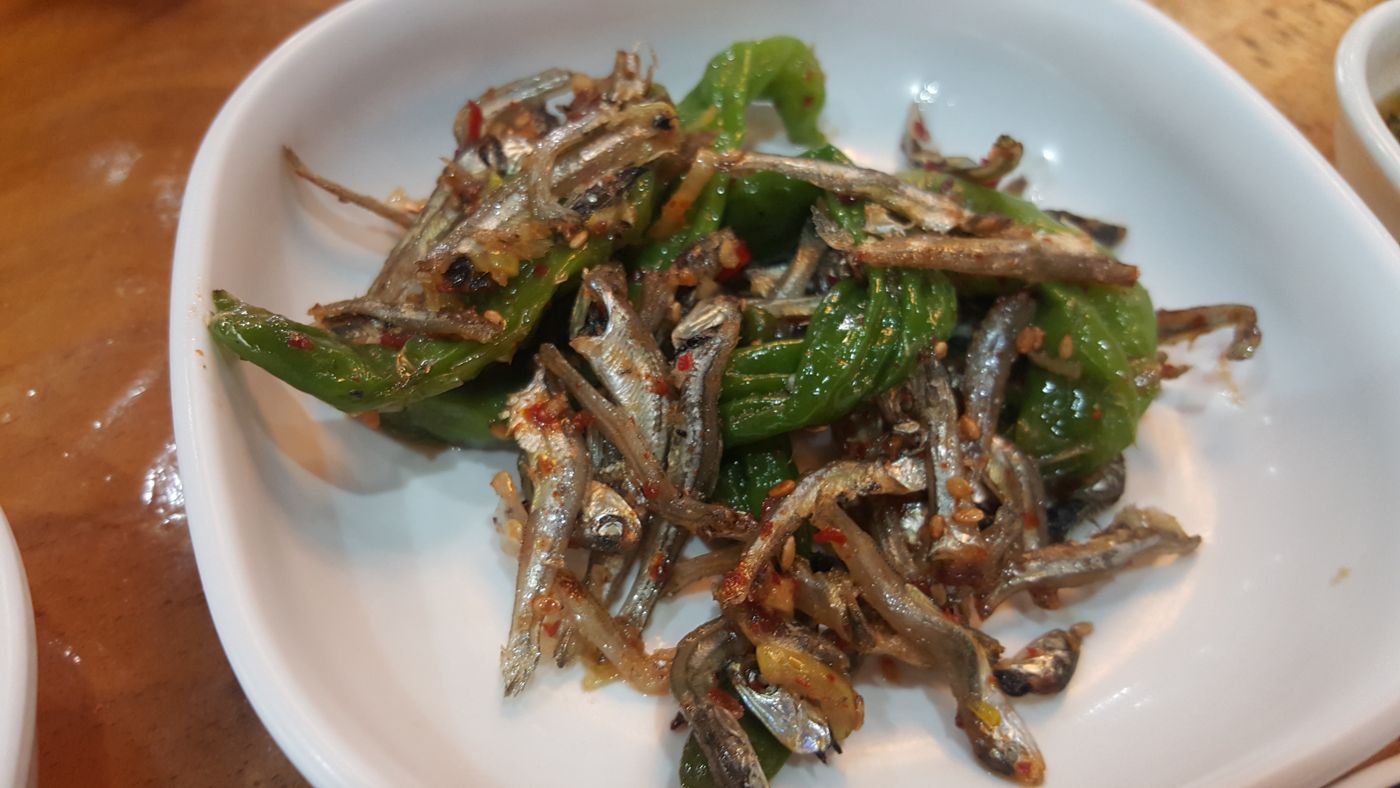 Kkwarigochu Myeolchi Bokkeum (Shishito Peppers with Anchovies)꽈리고추멸치볶음Small dried anchovies and wrinkled shishito-type peppers glazed in soy sauce and rice syrup — a sweet, salty, gently grassy lunchbox staple.
 Kongnamul Muchim콩나물무침Soybean sprouts cooked under a lid until just tender, then tossed with garlic, green onion and sesame oil — crisp, nutty and on tables across Korea.
Sources
- 01장조림 (Jangjorim) — Encyclopedia of Korean Folk Culture (National Folk Museum of Korea)
- 02장조림 (Jangjorim) — Encyclopedia of Korean Culture
- 03메추리알장조림 (Quail egg jangjorim) — Urimalsaem (National Institute of Korean Language)
- 04Korean Food Composition Table: Egg (Dalgyal), Whole, Boiled — National Institute of Agricultural Sciences
- 05What You Need to Know About Egg Safety — U.S. Food and Drug Administration
- 06Food Allergies — U.S. Food and Drug Administration
Last updated