Travel
Templestay and Temple Food
템플스테이와 사찰음식
What a Templestay involves, how the formal monastic meal (barugongyang) works, and why temple food leaves out the five pungent vegetables.
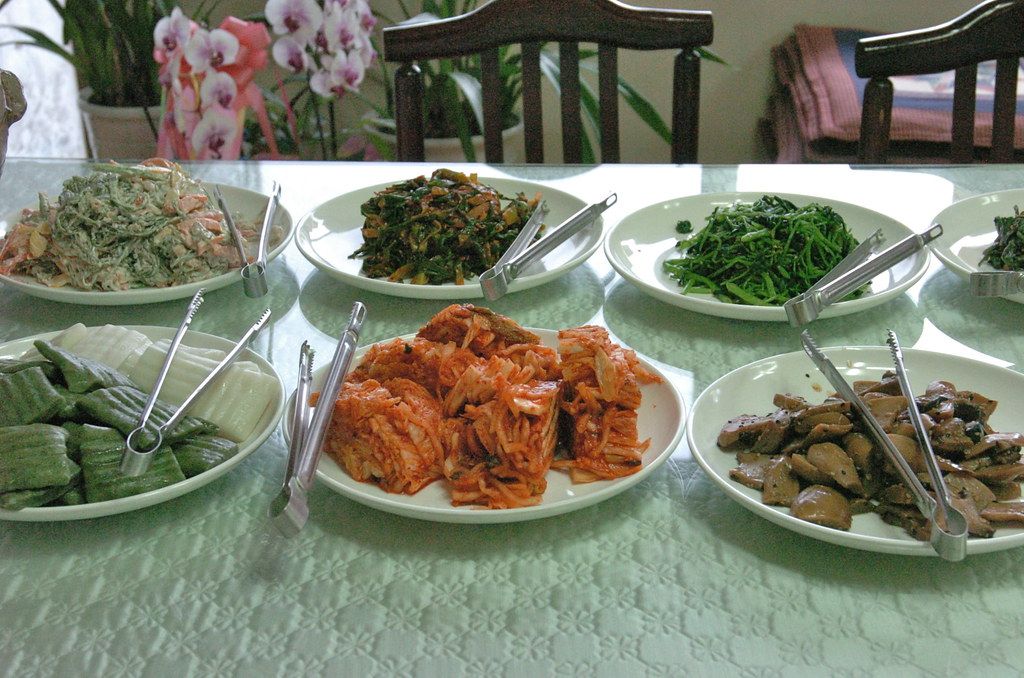 Photo: USAG-Humphreys, CC BY 2.0, via Flickr
Templestay (템플스테이) is a program that lets visitors spend a day or a night at a working Buddhist temple. Temple food (sachal-eumsik, 사찰음식) is a large part of it. This page explains what the program is like and what to expect at the table. The cuisine's history is in temple food.
What Templestay is
The official Templestay site describes it as a program of Buddhist culture and temple-life experiences meant to calm body and mind. Its search filter groups programs into day trips, experience stays, rest stays and group stays. VisitKorea describes the same split: experiential stays with hands-on activities, restful stays with minimal scheduling, and one-day programs of about three hours. Listed activities include meditation, 108 prostrations, early-morning chanting, tea with monks and meals in the formal style. Some temples offer cooking classes. The number of participating temples is not given as a single official total on the English site, so check the booking pages for the current list.
The temple table
Temple food is fully plant-based. VisitKorea says it follows the Buddhist principle of non-violence and so excludes animal ingredients, though dairy is allowed, and that it relies on natural seasonings such as mushrooms, kelp and perilla seeds. The Korea Herald adds that pepper, ginger and herbs stand in for the flavors other cooks get from aromatics. Fermented foods and wild or locally grown vegetables matter a great deal. For the building blocks, see doenjang, shiitake, dashima, perilla and gosari. Wellness context is in plant-based Korean eating.
The five pungent vegetables
Temple cooking avoids osinchae (오신채), the "five pungent vegetables." Sources agree on the idea but not entirely on the list. VisitKorea names green onions, garlic, chives, wild chives and Chinese squill; the Korea Herald lists onions, garlic, chives, green onions and leeks. The reason given is that strong-smelling alliums are believed to stir anger and desire and to distract from meditation. One practical result, per the Korea Herald, is temple kimchi made without garlic or fish products. If a dish at a temple looks like it should be sharper, this is why. See kimchi types for how ordinary kimchi differs.
Barugongyang, the formal meal
Barugongyang (발우공양) is the formal monastic meal. The Korea Herald describes it as eaten from baru, a set of four bowls for rice, soup, side dishes and water, with the water used at the end to clean the bowls. The rule is to take only what you need and leave nothing behind. Meals at a Templestay are typically quiet, and guests eat what is served rather than ordering. Elements to expect:
- Follow the monastic or staff instructions, since details vary from temple to temple.
- Take small portions first; you can ask for more.
- Finish what you take, including the final rinse.
Practical notes
VisitKorea lists etiquette points such as no outside food or smoking, entering the Buddha Hall by the side doors and walking behind anyone who is meditating or chanting. Dietary needs are easier to meet at a temple than in most restaurants, since the food is plant-based, but you should still tell the booking office about allergies; see allergens in Korean food and dietary needs in Korea. You can also taste temple food without staying overnight. VisitKorea mentions a temple-food restaurant run by the Jogye Order in Seoul and a temple-food center that offers classes; confirm current schedules before you go.
Related reading
For another kind of retreat, see jjimjilbang. For royal rather than monastic food, see royal court cuisine.