History & Culture
Hanjeongsik: The Full Korean Set Meal
한정식
The table-filling Korean set meal is younger than it looks: born in colonial-era restaurants, reshaped by yojeong politics and course service, and still debated today.
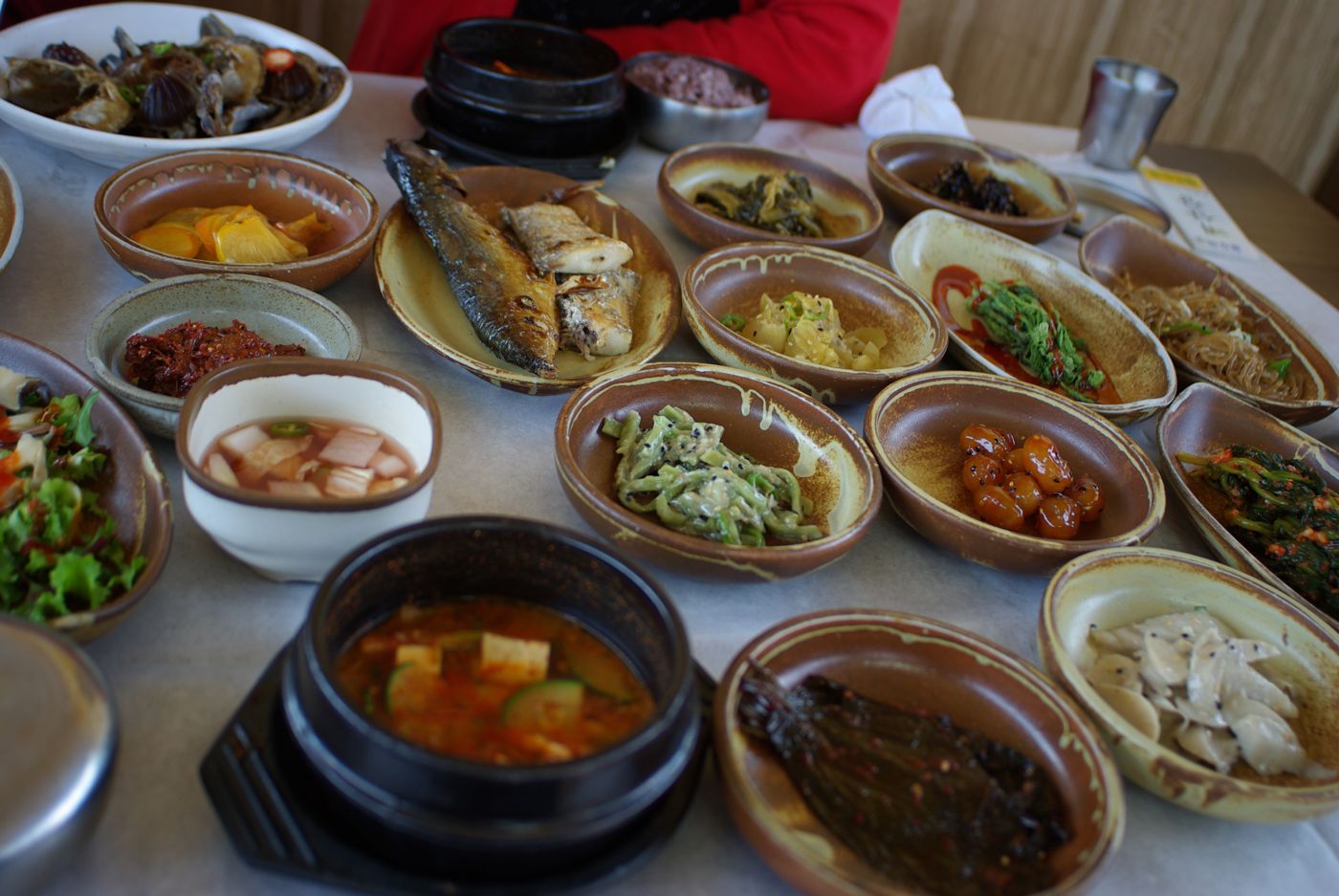 Photo: egg (Hong, Yun Seon), CC BY 2.0, via Wikimedia Commons
Hanjeongsik (한정식, 韓定食), roughly a set Korean meal, is what many visitors picture as the height of Korean dining: a low table covered edge to edge with dozens of small dishes, or a long procession of courses. It is often presented as royal or aristocratic cooking. Historians agree that it draws on those traditions, but most also agree that hanjeongsik as a restaurant meal is a modern creation, and they disagree about which roots matter most.
Not a traditional table
The traditional Korean meal was the bansang, rice, soup and a set number of side dishes, graded from three to twelve cheop (see Korean table settings). Its basic form was the oesang, a small table for one person. The large rectangular gyojasang, set for several diners at once, was used for feasts but was not the everyday standard, yet it is exactly the format of most hanjeongsik. The Digital Sunchang Culture Encyclopedia notes that the word hanjeongsik did not exist before the late Joseon period and probably emerged under colonial rule.
Three theories of origin
The same encyclopedia summarizes three theories. One traces hanjeongsik to the restaurant and yojeong culture of the colonial period; one to the bansang of yangban households; and one to court cooking carried out of the palace by former royal cooks. They are not mutually exclusive.
The court connection runs through Myeongwolgwan, a Seoul restaurant opened by An Sun-hwan, who had cooked for royal banquets. Sources disagree on its founding year, with the Korean Food Promotion Institute giving 1904 and other accounts 1909. Modeled in part on Japanese restaurants with entertainment, it served court-style dishes to officials and businessmen, often with performances by gisaeng entertainers. Rival houses followed, and later writers note that by the 1920s many restaurant tables were crowded with dishes of uncertain pedigree. One scholar quoted by the Seoul Shinmun calls Myeongwolgwan the forerunner of hanjeongsik restaurants; others caution that its food differed from true court cooking. For the court itself, see royal court cuisine.
Yojeong, politics and the name
After the Korean War, high-end yojeong, private restaurants with hostesses, became settings for political and business deals in Seoul. From the 1960s many turned into hanjeongsik restaurants. The food critic Hwang Kyo-ik has argued that taxes helped drive the change: in the late 1960s a yojeong paid an entertainment tax of 20 percent of revenue, while a hanjeongsik restaurant paid 5 to 10 percent. That is his explanation, not settled history. The food historian Joo Young-ha of the Academy of Korean Studies says that the term itself was coined by the government as a counterpart to Western course dinners, and he and others insist that hanjeongsik restaurants be distinguished from the entertainment houses.
Service changed as well. According to the Sunchang encyclopedia, the course format, with appetizers, then main dishes, then rice and soup and finally dessert, took hold in the 1970s, and course-style hanjeongsik restaurants multiplied from the 1980s. The 1988 Seoul Olympics encouraged efforts to present a pared-down Korean meal in courses.
Regional styles
The heaped-table style survives most strongly in Jeolla, whose generosity at table is a point of regional pride. North Jeolla hanjeongsik typically runs to about 40 dishes and sometimes more than 80; in Sunchang, restaurants set 30 or more, leaning on the county's famous gochujang, pickles and salted fish because seafood was hard to get in the mountains; its best-loved dish is pork marinated in gochujang and grilled over coal briquettes. Jeonju is similarly known for lavish set tables. Namdo, the southwestern coast around Mokpo and Gwangju, brings seafood, fermented skate served in a trio with pork and kimchi, and other local dishes. One celebrated Seoul hanjeongsik house, the Seoul Shinmun reports, was famous for Namdo food of this kind.
Debate and change
Hanjeongsik attracts criticism as well as admiration. The Sunchang encyclopedia itself points to waste, food that cools before it can be eaten, and display for its own sake, and suggests smaller, better-chosen menus. Seoul's traditional hanjeongsik houses were hit by a 2003 cap on officials' entertainment spending and by the 2016 anti-graft law that limited the value of meals for public officials. At the same time, chefs have reworked the idea into contemporary Korean fine dining, a lineage the Korean Food Promotion Institute traces from court cooking through the restaurants of the early twentieth century. Whatever the format, the core idea is the old one of the banchan table: many small, contrasting dishes eaten together with rice, as discussed in sharing banchan and the history of banchan.