History & Culture
The Korean Table: Bapsang and the Cheop System
반상 차림
How a Korean meal is built around rice, soup and banchan, what the 3- to 12-cheop table settings mean, and how side dishes came to be shared.
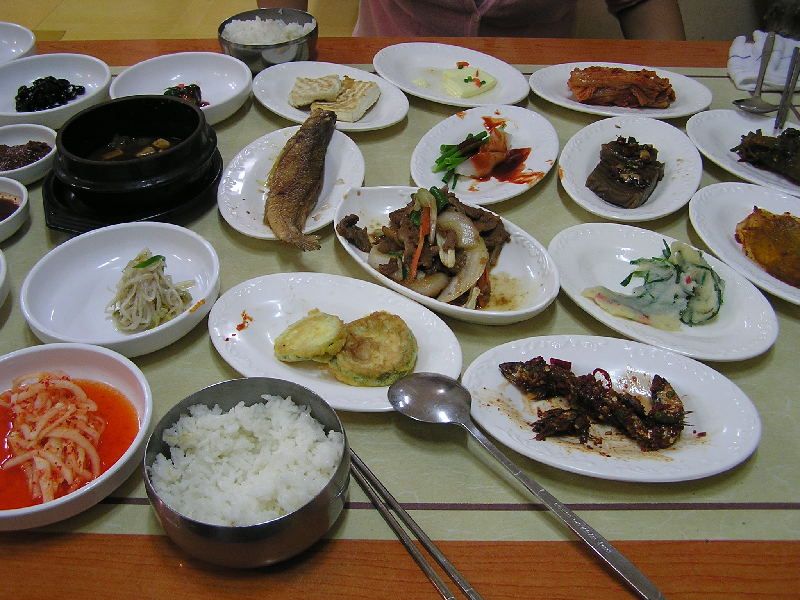 Photo: No machine-readable author provided. Warszk assumed (based on copyright claims)., CC BY-SA 3.0, via Wikimedia Commons
A Korean meal is not organized as a sequence of courses. Everything arrives at once, and the table is read as a whole: a bowl of rice, a bowl of soup, and an array of small side dishes, or banchan, that are eaten with the rice. In Korean this everyday setting is called bansang (반상), a table composed of rice and the dishes that accompany it. Rice is the staple; the banchan exist to make the rice taste good.
Names for the table
Older usage distinguished the same meal by who was being served. A table for a younger or lower-ranking person was a bapsang (밥상), the polite term for a table set before an elder was jinjisang (진짓상), and the king's table was the surasang (수라상). A table set for one person was an oesang (외상), and one set for two diners sharing was a gyeomsang (겸상). Historically, the individual table was the more formal arrangement, with each person, especially an elder or the head of a household, receiving his or her own small tray.
What a cheop is
Formal bansang were graded by the number of cheop (첩), a word for the lidded side-dish bowls on the table. The count runs in odd numbers: 3, 5, 7, 9 and 12 cheop. Crucially, the number covers only the side dishes served in those bowls. Rice, soup, kimchi, stews such as jjigae, and the small saucers of soy sauce and other condiments are basic elements of every setting and are not counted.
- 3-cheop: a fresh, raw-vegetable dish (saengchae), a cooked vegetable dish (sukchae, the family of spinach namul and bracken namul), and either a grilled or a braised dish.
- 5-cheop: adds pan-fried jeon such as zucchini jeon, plus a dried side dish or salted, fermented seafood (jeotgal), and a stew alongside the soup.
- 7-cheop: adds another grilled or braised item and a raw or blanched fish dish (hoe), with both a stew and a steamed dish (jjim) on the table.
- 9- and 12-cheop: multiply the grilled, braised and fried dishes across different meats, fish and vegetables. Twelve cheop is the scale described for the king's surasang.
The condiments scale with the menu. A 3-cheop table needs only soy sauce; at five cheop a vinegared soy sauce appears for dipping the jeon; from seven cheop onward a vinegared chili paste or mustard sauce is added for the raw fish.
The logic of variety
The cheop system was less a status ladder than a design principle. The aim was to avoid repeating the same ingredient or the same cooking method, so that a well-set table offers contrasts: something raw and something cooked, something braised in soy like potato jorim, something crisp and fresh like radish salad, something salty and fermented to sharpen the appetite. Attention to color was part of the same idea. Kimchi anchors the table no matter how small it is.
Placement
The basic rule of placement is simple: the rice bowl sits on the diner's left and the soup bowl on the right. The condiment saucers and kimchi go toward the center, stews and steamed dishes to the right, and the remaining banchan are arranged so their colors complement one another. Spoons and chopsticks were valued possessions, and each family member traditionally had a set of his or her own.
How banchan are shared today
In most modern homes and restaurants, the individual tray has given way to a single larger table. Each person still has a personal bowl of rice and often a personal bowl of soup, but the banchan are set in the middle and shared, with diners reaching in with their chopsticks a bite at a time rather than serving themselves a portion. Restaurants typically bring a round of complimentary banchan with a meal and refill them on request, a custom that keeps the old idea of a full table alive even when the main order is a single dish.
Whatever the number of dishes, the principle holds: rice at the center of the meal, and a range of small, contrasting dishes, from kimchi to namul to a braise, arranged to be eaten together.