Wellness
Sharing Banchan: Eating Together
함께 나누는 반찬
Shared side dishes are the heart of the Korean table. The customs and manners around them, how hygiene habits have changed, and portions that suit sharing.
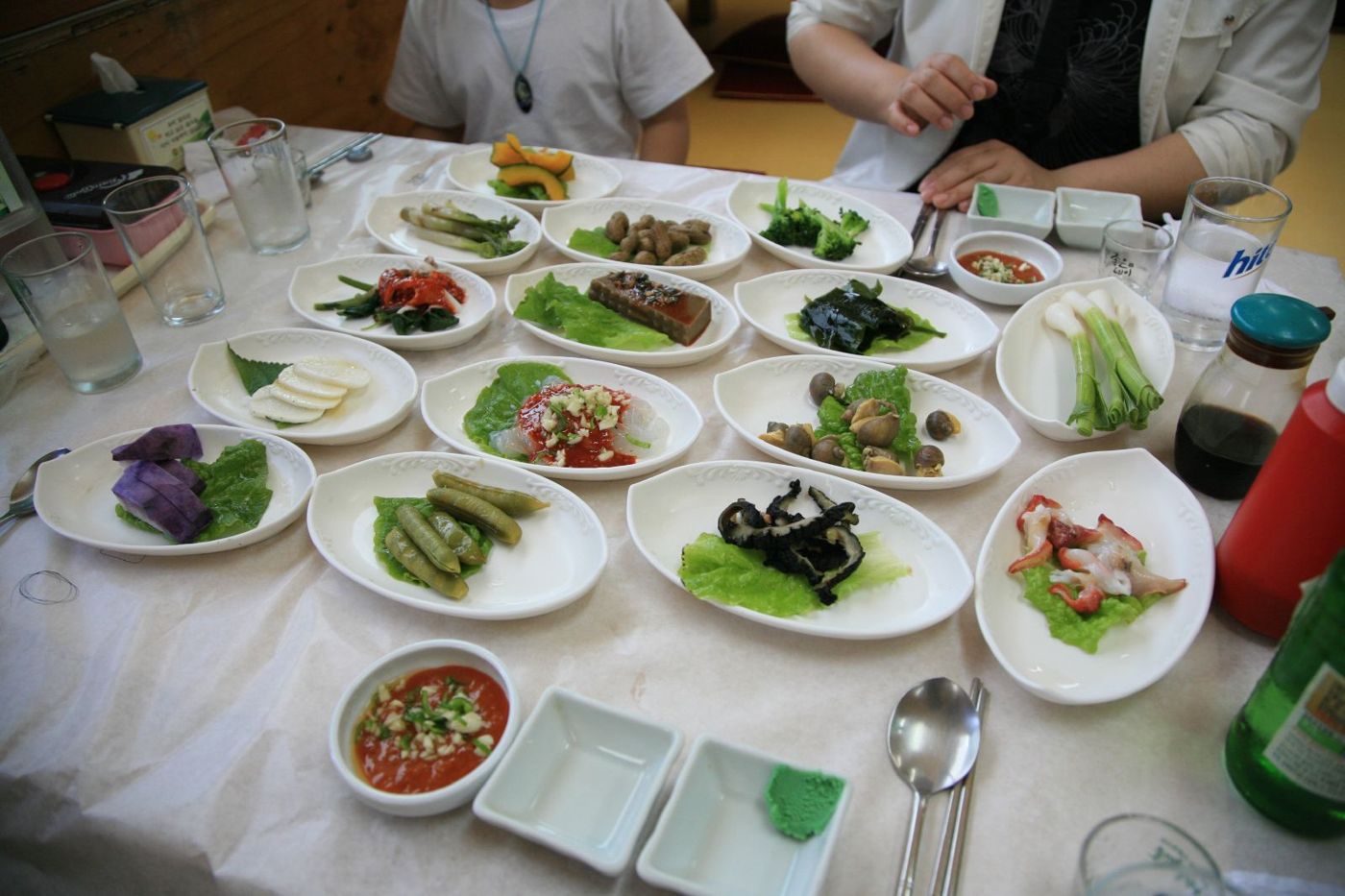 Photo: Junho Jung at Flickr from South Korea, CC BY-SA 3.0, via Wikimedia Commons
At a Korean table, the rice and soup are yours, but the banchan belong to everyone. Small dishes of kimchi, namul and braised things sit in the middle, and each person reaches in with chopsticks for a little at a time. That simple arrangement shapes how Koreans eat, talk and look after one another at meals.
A table set all at once
Korean meals are not served in courses. As Korea.net puts it in a guide to table manners, all the dishes come to the table at once: individual bowls of rice and soup, surrounded by shared side dishes. The structure of the everyday meal is described in the balanced Korean meal, and the layout in Korean table settings.
Sharing was not always the formal ideal. Historically, the individual table, with each person, especially an elder, receiving a small tray of their own, was considered the more proper arrangement, and a table shared by two diners had its own name. See history of banchan.
The habit of sharing also reaches beyond the table: UNESCO's inscription of kimjang highlights how households exchange kimchi with one another and pass on methods across generations.
Manners at a shared table
Etiquette varies by family and occasion, but some customs are widely observed:
- Elders first: Younger diners wait for older people to begin eating before they start.
- Spoon and chopsticks: The Encyclopedia of Korean Culture describes the spoon as the utensil for rice and soup and chopsticks as the tool for picking up side dishes. While using chopsticks, the spoon rests on the rice or soup bowl.
- Bowls stay down: Rice and soup bowls are not lifted from the table while eating.
- No chopsticks upright in rice: Standing chopsticks in a rice bowl recalls rituals for the dead and is avoided.
- Be considerate: Korea.net's guide also advises against picking teeth or blowing your nose at the table.
Many shared-table manners come down to the same idea: take what you will eat, from your side of the dish, without rummaging for the best piece.
Sharing and hygiene
Communal dishes raise an obvious question: whose spoon has been where? Korea addressed it directly during the COVID-19 pandemic. In July 2020 the Ministry of Agriculture, Food and Rural Affairs launched a dining-culture campaign under the slogan "정은 담고 음식은 덜고," roughly "share the warmth, serve out the food." It promoted three practices:
- Serving food onto individual plates with shared ladles and tongs, rather than eating straight from common dishes.
- Hygienic handling of spoons and chopsticks, such as individually wrapped cutlery or sets laid out for each diner.
- Masks for restaurant staff.
Restaurants that followed all three could be designated ansim sikdang (안심식당), or "safe restaurants"; more than 2,300 had been designated by August 2020. The ministry framed the campaign as infection prevention but also as a longer-term effort to move away from unhygienic habits.
A separate rule has applied to restaurant banchan for longer. Revised regulations under Korea's Food Sanitation Act, effective in April 2009, bar restaurants from reusing food that customers leave behind.
At home, the same principles translate easily:
- Use serving utensils for stews and shared plates, especially when someone is unwell.
- Plate from the container: Put out a small amount of each banchan and return to the storage container with clean utensils, rather than with chopsticks that have been eaten from.
- Keep leftovers separate: Banchan that has been on the table is best eaten up rather than tipped back into the main batch.
Mindful portions
Sharing suits mindful eating. Taking a little of many dishes encourages variety, and putting out modest amounts means less goes to waste.
- Start small and refill: A few bites of each dish, with seconds of the ones you enjoy.
- Let vegetables lead: Reach often for lightly seasoned namul and less often for the saltiest dishes. See vegetables and namul and sodium in Korean food.
- Slow down: Reaching for one bite at a time from shared dishes naturally paces a meal.
However the dishes are passed and served, the point of the shared table stays the same: a meal is something you make, and enjoy, together.
Sources
- 01[While in Korea] Episode 7 – Table manners (Korea.net, 2019)
- 02수저 (Spoon and chopsticks) — Encyclopedia of Korean Culture
- 03식당에 가면 음식은 꼭 덜어서 드세요~ (Ministry of Agriculture, Food and Rural Affairs briefing on the dining-culture campaign, Korea.kr, July 2020)
- 04덜어먹기 등 지키는 '안심식당' 우리동네 어디에? (Korea.kr policy news, August 2020)
- 05남은 음식 재사용하면 영업정지 처분받는다 (Ministry of Health and Welfare press release, Korea.kr, April 2009)
- 06Kimjang, making and sharing kimchi in the Republic of Korea (UNESCO Intangible Cultural Heritage)