Techniques
Making Muk
묵 쑤기
How Korean cooks turn acorn, mung bean and buckwheat starch into soft, sliceable jellies, and how to season them before they firm up too much.
Muk is a Korean jelly made by cooking a plant starch with water into a thick paste and letting it set. The Encyclopedia of Korean Culture describes it as a food with little flavor of its own, prized instead for its smooth, cool texture and its ability to carry a seasoning. The verb used for making it, ssuda, is the same one used for cooking porridge, which is a good clue to the method: muk is essentially a very thick starch porridge that sets as it cools.
The three classic muk
- Mung bean jelly (nokdu-muk or cheongpo-muk): pale and almost translucent. The encyclopedia notes that it was considered the more refined, upper-class muk, and that it is the base of tangpyeongchae, a dressed dish of mung bean jelly, beef and vegetables first recorded in the late nineteenth century. Tinted yellow with gardenia, it becomes hwangpo-muk, a specialty of Jeonju.
- Acorn jelly (dotori-muk): brown and slightly astringent; it is the base of dotori-muk-muchim. Acorns (dotori) have been eaten on the peninsula since prehistoric times and were long a famine food, which the encyclopedia traces through Goryeo and Joseon records.
- Buckwheat jelly (memil-muk): gray-brown and nutty. Sources describe it, together with acorn jelly, as everyday food of ordinary households, and a winter-night snack once sold by street peddlers.
The encyclopedia also records a seasonal rhythm: buckwheat jelly mostly in winter, mung bean jelly traditionally prepared in spring, and acorn jelly year-round.
Step 1: Extract the starch
Traditional muk began with whole seeds, not packaged flour, and the extraction is most of the work.
- Mung beans are soaked, rubbed to remove their skins, and ground fine with water; the slurry is strained through cloth or a fine sieve and left to settle so the starch sinks to the bottom.
- Acorns are dried, cracked and winnowed, then steeped in water for several days, with frequent changes, until the bitterness and astringency leach out. Only then are they ground and the starch settled.
- Buckwheat is soaked, ground with its hull and strained in the same way.
In every case the clear water on top is poured off, leaving a starch sediment (anggeum). Dried acorn, mung bean and buckwheat starches are now sold ready to use, which skips this stage.
Step 2: Cook, stirring constantly
The starch is whisked into cold water first, so it disperses without lumps, and then heated while being stirred with a wooden paddle. A recipe for Jeonju's yellow mung bean jelly recorded in the Encyclopedia of Korean Culture uses roughly five to six parts liquid to one part settled starch; packaged starches usually print their own ratio, and it varies by brand and by how firm you want the jelly.
- Low, steady heat. An early twentieth-century cookbook quoted in the encyclopedia warns that a mixture cooked too thick turns hard, and one cooked over too high a flame scorches.
- Watch for the change. The paste goes from cloudy to glossy and translucent as the starch gelatinizes. Acorn jelly recipes add a little salt and oil at this point and let the mixture cook a little longer, covered, to finish.
Step 3: Set and slice
Pour the hot paste into a container rinsed with water or lightly oiled, smooth the top, and leave it to cool completely. Once firm, the block can be turned out, sliced and seasoned.
Seasoning and serving
Because muk is mild, the dressing does the talking. The encyclopedia gives a typical sauce of soy sauce, chili flakes, green onion, garlic, a little sugar and sesame oil spooned over thick slices, often tossed with cucumber or green chili. Mung bean jelly is traditionally paired with spring greens such as minari and mung bean sprouts and dressed with vinegared soy or simply salt and sesame oil; buckwheat jelly is said to be best mixed with chopped baechu-kimchi. Dried muk was also rehydrated and stir-fried, and older recipes describe muk steeped in soy sauce as a kind of jangajji.
Storage
Muk is best eaten the day it is made. Refrigeration causes the starch to retrograde, making the jelly firm, opaque and crumbly; the encyclopedia suggests reviving chilled muk by slicing it and blanching the slices briefly in boiling water, then cooling them before dressing. Season just before serving, since a dressed jelly weeps liquid as it sits.
Dishes using this technique
- Dotori Muk Muchim도토리묵무침Slices of soft, faintly bitter acorn jelly tossed with crisp vegetables and a soy–chili–sesame dressing — a cool, light side dish and a favorite with drinks.
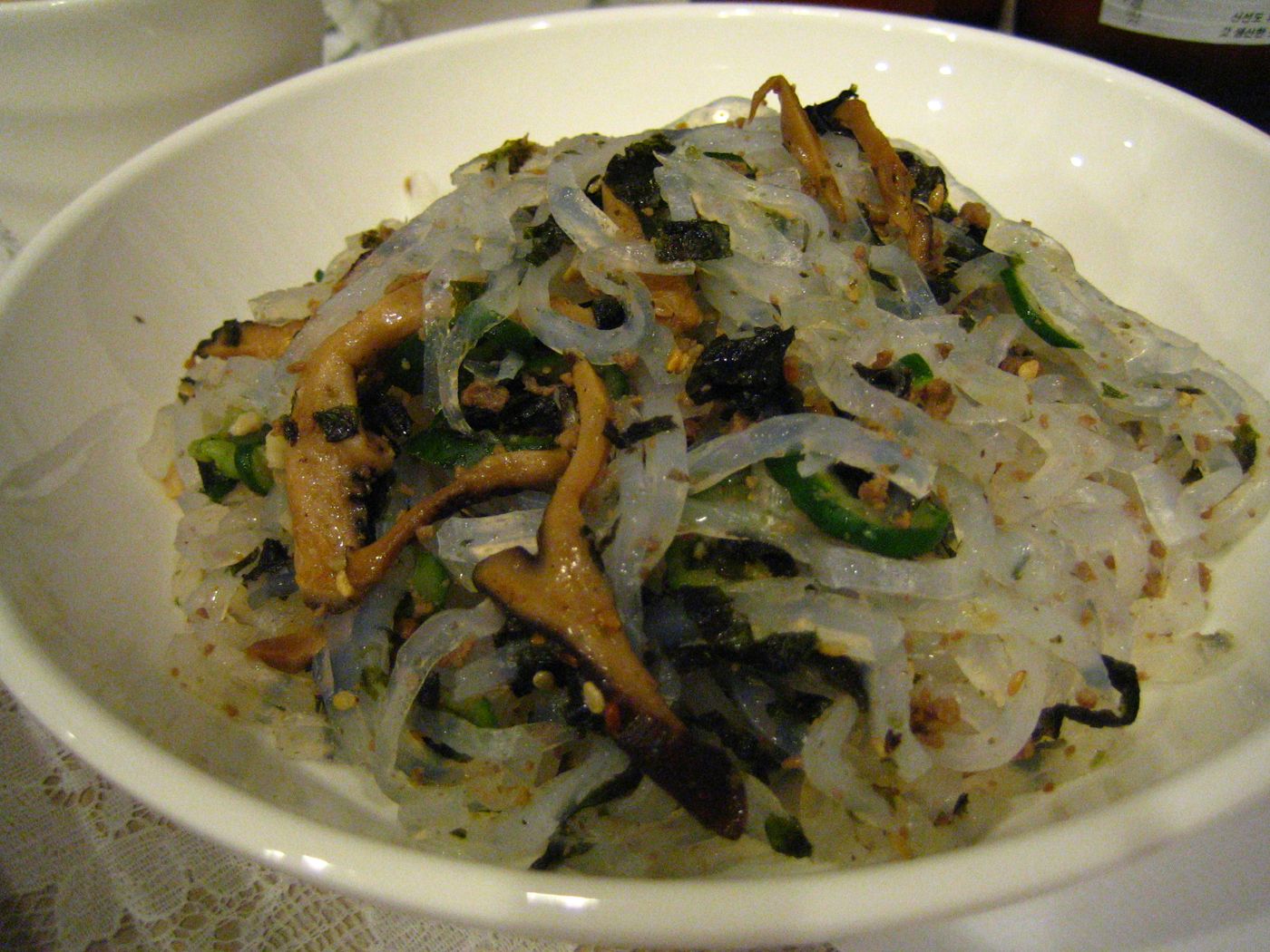 Tangpyeongchae탕평채Mung bean jelly tossed with beef, sprouts, water dropwort, egg and roasted gim in a soy-vinegar dressing — a classic spring dish named after a Joseon policy of political harmony.