Ingredient
Cockles (kkomak)
꼬막
Romanization: kkomak
Small, deeply ribbed ark clams with red, briny flesh, gathered from the winter mudflats of South Jeolla. Beolgyo in Boseong County is the name every Korean connects with them.
Flavor
Sweet, briny and faintly metallic, with a springy, chewy bite and a savory red liquor inside the shell; overcooking turns the meat tough and dry.
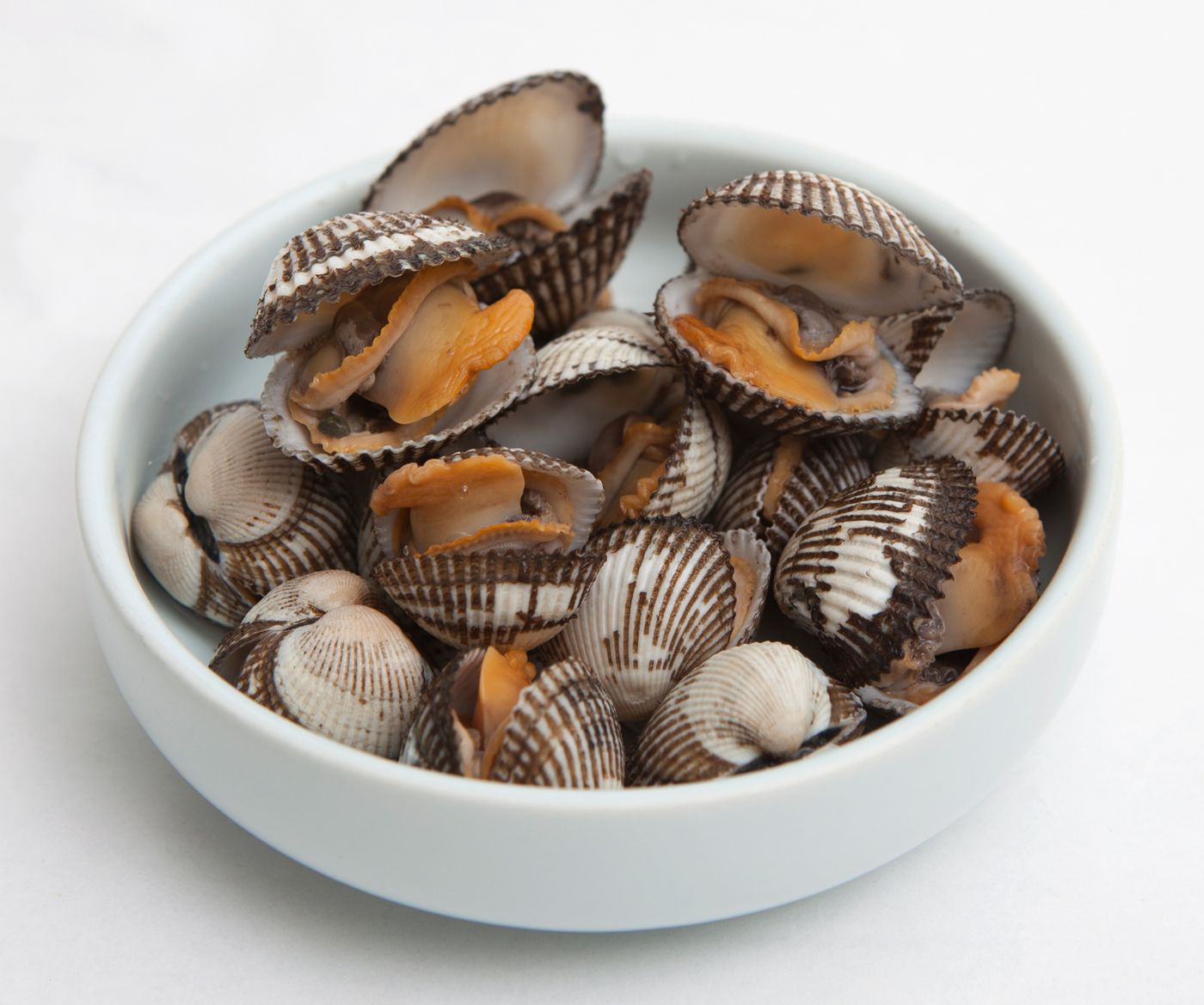 Photo: 국립국어원, CC BY-SA 2.0 kr, via Wikimedia Commons
Origin & History
Kkomak is the granular ark (Tegillarca granosa), a thick-shelled clam whose shell carries heavy radiating ribs, white inside, with reddish meat. It lives buried in soft mud on sheltered tidal flats along Korea's west and south coasts and spawns in summer. Two relatives share its name at the market: the larger saekkomak, and the much larger blood ark pijogae (listed in the Encyclopedia of Korean Culture as Scapharca broughtonii), which grows to about 12 cm. The Encyclopedia of Korean Folk Culture tells them apart by their ribs: roughly 17–18 on true kkomak, 30–32 on saekkomak and 42–43 on pijogae, with the shell going from bare to increasingly hairy as the clams get bigger. Unusually for a mollusk, all three carry hemoglobin rather than hemocyanin, which is why the flesh and the liquor inside the shell look red, an adaptation to oxygen-poor mud.
Cockles have long fed coastal people. Jeong Yak-jeon's Jasan eobo described the meat as yellowish and sweet, and the 15th-century gazetteer Dongguk yeoji seungnam lists them as a local product of Jangheung, Haenam, Boseong and Heungyang in Jeolla. Beolgyo, a town on the tidal flats of Boseong County, is so closely tied to cockles that, according to the Encyclopedia of Korean Culture, households there set them out at every large feast and on the ancestral-rite table. "Beolgyo kkomak" was registered as Korea's first fisheries geographical indication. The prized true kkomak is still gathered by hand from a ppeolbae, a wooden mud sled pushed across the flats, while saekkomak is farmed and harvested with nets.
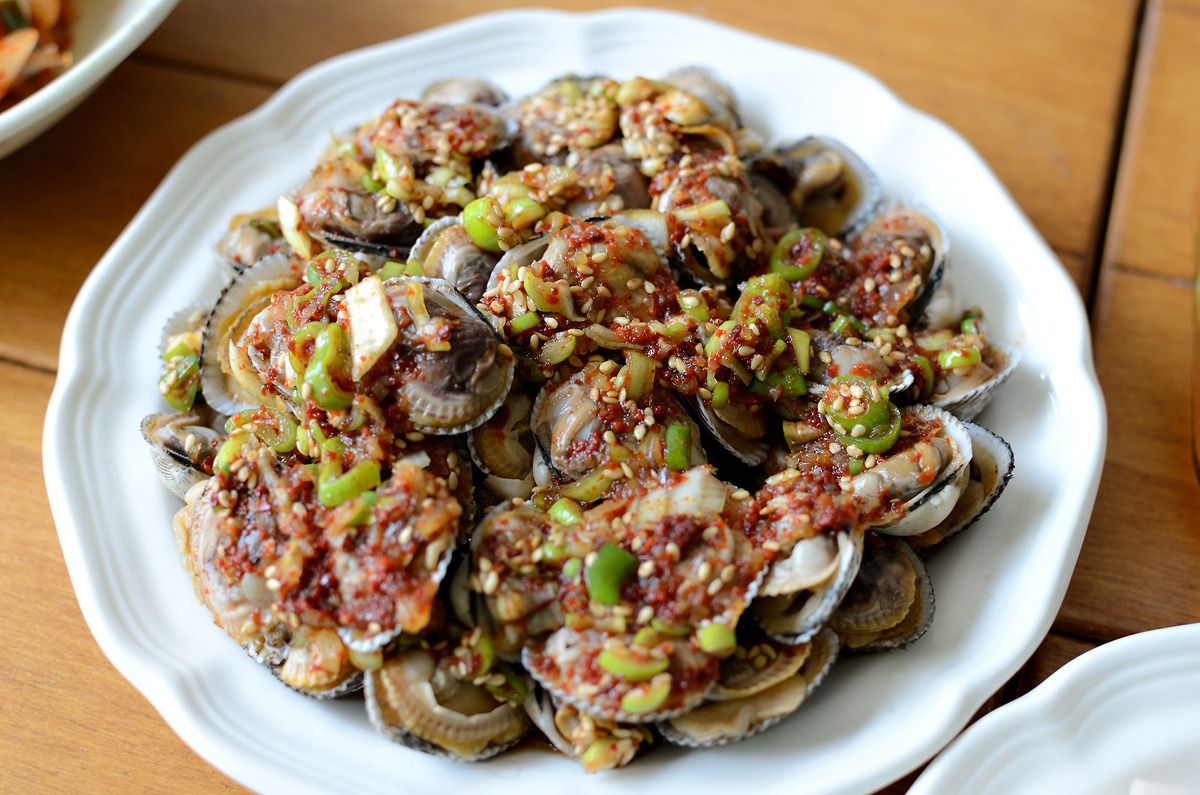
That hand-gathered harvest is in trouble. A 2026 Herald Business report citing Boseong County put Beolgyo's true-kkomak catch at about 8,500 tons in 2010 and only 26 tons in 2025, blaming climate change and overharvesting; a 20 kg sack now sells for 700,000–800,000 won, so most diners eat saekkomak, of which about 3,851 tons came from Beolgyo, Goheung, Suncheon Bay and Yeoja Bay in 2025. The county has begun reseeding Yeoja Bay with hatchery spat. In the kitchen, cockles are cleaned of grit, blanched just until barely cooked, and eaten with seasoned soy sauce as kkomak-muchim or with vinegared chili paste as kkomak-hoe; the season runs from the cold months into spring.
Nutrition
| Calories | 63 kcal |
|---|---|
| Protein | 12.6 g |
| Fat | 0.3 g |
| Carbohydrates | 1.6 g |
| Fiber | 0 g |
| Sodium | Not reported |
Notable forIron (6.8 mg) · Niacin (3.4 mg) · Calcium (83 mg)
Values copied from the Korean Food Composition Table (Rural Development Administration / National Institute of Crop Science) for this exact food, per 100 g edible portion. Blank fields in the table are shown as not reported. The table lists saekkomak separately (꼬막, 새꼬막, 생것). Actual values vary with ingredients, portion size and preparation.
Health Benefits
- Lean protein and iron: Raw cockle meat in the Korean table has about 12.6 g of protein and under half a gram of fat per 100 g, with a notable 6.8 mg of iron.
- Traditionally valued: The Encyclopedia of Korean Folk Culture notes cockles are traditionally credited with easing fatigue and anemia; these are folk beliefs, not established medical effects.
- Mollusk allergy: Cockles are bivalve mollusks. U.S. law's major-allergen list covers crustacean shellfish but not mollusks, so labeling may differ; people with shellfish allergies should ask an allergist which kinds are safe.
- Lightly cooked shellfish: Kkomak is traditionally only blanched. The FDA advises pregnant women, young children, older adults and people with weakened immunity to avoid raw or undercooked shellfish.
Informational, not medical advice. Talk to a qualified professional about your own health and diet.
Sources
- 01꼬막 (Cockle) — Encyclopedia of Korean Culture
- 02꼬막 (Cockle) — Encyclopedia of Korean Folk Culture, National Folk Museum of Korea
- 03고갈 위기에 몰린 '벌교 참꼬막' 한 망에 80만원 (Beolgyo cockles near depletion) — Herald Business via Nate News (2026)
- 04Korean Food Composition Table — Granulated ark shell, Raw
- 05Selecting and Serving Fresh and Frozen Seafood Safely — U.S. Food and Drug Administration
- 06Food Allergies — U.S. Food and Drug Administration