Ingredient
Soybeans
대두
Romanization: daedu
Dried yellow soybeans, called kong in everyday speech and daedu ("big bean") on labels and in agriculture. They are the quiet foundation of the Korean table: the raw material for jang, tofu, soybean sprouts and soy milk, and a bean cooked into rice and braised as banchan.
Flavor
Raw dried beans are hard and grassy; cooked, they turn nutty, savory and faintly sweet with a dense, creamy bite. Roasting brings out a toasty, almost peanut-like aroma, and fermentation transforms them into the deep, salty savoriness of jang.
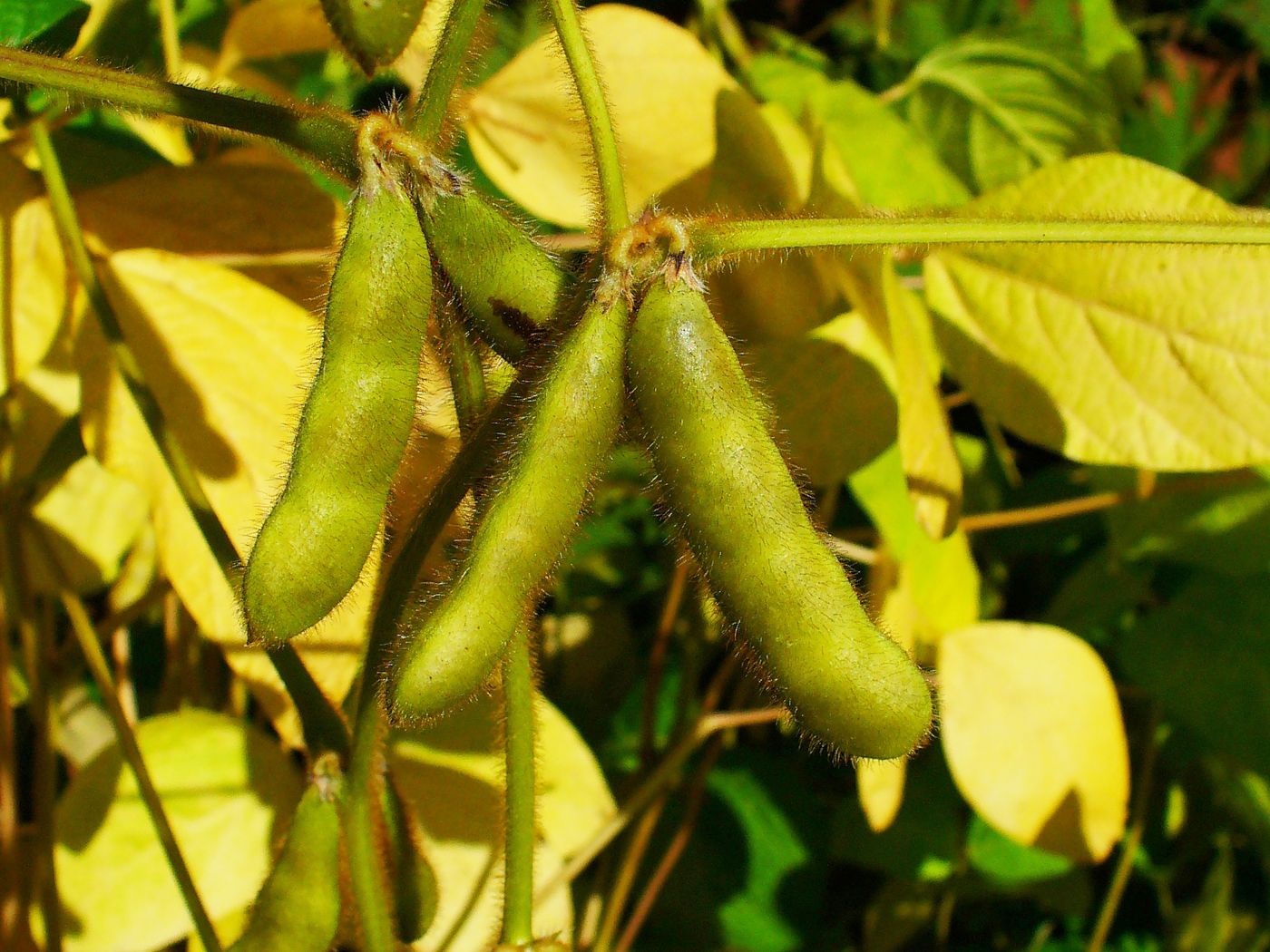 Photo: H. Zell, CC BY-SA 3.0, via Wikimedia Commons
Origin & History
Daedu is the soybean, Glycine max. Koreans usually just say kong, and sort the beans by size and color — yellow, black, green, speckled and many local names in between. The Encyclopedia of Korean Culture traces the word daedu to ancient China: once small-seeded legumes such as adzuki beans arrived, the original bean became the "big bean" (daedu) and the newcomers the "small bean" (sodu).
Where the soybean was first domesticated is still argued. The conventional view, repeated in the Encyclopedia of Korean Culture, places its homeland in northeastern China — Manchuria, the old territory of Goguryeo — pointing to an ancient Chinese text that has Duke Huan of Qi bringing soybeans back from that region, and to soybeans recovered from the Bronze Age site of Odong in Hoeryong, North Hamgyeong. More recent archaeology complicates the picture. A 2011 comparison of nearly 950 charred soybeans from China, Korea and Japan found that seeds had already grown markedly larger in Korea by about 3,000 years ago, in the Early Mumun period, and argued that the bean was domesticated in several places in East Asia rather than once. Some Japanese researchers now argue for an especially early start in Japan. What is not in doubt is that the peninsula and Manchuria sit squarely inside the soybean's ancestral range.
Over the centuries the soybean became the protein of ordinary Koreans, who rarely ate meat. Cooked into rice as kongbap, it fed families; an 1813 preface quoted by the encyclopedia praises beans as more precious than jewels for the people's livelihood. Its greatest role, though, is as the base of fermentation: soybeans are boiled and shaped into meju, the starter for doenjang and ganjang (see making jang). They are ground and curdled into dubu and its soft cousin sundubu, sprouted in the dark into kongnamul, roasted and ground into the konggaru that coats rice cakes, and braised in soy sauce into kongjaban. Black soybeans are the usual choice for kongbap.
Domestic production has never kept pace with this demand. The encyclopedia records yields per area rising sharply between 1955 and 1989 thanks to improved varieties, even as planted area shrank, and Jeolla in the southwest as the main growing region.
Nutrition
| Calories | 409 kcal |
|---|---|
| Protein | 36.21 g |
| Fat | 14.71 g |
| Carbohydrates | 32.99 g |
| Fiber | 25.6 g |
| Sodium | 2 mg |
Notable forPotassium (1,838 mg) · Iron (6.66 mg) · Magnesium (256 mg) · Folate (180 µg)
Values copied from the Korean Food Composition Table (Rural Development Administration / National Institute of Crop Science) for this exact food, per 100 g edible portion. These are values for dry beans; soaking and cooking roughly double to triple their weight with water. Actual values vary with ingredients, portion size and preparation.
Health Benefits
- A rich plant protein: Dried soybeans are more than one-third protein by weight in the Korean Food Composition Table, and Harvard's Nutrition Source notes that soy is a complete protein, supplying all the essential amino acids.
- Fiber and minerals: The same table lists soybeans as high in dietary fiber, potassium, magnesium and iron, along with folate.
- Measured evidence on heart and hormones: Harvard summarizes research showing only modest effects on cholesterol (the U.S. FDA revoked its soy heart-health claim in 2017) and mixed or neutral findings for breast cancer and hot flashes, while describing whole soy foods as safe to eat several times a week. People with hypothyroidism are advised to have their thyroid function monitored.
- Major allergen: Soybeans are one of the nine major food allergens the U.S. FDA requires on labels. Soy hides in many Korean staples — doenjang, ganjang, gochujang, tofu, sprouts, soy milk and roasted bean flour.
- Fermented forms are salty: The beans themselves are almost sodium-free, but the jang made from them are very high in salt; see sodium in Korean food.
Informational, not medical advice. Talk to a qualified professional about your own health and diet.
Dishes with Soybeans
- Kongbiji Jjigae (Okara Stew)콩비지찌개Soybean pulp left from tofu-making — or freshly ground soaked soybeans — simmered thick with pork and sour kimchi and seasoned with salted shrimp; a nutty, homely winter stew.
 Misutgaru (Roasted Grain Drink)미숫가루A fine powder of steamed, dried and roasted grains stirred into cold water with honey — a nutty summer drink that doubled for centuries as travel food and famine ration.
Sources
- 01콩 (Soybean) — Encyclopedia of Korean Culture
- 02콩밥 (Kongbap) — Encyclopedia of Korean Culture
- 03Lee, Crawford, Liu, et al. (2011). Archaeological soybean (Glycine max) in East Asia: does size matter? PLoS ONE 6(11): e26720
- 04Korean Food Composition Table — Soybean, Yellow, Dried
- 05Straight Talk About Soy — The Nutrition Source, Harvard T.H. Chan School of Public Health
- 06Food Allergies — U.S. Food and Drug Administration