History & Culture
Haenyeo: The Women Divers of Jeju
해녀
Jeju's haenyeo free-dive for abalone, sea urchin and turban shells. Their skills, cooperatives and rituals were inscribed by UNESCO in 2016, but the community is aging fast.
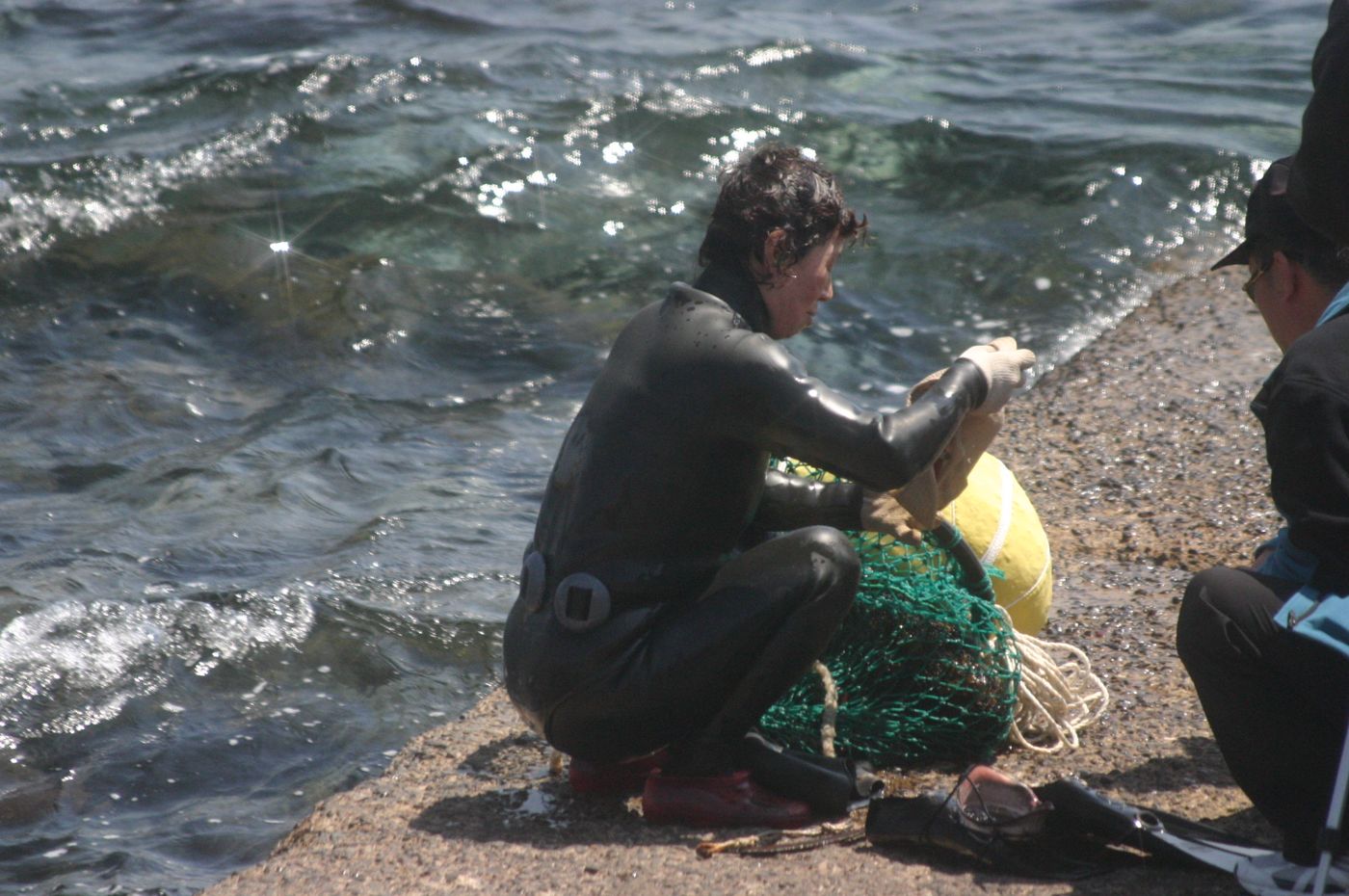 Photo: karendotcom127, CC BY 2.0, via Wikimedia Commons
On the coasts of Jeju, groups of women in black wetsuits swim out with an orange float and a net, dive without breathing equipment, and come up with shellfish and seaweed. They are the haenyeo (해녀), "sea women." Their work feeds a distinct island seafood culture, but it is also a social institution, with its own ranks, rules, shelters and rituals. In 2016 UNESCO inscribed the Culture of Jeju Haenyeo on its Representative List of the Intangible Cultural Heritage of Humanity.
A long history
Shell middens suggest that people have gathered food from Jeju's shallows since prehistoric times. The first written mention of women divers, according to the Jeju Haenyeo Museum, dates to 1629, when the scholar Yi Geon, writing in exile on the island, described jamnyeo (潛女), "diving women." Over the following centuries diving became overwhelmingly women's work on Jeju, and haenyeo were often principal earners for their households, combining diving with farming. They also traveled: in the modern era many worked seasonally on the mainland and abroad, in Japan, China and Russia.
Their history includes resistance. In January 1932 haenyeo protested against a Japanese-controlled fishing union that they said was cheating them in the sale of their harvest. The Korea Times reports that some 17,000 people took part over the course of the movement, and that the protesters marched carrying their tools. In 2025 Korea's patriots ministry recognized three of the leaders, Bu Chun-hwa, Kim Ok-ryeon and Bu Deok-ryang, as independence activists.
How haenyeo work
UNESCO describes dives to around ten meters, each lasting about a minute on a single breath, for up to seven hours a day on roughly ninety days a year. On surfacing, divers release their breath with a distinctive whistling sound, sumbisori. The community sorts divers by skill into three grades, hagun, junggun and sanggun, and the most experienced divers guide the others. Village fishery cooperatives hold the rights to the near-shore fishing grounds and, together with haenyeo associations, manage how they are worked. UNESCO highlights this community management, and the divers' habit of taking only what they can gather by breath, as an example of environmentally sustainable fishing.
Before rubber wetsuits, divers wore traditional cloth diving suits and warmed themselves at a bulteok (불턱), a ring of stacked stones on the shore where they changed, built fires and talked. Most bulteok are now heritage sites, though a few in Gujwa-eup, on the island's northeast coast, are still used.
What they harvest
The core catch is shellfish and seaweed: jeonbok (abalone), seonggye (sea urchin), sora (turban shell), sea cucumber, octopus and seaweeds such as tot and miyeok. Abalone is the prize; sea urchin, whose roe is gathered in season, and turban shell are the everyday staples. Catches vary by village, season and cooperative rules.
Haenyeo foodways
The haenyeo catch shapes how Jeju eats. Many coastal villages have restaurants run by haenyeo or their cooperatives, serving what was gathered that day. Typical dishes include jeonbok-juk, abalone rice porridge; seonggye-guk, sea urchin soup, usually made with miyeok in the style of miyeok-guk; and raw or grilled turban shell. A Visit Jeju listing describes a haenyeo set meal of abalone, turban shell, sea urchin, sea cucumber, octopus and sea squirt with sea urchin and seaweed soup. Raw shellfish belongs to Korea's wider hoe culture; people with shellfish allergies, or who are pregnant or immunocompromised, should take the usual care with raw seafood.
Ritual and community
Diving is dangerous, and ritual has long surrounded it. The best known is jamsugut (잠수굿), a shamanic rite held in many villages between the first and third lunar months to pray for safety, a good catch and unity, which includes a section welcoming the sea god. Haenyeo associations and fishing villages organize it with shamans. Jeju Province now subsidizes these rites to keep them going.
An aging community
The number of haenyeo is falling steeply. According to the Seoul Shinmun, about 2,600 were active in 2024, and 61 percent of them were 70 or older. Few young women take up the work, despite a haenyeo school, a museum and public support. The haenyeo are often cited as a symbol of Jeju women's strength and of a fishing ethic that takes only what the sea can renew. Whether that culture can be passed on is now a central question for the island.
Sources
- 01Culture of Jeju Haenyeo (women divers) — UNESCO Intangible Cultural Heritage
- 02잠수굿 (Jamsugut) — Digital Jeju Culture Encyclopedia
- 03Jeju Haenyeo Museum — Visit Jeju
- 04Jeju's three female divers named independence fighters by patriots ministry — The Korea Times (2025)
- 05해녀 10명 중 6명은 70대 이상… 사라질 위기 '해녀굿', 제주도가 지킨다 — Seoul Shinmun (2026)
- 06Seopjikoji Haenyeo Bapsang — Visit Jeju