Ingredient
Sea urchin (seonggye)
성게
Romanization: seonggye
Spiny sea urchins whose golden roe is scooped out and eaten raw, folded into rice, or simmered with seaweed. On Jeju, haenyeo divers gather them in early summer and cook them into a celebratory seaweed soup.
Flavor
Rich, sweet and briny, with a custard-soft, melting texture; very fresh roe is bright yellow and firm, while dark or brownish roe tastes bitter and metallic.
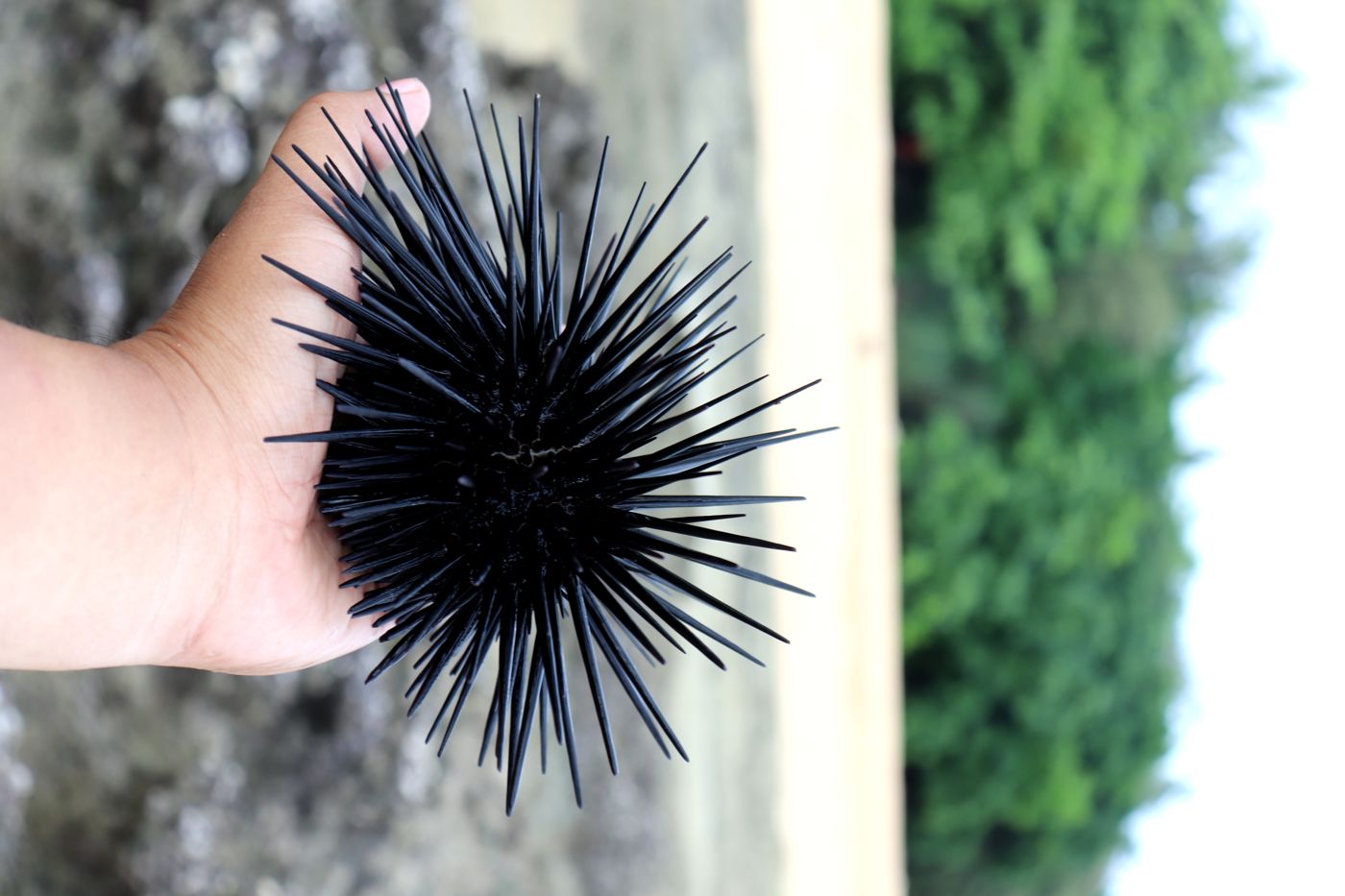 Photo: FroyAgta, CC BY-SA 4.0, via Wikimedia Commons
Origin & History
Seonggye is the general name for the sea urchins, echinoderms related to starfish and sea cucumbers. What Koreans eat is not the shell but the gonads, the soft yellow-orange lobes inside, usually called the roe. Around 30 species live in Korean waters, and the purple sea urchin is by far the most commonly harvested. Older Korean called them bamsongi-jogae, "chestnut-burr shellfish," for the way the spines bristle like a chestnut husk; on Jeju they are gusal or seomge. Jeong Yak-jeon's early-19th-century Jasan eobo described the purple urchin's roe as yellow and like unset tallow, sweet in taste, and eaten raw or in soup, which is still how it is eaten.
On Jeju, urchins belong to the haenyeo, the island's women free-divers. According to the Encyclopedia of Korean Folk Culture, the purple-urchin harvest picks up as the May agar-weed season winds down and peaks in June. Divers pry the animals out of rock crevices with a small hooked tool, and a five-hour dive can yield 30–40 kg of urchins. Then comes a second shift of about the same length at the divers' work shed, splitting each shell with a small knife, spooning out the roe and straining away bits of gut; only about a tenth of the catch by weight ends up as roe. Urchins are also a significant fishery on the east coast, where purple urchins are abundant.
Fresh roe is eaten straight from the shell, wrapped in raw miyeok, or mixed into rice, and it is salted into a short-keeping jeotgal eaten within a few days. Its most famous Jeju form is seonggye-guk, roe simmered with miyeok in a large pot: a local cousin of miyeok-guk traditionally served at feasts. The folk encyclopedia notes that families planning a wedding outside urchin season would buy roe in summer and freeze it, so the soup could still be served to guests. A rice porridge finished with urchin is cooked for children.
Nutrition
| Calories | 148 kcal |
|---|---|
| Protein | 15.8 g |
| Fat | 8.5 g |
| Carbohydrates | 2 g |
| Fiber | 0 g |
| Sodium | 190 mg |
Notable forIron (4 mg) · Potassium (490 mg) · Riboflavin (0.4 mg)
Values copied from the Korean Food Composition Table (Rural Development Administration / National Institute of Crop Science) for this exact food, per 100 g edible portion. Blank fields in the table are shown as not reported. The table lists purple sea urchin roe separately (성게, 보라성게, 알, 생것), along with salted urchin roe (성게, 젓갈). Actual values vary with ingredients, portion size and preparation.
Health Benefits
- Protein and minerals: Raw urchin roe supplies about 15.8 g of protein per 100 g in the Korean table, along with 4 mg of iron and 490 mg of potassium; a typical portion is much smaller than 100 g.
- Traditionally valued: Jeju tradition treats urchin as a restorative food, including for new mothers; these are folk beliefs, not established medical effects.
- Raw seafood: Urchin is normally eaten raw. The FDA advises pregnant women, young children, older adults and people with weakened immunity to avoid raw or undercooked seafood.
- Allergies: Sea urchins are echinoderms, not fish, crustaceans or mollusks, and are not among the nine U.S. major food allergens; anyone with seafood allergies who reacts to them should seek an allergist's advice.
- Salted roe: Urchin jeotgal is preserved with salt, so it is a much saltier food than fresh roe.
Informational, not medical advice. Talk to a qualified professional about your own health and diet.
Dishes with Sea urchin (seonggye)
Dish guides featuring sea urchin (seonggye) are coming soon.
Sources
- 01성게 (Sea urchin) — Encyclopedia of Korean Folk Culture, National Folk Museum of Korea
- 02성게 (Sea urchin) — Encyclopedia of Korean Culture
- 03Korean Food Composition Table — Sea urchin, Raw
- 04Selecting and Serving Fresh and Frozen Seafood Safely — U.S. Food and Drug Administration
- 05Food Allergies — U.S. Food and Drug Administration