Ingredient
Rice flour
쌀가루
Romanization: ssalgaru
Flour ground from rice — usually non-glutinous maepssal for steamed cakes and rice-cake sticks, glutinous chapssal for chewy, pounded or fried ones. It is the essential ingredient of tteok, and how it is milled shapes the texture of the finished cake.
Flavor
Clean, mild and lightly sweet. Steamed ordinary rice flour is soft, tender and slightly crumbly; glutinous rice flour turns dense, sticky and stretchy.
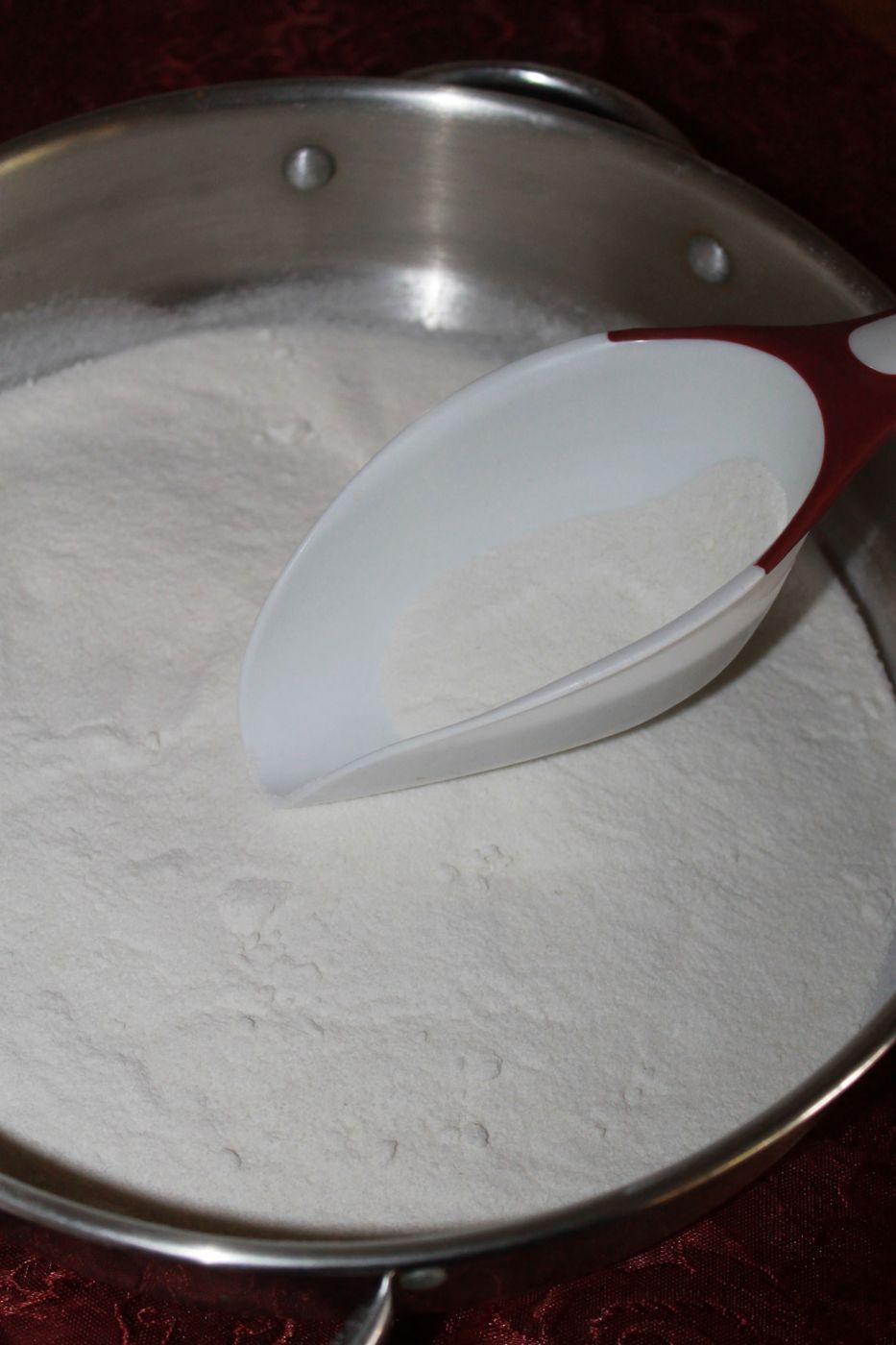 Photo: Nithyasrm, CC BY-SA 4.0, via Wikimedia Commons
Origin & History
Ssalgaru is simply rice flour, but in Korea it is above all tteok flour. An observation in the reference work Joseon sangsik, cited by the Encyclopedia of Korean Culture, contrasts the rice cakes of East Asia: Chinese cakes were based on baked wheat flour, Japanese on pounded glutinous rice, and Korean on steamed flour of ordinary non-glutinous rice. The plainest example is baekseolgi, a snow-white cake of moistened rice flour steamed in a siru. The Joseon-era Seongho saseol describes this method of dampening the flour before steaming. Two flours dominate: mepssalgaru from ordinary rice, for steamed layer cakes (siru-tteok) and the long white sticks of garaetteok; and chapssalgaru from glutinous rice, for boiled dumplings (danja and gyeongdan) and pan-fried flower cakes (hwajeon). See tteok and making tteok.
Food scientists distinguish two ways of making rice flour. In wet milling, the grain is soaked, drained and then ground, which produces very fine particles with little damaged starch. In dry milling, dry grain is ground directly. It is simpler and uses no water, but the flour tends to be coarser unless finely sieved, and grinding it finer raises the share of damaged starch. Those differences matter: a Korean study of baekseolgi found that flour particle size changed the cake's structure, with finer flour giving a looser, fluffier crumb and coarser flour a tighter, firmer one. Korean neighborhood mills (bangatgan) have traditionally ground rice that customers soaked at home, producing a damp flour that is steamed promptly.
Mills took over what was once home labor. The Encyclopedia of Korean Culture notes that as mills multiplied, tteok making moved out of the home, from grinding to steaming, until most families bought rice cakes ready-made. Until recently, it adds, people lined up at the mill from before dawn two or three days before Seollal to have garaetteok pressed for New Year's tteokguk.
Nutrition
| Calories | 378 kcal |
|---|---|
| Protein | 7.24 g |
| Fat | 1.07 g |
| Carbohydrates | 81.07 g |
| Fiber | 0.6 g |
| Sodium | 2 mg |
Notable forManganese (1.15 mg)
Values copied from the Korean Food Composition Table (Rural Development Administration / National Institute of Crop Science) for this exact food, per 100 g edible portion. The table does not say whether this sample was wet- or dry-milled; damp, freshly wet-milled flour contains more water and so somewhat less energy per 100 g. Actual values vary with ingredients, portion size and preparation.
Health Benefits
- A gluten-free flour: NIDDK lists rice flour among flours that are safe for people with celiac disease, which makes plain rice cakes a useful option — though many tteok are filled, coated or seasoned with other ingredients, so check labels on packaged products.
- Low in fiber: Polished rice flour is almost all starch, with very little fiber, fat or sodium per the Korean Food Composition Table; brown-rice flour retains more of the grain.
- Added salt and sugar in tteok: Rice cakes are often seasoned with salt in the flour and sweetened fillings or syrups, so read labels on packaged versions.
- Sticky cakes need care: Dense glutinous-rice cakes should be cut small and eaten slowly, especially by young children and older adults.
Informational, not medical advice. Talk to a qualified professional about your own health and diet.
Dishes with Rice flour
Dish guides featuring rice flour are coming soon.
Sources
- 01떡 (Tteok) — Encyclopedia of Korean Culture
- 02가래떡 (Garaetteok) — Encyclopedia of Korean Culture
- 03Fang, Chen, Xu, Liu & Zhong (2023). The possibility of replacing wet-milling with dry-milling in the production of waxy rice flour. Foods 12(2): 280
- 04The particle size of rice flour greatly affects the structural, textural and masticatory properties of steamed rice cake (Baekseolgi). Food Science and Biotechnology (2021)
- 05Korean Food Composition Table — Rice (Ssal), White, Powder
- 06Eating, Diet, & Nutrition for Celiac Disease — NIDDK