Ingredient
Japanese Spanish mackerel (samchi)
삼치
Romanization: samchi
A long, silver-blue mackerel that Korean homes salt and grill like godeungeo. On the south-coast islands around Yeosu and Geomundo, big autumn fish are eaten raw, wrapped in ripe kimchi.
Flavor
Mild and buttery for an oily fish, with soft, white, delicate flesh that browns well under salt; raw autumn belly is rich and almost melting.
Origin & History
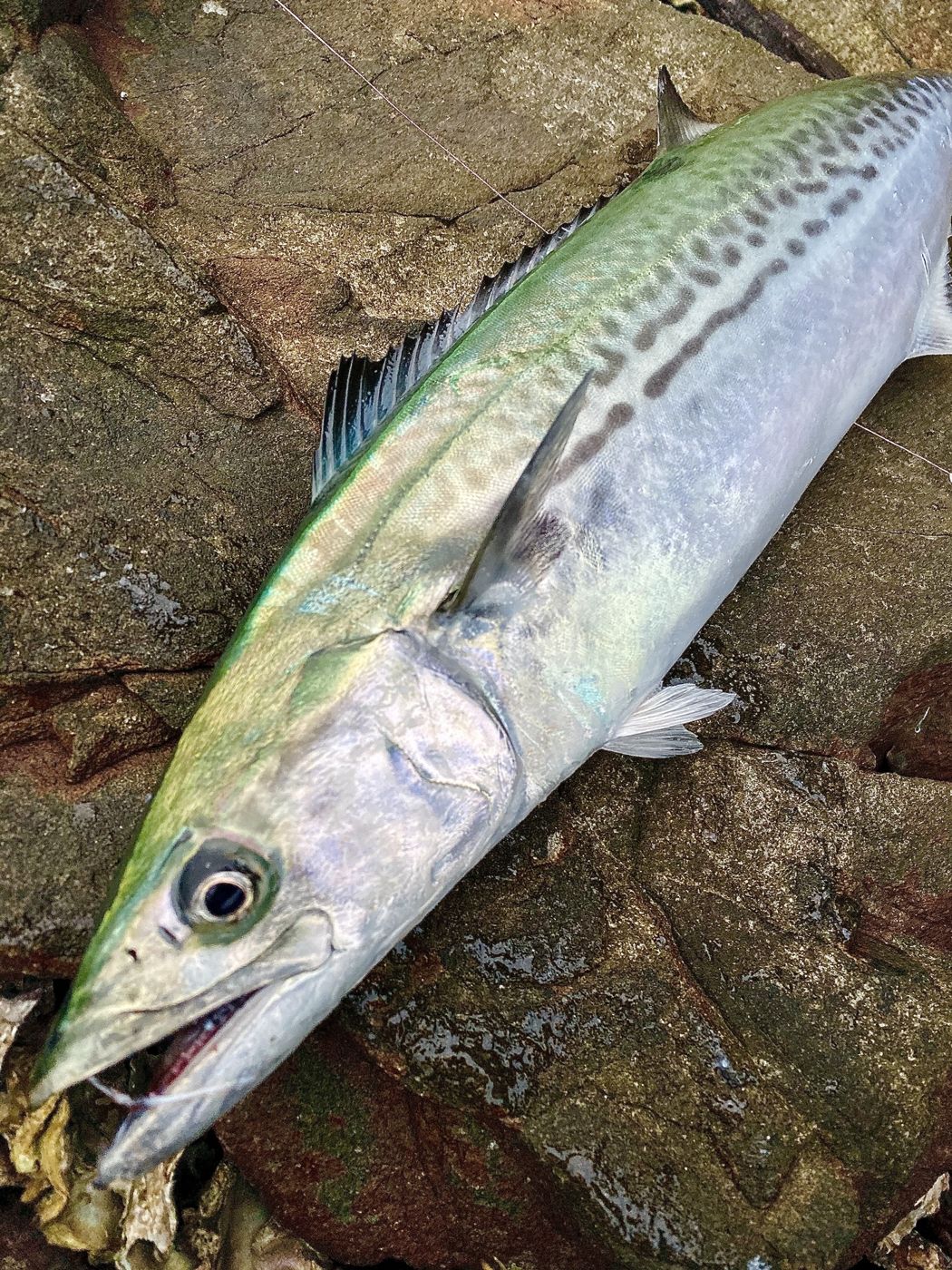
Samchi is the Japanese Spanish mackerel (sawara in Japanese), a fast-growing predator of the mackerel family that the Encyclopedia of Korean Folk Culture says can reach about a meter in seven years and weighs well over 7 kg at full size. Its back is gray-blue, its belly a metallic silver, and its sides are marked with seven or eight rows of gray spots. It moves north and inshore in spring and summer to spawn and feed, mainly on anchovies and sand lance, and returns south for the winter; around Geomundo it can be found year-round. Regional names include maeo on the west coast, mangeo in the east, and gosi in South Jeolla. The main grounds stretch from Cheongsando south through Geomundo, Chujado and the waters around Jeju, and fish from the south coast are exported to Japan.
Joseon records list it as mangeo, and the character for "to perish" in that name may have put off the gentry. Seo Yu-gu remarked that fishing households ate samchi readily while scholar-official families seldom served it, disliking the name; the folk encyclopedia adds that the fish spoils quickly and was hard to enjoy away from the coast. It is caught by drift net and set net, and by trolling: a traditional method of dragging shiny lures from bamboo poles off the stern, the fisher feeling for bites by hand.
On the mainland samchi is above all a grilling fish, salted or plain, alongside godeungeo and saury, and grilled-fish restaurants in Seoul and Incheon serve it widely. Fish under 50 cm are usual for the grill, but on the southern islands and in Yeosu, fish over 60 cm are sliced as samchi-hoe. The folk encyclopedia records islanders' praise that autumn samchi beats beef and is eaten "with the tongue, not the teeth"; the fatty belly is the prize, and slices are wrapped in well-fermented baechu-kimchi or gat-kimchi, or in gim with a seasoned dip. Autumn fish are richer than spring ones.
Nutrition
| Calories | 112 kcal |
|---|---|
| Protein | 20.08 g |
| Fat | 2.93 g |
| Carbohydrates | 0 g |
| Fiber | 0 g |
| Sodium | 39 mg |
Notable forPotassium (387 mg) · Phosphorus (211 mg) · Magnesium (30 mg)
Values copied from the Korean Food Composition Table (Rural Development Administration / National Institute of Crop Science) for this exact food, per 100 g edible portion. Blank fields in the table are shown as not reported. Fat in samchi varies with season; the folk encyclopedia notes autumn fish are fattier than spring fish. Actual values vary with ingredients, portion size and preparation.
Health Benefits
- Protein and minerals: Raw samchi has about 20 g of protein per 100 g in the Korean table, with 387 mg of potassium and 211 mg of phosphorus and only 39 mg of sodium before salting.
- Mercury: The FDA/EPA advice lists Spanish mackerel as a "Good Choice" (eat one serving a week); that rating refers to American Spanish mackerel, a related species, and samchi itself is not separately rated. King mackerel, a larger relative, is on the "Choices to Avoid" list.
- Fish allergy: Fish is one of the nine major food allergens under U.S. law.
- Salt and raw fish: Salted samchi for grilling adds sodium. For samchi-hoe, the FDA advises at-risk groups to avoid raw fish and suggests previously frozen fish to kill parasites.
Informational, not medical advice. Talk to a qualified professional about your own health and diet.
Dishes with Japanese Spanish mackerel (samchi)
Dish guides featuring japanese spanish mackerel (samchi) are coming soon.
Sources
- 01삼치 (Japanese Spanish mackerel) — Encyclopedia of Korean Folk Culture, National Folk Museum of Korea
- 02삼치잡이 (Spanish mackerel fishing) — Encyclopedia of Korean Folk Culture, National Folk Museum of Korea
- 03Korean Food Composition Table — Spanish mackerel, Raw
- 04Advice about Eating Fish — U.S. Food and Drug Administration / EPA
- 05Selecting and Serving Fresh and Frozen Seafood Safely — U.S. Food and Drug Administration
- 06Food Allergies — U.S. Food and Drug Administration