Ingredient
Pacific saury (kkongchi)
꽁치
Romanization: kkongchi
A slender, oily autumn fish that Koreans grill, braise, simmer with kimchi from the can, and, around Pohang, wind-dry into gwamegi, the chewy winter delicacy eaten wrapped in seaweed.
Flavor
Rich, oily and assertively fishy-savory, with soft, dark-edged flesh that crisps beautifully on the grill; gwamegi is chewy, fatty and deeply savory, with a pronounced marine aroma.
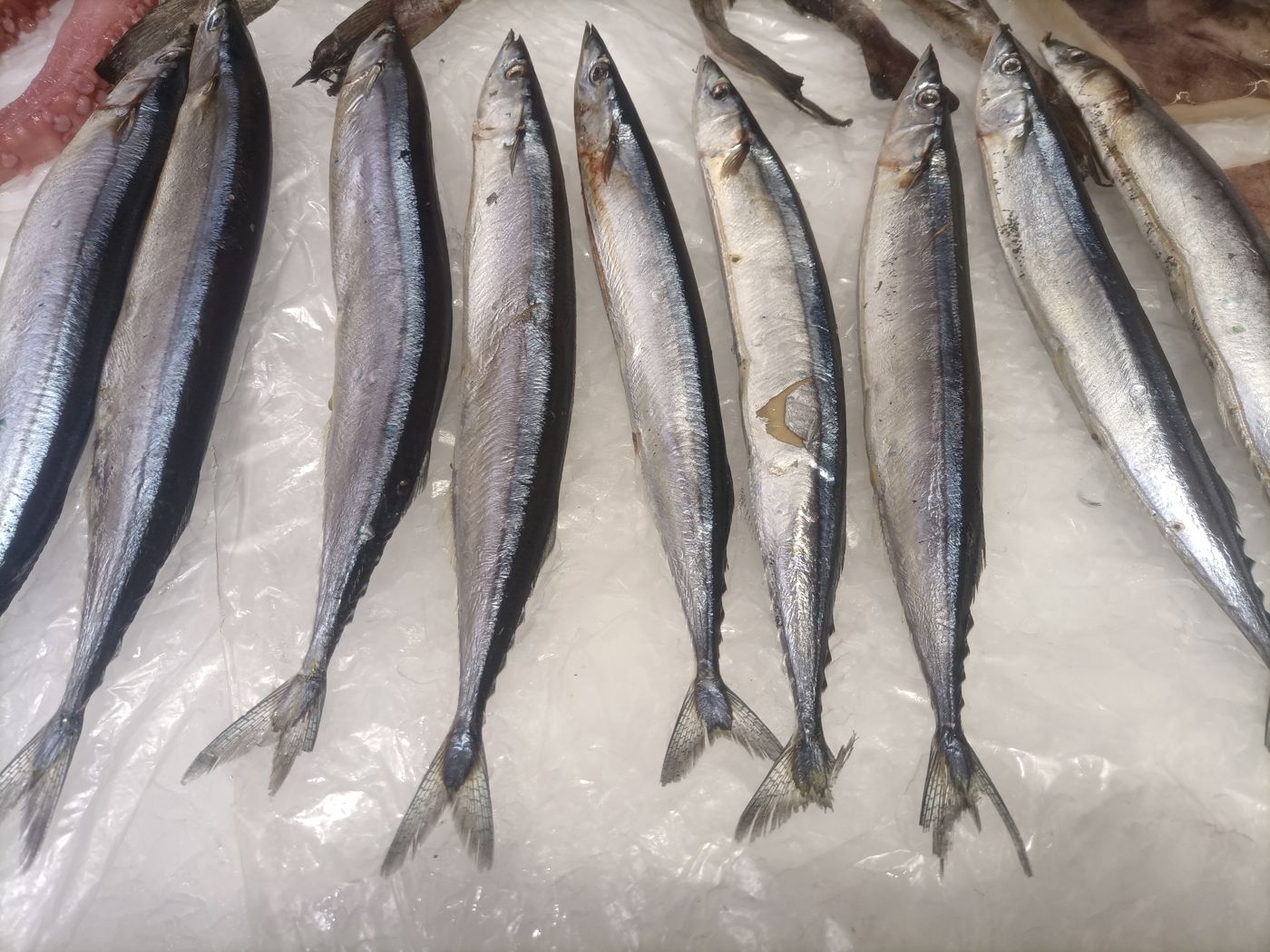 Photo: Fumikas Sagisavas, CC0, via Wikimedia Commons
Origin & History
Kkongchi is the Pacific saury, a long, needle-jawed fish with a dark blue-green back and silver belly. Jeong Yak-yong's Aeongakbi explained the name: a small, needle-like hole near the gills earned it the name gongchi, which hardened over time into kkongchi. It is a warm-current fish; Korean catches grew after 1945, peaked in the mid-1970s, and have declined unevenly since the 1980s, with frozen imports and distant-water fishing now meeting much of the demand. According to the Encyclopedia of Korean Folk Culture, saury is fattiest and best in October and November, when its fat content reaches about 20 percent.
It is one of Korea's most ordinary fish: grilled, braised, salted, canned, and simmered with sour, aged kimchi in the canned-saury kimchi-jjigae that has whole restaurants devoted to it. Coastal cooks have more specific uses. On the east coast, roe-filled spring saury is salted whole into kkongchi-jeot, eaten as a side dish after a month or so and eventually used as a liquid seasoning. In Pohang, raw saury is minced into dumplings for a spicy vegetable soup, and on Ulleungdo fishers once caught spawning saury by hand under floating mats of seaweed and turned them into mulhoe.
Its most famous form today is gwamegi, the specialty of Pohang. The folk encyclopedia explains that gwamegi originally meant herring hung by the eyes to dry, a name thought to come from gwanmok ("pierced eye"), and was already an east-coast specialty by the late 18th century. Herring dominated during the colonial period, but once saury became plentiful in the 1960s it took over. From mid-November, saury are strung on racks by the sea at Guryongpo and nearby and left to freeze and thaw in the winter wind until chewy and half-dried, below about 40 percent moisture. Purists eat the whole fish; most people buy split, skinned fillets and wrap them in raw miyeok, dashima or gim with garlic, green onion and chili paste. Gwamegi won national fame only from the mid-1990s, helped by vacuum packing, and Guryongpo holds a festival for it every year.
Nutrition
| Calories | 142 kcal |
|---|---|
| Protein | 22.7 g |
| Fat | 4.7 g |
| Carbohydrates | 0.4 g |
| Fiber | 0 g |
| Sodium | 80 mg |
Notable forNiacin (6.4 mg) · Phosphorus (241 mg) · Riboflavin (0.28 mg)
Values copied from the Korean Food Composition Table (Rural Development Administration / National Institute of Crop Science) for this exact food, per 100 g edible portion. Blank fields in the table are shown as not reported. Saury fat varies greatly by season (the folk encyclopedia cites about 20% in October–November), so this sample is a lean one. Gwamegi (꽁치(과메기), 동건품) is listed separately at 421 kcal, 32.1 g protein and 29.9 g fat per 100 g. Actual values vary with ingredients, portion size and preparation.
Health Benefits
- Protein and B vitamins: Raw saury has about 22.7 g of protein per 100 g in the Korean table, with 6.4 mg of niacin; the oily autumn fish and gwamegi are richer in fat, including omega-3 fats typical of oily fish.
- Fish allergy: Fish is one of the nine major food allergens under U.S. law.
- Mercury: The FDA/EPA advice on eating fish does not rate Pacific saury, so it offers no specific mercury guidance for it.
- Gwamegi is not cooked: It is air-dried and eaten without cooking. The FDA advises pregnant women, young children, older adults and people with weakened immunity to avoid raw or undercooked fish.
- Canned and salted forms: Canned saury in kimchi stew and salted kkongchi-jeot add considerable sodium.
Informational, not medical advice. Talk to a qualified professional about your own health and diet.
Dishes with Pacific saury (kkongchi)
Dish guides featuring pacific saury (kkongchi) are coming soon.
Sources
- 01꽁치 (Pacific saury) — Encyclopedia of Korean Folk Culture, National Folk Museum of Korea
- 02과메기 (Gwamegi) — Encyclopedia of Korean Folk Culture, National Folk Museum of Korea
- 03Korean Food Composition Table — Pacific saury, Raw
- 04Korean Food Composition Table — Pacific saury (gwamegi), Frozen dried
- 05Selecting and Serving Fresh and Frozen Seafood Safely — U.S. Food and Drug Administration
- 06Food Allergies — U.S. Food and Drug Administration