Ingredient
Mussels
홍합
Romanization: honghap
The dark-shelled mussel behind Korea's milky seafood broths, miyeok soups and street-stall stews. Cooks use it fresh and dried, and braised sweet-salty in the old court dish honghap-cho.
Flavor
Briny but gentle, with a faint natural sweetness. The meat is plump and chewy-tender, and the cooking liquid becomes a milky, savory broth that needs little else.
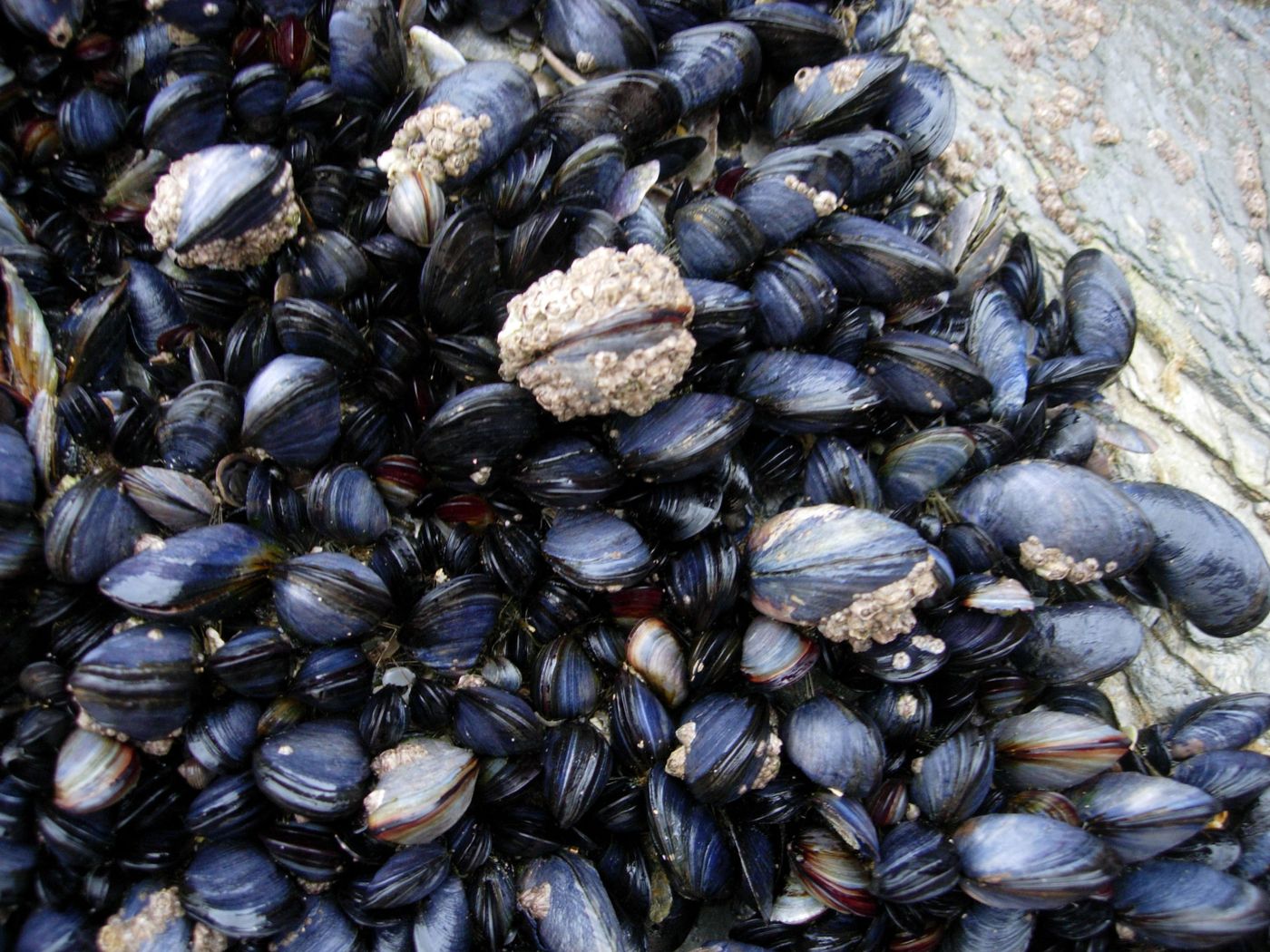 Photo: Wilson44691 at English Wikipedia, Public domain, via Wikimedia Commons
Origin & History
Honghap means 'red clam,' for the reddish flesh. The Encyclopedia of Korean Folk Culture notes that Korea has some two dozen mussel-family shellfish but only a few are eaten: the big native honghap, the east-coast donghae-honghap and the jinju-damchi, the Mediterranean mussel. The big native mussel clings to reefs in deeper water and is gathered by hand, which makes it scarce and pricey. The mussels served in street stalls and seafood noodle shops today are mostly the Mediterranean mussel. According to the folk encyclopedia it is a European species that arrived in the 1950s, probably on ship hulls or in ballast water, and it is now harvested from heavy ropes lowered into the sea. Fresh mussels threaded on skewers and sun-dried were known as hapja.
Old texts treated the mussel with respect. The folk encyclopedia quotes the Donguibogam, a medical text, calling it 'wife of the East Sea' (donghae-buin), plain in looks but greatly nourishing. It quotes the Gyuhap chongseo (1815) giving another name, damchae ('bland vegetable'), because it is the one unsalty creature among salty seafoods. Jeong Yak-jeon's Jasaeobo describes mussels clustering by the hundreds on reefs, opening with the incoming tide and closing as it recedes. In the court kitchen, the folk encyclopedia says, honghap-cho, mussels braised in soy sauce, sugar and sesame oil, was served alongside the skewered hwayang-jeok. A starch-free version was also set out on offering tables (see royal court cuisine and jesa food).
At home, mussels go into soups and stews. The folk encyclopedia lists honghap-miyeokguk (see miyeok-guk), the soup used in ritual cooking, porridge, baeksuk (poached), sujebi dumpling soup, squid stew, bean sprouts and tteokbokki. The broth is described as milky and refreshing. Cooks simmer them just until the shells open. For a wider seafood pot, see haemul-tang, and for relatives, clams and oysters.
Nutrition
| Calories | 82 kcal |
|---|---|
| Protein | 13.8 g |
| Fat | 1.2 g |
| Carbohydrates | 3.1 g |
| Fiber | Not reported |
| Sodium | Not reported |
Notable forProtein · Iron (6.1 mg) · Phosphorus (249 mg)
Values copied from the Korean Food Composition Table (Rural Development Administration / National Institute of Crop Science) for this exact food, per 100 g edible portion. Blank fields in the table are shown as not reported. The table lists a refuse (shell) portion of 76 percent, so a kilogram of mussels in the shell yields little meat. It also gives 43 mg calcium per 100 g. Actual values vary with ingredients, portion size and preparation.
Health Benefits
- Lean protein and minerals: Per the Korean Food Composition Table, raw mussel meat provides about 14 g of protein and 6.1 mg of iron per 100 g edible portion, with little fat.
- Traditional reputation: The folk encyclopedia says mussels are valued for taurine, calcium, phosphorus and iron, and old texts call the mussel a restorative food. These are traditional beliefs, not claims about treating illness.
- Shellfish toxins: The folk encyclopedia notes that mussels can carry shellfish toxins, usually between late April and late June, caused by toxic algae the shellfish feed on rather than by the mussel itself. Buy from a reliable source and heed local harvest advisories.
- Cook until open: The FDA advises discarding mussels with cracked shells and any that stay open when tapped before cooking or fail to open during cooking. It also advises pregnant women, children, older adults and people with weakened immune systems to avoid raw or undercooked fish and shellfish.
- Allergy: People with a known shellfish allergy should check with their clinician before eating mussels. See allergens in Korean food.
Informational, not medical advice. Talk to a qualified professional about your own health and diet.
Dishes with Mussels
Dish guides featuring mussels are coming soon.
Sources
- 01홍합 (Mussel) — Encyclopedia of Korean Folk Culture (한국의식주생활사전)
- 02홍합초 (Honghap-cho, braised mussels) — Encyclopedia of Korean Folk Culture (한국의식주생활사전)
- 03담치, 참담치(홍합), 생것 (Hard shelled mussel, raw) — Korean Food Composition Table, RDA
- 04Selecting and Serving Fresh and Frozen Seafood Safely — U.S. Food and Drug Administration