History & Culture
Korean Convenience-Store Food
편의점 음식
Triangle gimbap, packed dosirak and instant ramyeon eaten at the window counter: how South Korea's dense network of convenience stores became part of the everyday food landscape.
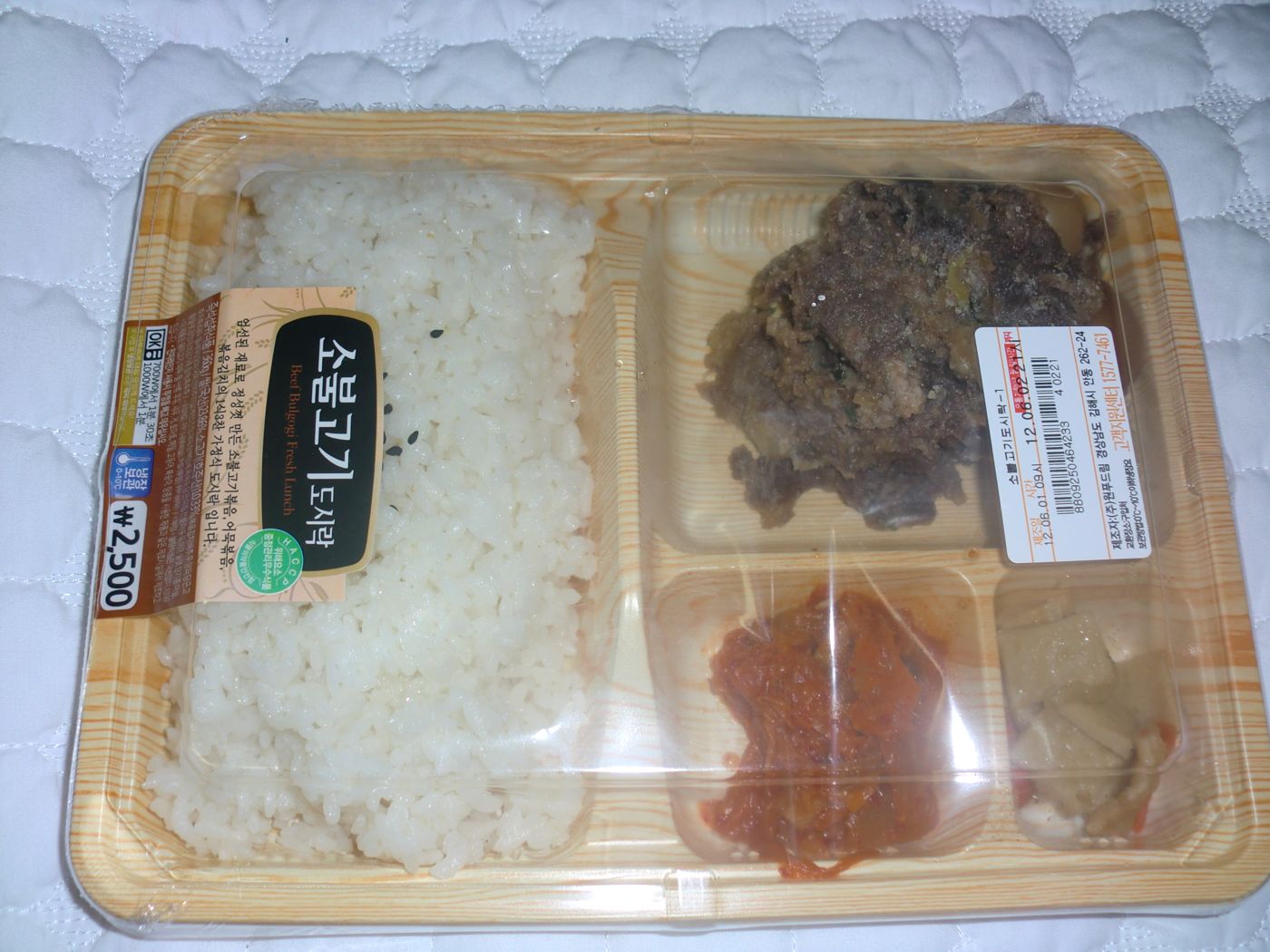 Photo: hyolee2, CC BY-SA 3.0, via Wikimedia Commons
In South Korea the pyeonuijeom (편의점), convenience store, is less a place to pick up a snack than a small, always-open food hall. Rice balls, packed lunches, instant noodles with free hot water, sandwiches, fruit cups and drinks fill the shelves, and many stores have a counter or a few tables where people eat on the spot. For students, office workers and the growing number of people who live alone, it is a regular part of the week.
How many stores?
Korea has an unusually dense network. Citing Statistics Korea, a 2026 study in Frontiers in Public Health counts 43,975 convenience stores in 2019 and 57,617 in 2022, a rise of about 31 percent in three years. Counting only the four largest chains, an industry association put the total at 55,194 at the end of 2023, slightly below the 2022 peak. The Korea JoongAng Daily, comparing that figure with Japan's, works out roughly one store for every 940 people in Korea against one for about 2,150 in Japan.
Growth has now flattened. In May 2025 the JoongAng Daily reported that the industry was showing its first declines in both store numbers and sales since tracking began, as e-commerce and overnight grocery delivery took business, and price wars cut margins. The same report notes that food has traditionally made up more than half of convenience-store revenue.
The chains themselves arrived in the late 1980s, and the boom is usually linked to the rise of single-person households, long working hours and city life.
What people eat
- Samgak-gimbap (삼각김밥): A triangle of seasoned rice with a filling, such as tuna and mayonnaise, spicy pork or bulgogi, wrapped in gim. The packaging keeps the seaweed in a separate film so that it stays crisp until the wrapper is pulled apart. The format adapts the Japanese convenience-store onigiri; it is a cousin, not a version, of rolled gimbap.
- Dosirak (도시락): Boxed meals of rice with several small sides, often a miniature banchan spread of meat, egg roll, kimchi and a vegetable. They continue the long tradition of the packed lunch described in dosirak.
- Ramyeon: Cup and bag ramyeon are staples, and many stores supply hot water and, increasingly, cooking machines so that customers can eat at the window counter. Shoppers often combine items: ramyeon with a triangle gimbap, or with cheese, sausage and kimchi.
- Other ready meals: Sandwiches, salads, tteokbokki cups, fried chicken, hot bars, fruit, dairy and a wide range of drinks, along with frozen dishes for the microwave.
Nutrition: convenient, but check the label
Convenience-store meals are filling and inexpensive, but they are often high in sodium and refined carbohydrate and low in vegetables and fiber. A 2024 study in Nutrition Research and Practice, citing Korean government survey data, gives the average sodium content of a convenience-store dosirak as 1,361 mg, about two-thirds of the World Health Organization's daily limit of 2,000 mg. Instant noodles, especially if the broth is finished, add considerably more. A 2025 analysis of ready-to-eat foods found that both vegetarian and nonvegetarian options fell short of one-third of daily nutrient reference values for a single meal while still carrying high sodium.
Research at population level is still developing. The Frontiers study found that districts with more convenience stores per person had a higher prevalence of hypertension, but that is an association across areas, not proof that the stores cause it. Researchers have proposed healthier options, such as lower-sodium meals and clearer labeling, as a way to use the stores' reach for good. Practical habits help: read the nutrition panel, leave some of the broth, and add fruit, milk or a salad. For context, see sodium in Korean food and the balanced Korean meal.
Food safety
Chilled rice meals and sandwiches have short shelf lives and depend on an unbroken cold chain. Check the date and time printed on the label, avoid packs that feel warm or are swollen, and eat them soon after buying rather than carrying them around for hours on a hot day. Reheat dosirak until steaming throughout, following the package's microwave instructions. The same principles appear in food safety at home.
A changing food landscape
Convenience-store eating sits alongside street food and restaurants in the story of food in modern Korea. It reflects a society with longer working days, more people living alone and less time to cook, yet it echoes older habits: rice as the center of the meal, a lunchbox with banchan, a bowl of noodles shared at a counter.
Sources
- 01The golden age of convenience stores is over. Here's what's tanking their sales. — Korea JoongAng Daily (2025)
- 02Spatial analysis of the association between convenience store density and the prevalence of obesity and hypertension in South Korea — Frontiers in Public Health (2026)
- 03A study on the consumer behavior and attitude toward low-sodium convenience store foods — Nutrition Research and Practice (2024)
- 04Comparative nutritional assessment of vegetarian and nonvegetarian ready-to-eat foods — Clinical Nutrition Research