Ingredient
Instant noodles (ramyeon)
라면
Romanization: ramyeon
Steamed and fried wheat noodles packed with a seasoning sachet, cooked in minutes. Beyond the bowl itself, the noodle block is a pantry ingredient, added as ramyeon sari to budae-jjigae.
Flavor
Springy, slightly chewy noodles with a toasty, fried-wheat flavor; the soup base is intensely savory and salty, and Korean brands lean toward a spicy, chili-red broth.
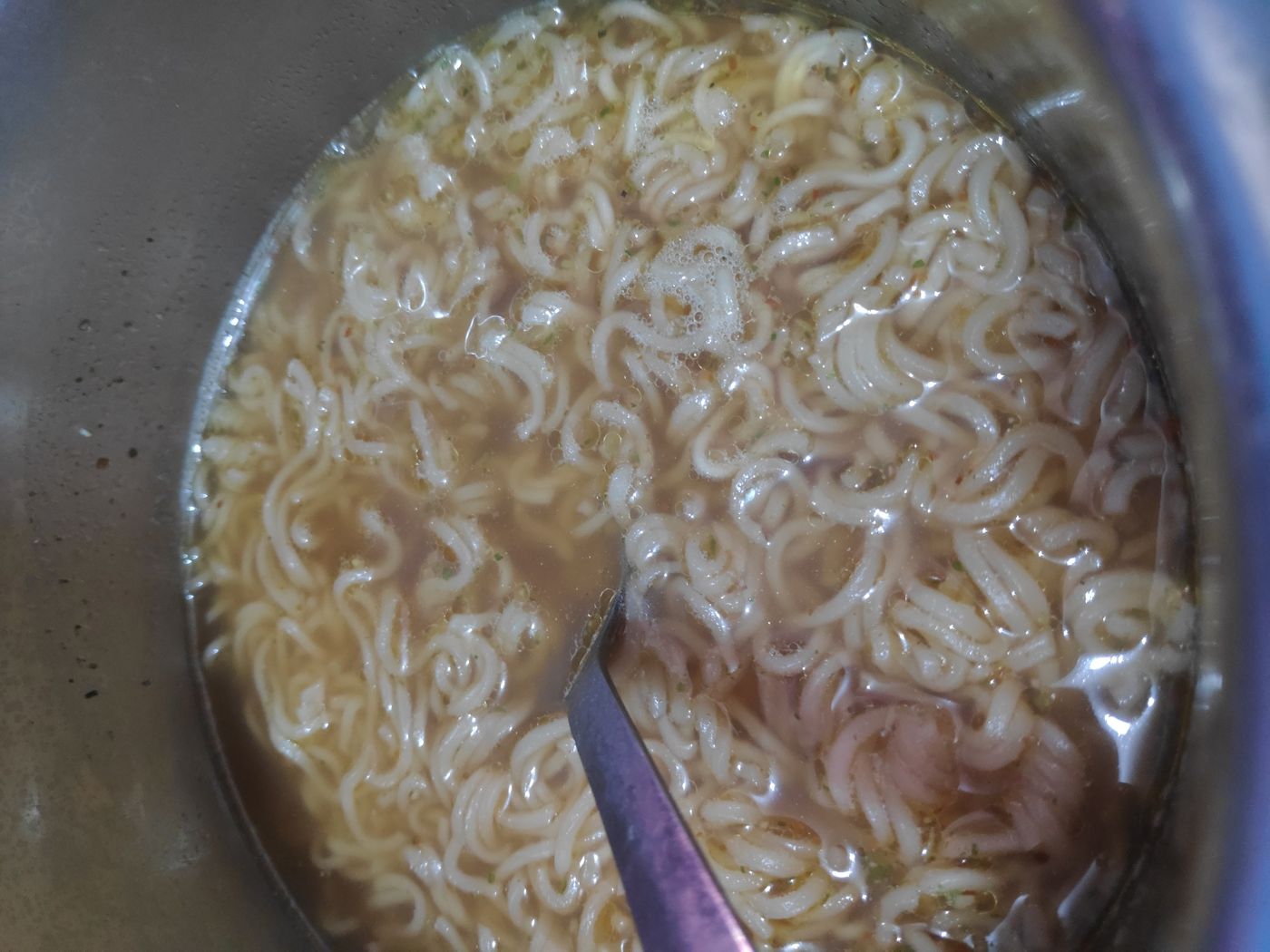 Photo: Gaurav Dhwaj Khadka, CC BY-SA 4.0, via Wikimedia Commons
Origin & History
Ramyeon is Korea's instant noodle: wheat dough is mixed, cut into wavy noodles, steamed, shaped into a block, deep-fried and cooled, then packed with a powdered or liquid soup base made from dried meat extracts, seasonings, spices and salt. Instant noodles were invented in Japan, which began producing them in the late 1950s. Samyang Foods made Korea's first in 1963.
Early ramyeon was a pricey novelty, but the industry grew fast. Annual production passed a billion packs by the mid-1970s, and exports began in the late 1970s. The 1980s brought cup noodles that need only boiling water. A 2017 study in Nutrition Research and Practice describes South Korea as having the highest per-capita instant noodle consumption in the world. The noodles' rise was part of the wider postwar shift to wheat described in noodles in Korean history.
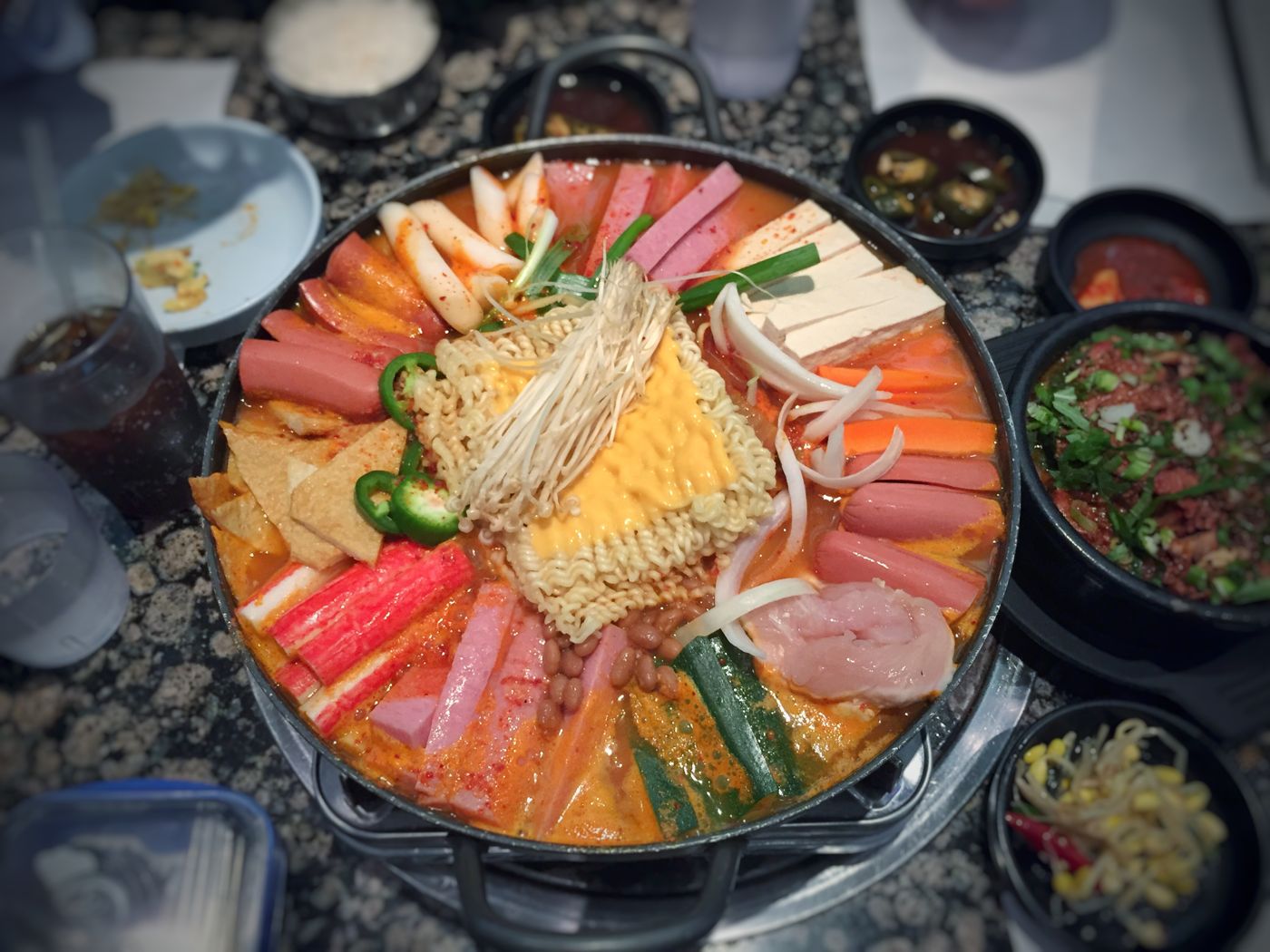
Koreans also treat the noodle block as an ingredient. As ramyeon sari, a portion of plain noodles, it goes into budae-jjigae, the army-base stew of ham, sausage, kimchi and tofu. The Encyclopedia of Korean Culture notes that early versions of the stew had no ramyeon at all: the noodles arrived only in 1963 and were at first too expensive to add.
Nutrition
| Calories | 416 kcal |
|---|---|
| Protein | 8.6 g |
| Fat | 12.6 g |
| Carbohydrates | 67.12 g |
| Fiber | 2.3 g |
| Sodium | 1472 mg |
Notable forSodium (1,472 mg) · Calcium (203 mg) · Riboflavin (1.11 mg)
Values copied from the Korean Food Composition Table (Rural Development Administration / National Institute of Crop Science) for this exact food, per 100 g edible portion. The noodle block alone (Ramyeon, Dry noodle / 라면, 말린것) lists 432 kcal, 13.56 g fat and 327 mg sodium per 100 g — most of the salt is in the seasoning packet. A typical single pack weighs more than 100 g, so a whole pack with its seasoning delivers more than these figures. Actual values vary with ingredients, portion size and preparation.
Health Benefits
- Energy-dense and fried: The noodles are deep-fried during manufacture, so ramyeon is high in fat and energy per 100 g in the Korean Food Composition Table, with modest protein and fiber.
- Most of the salt is in the packet: With seasoning, ramyeon lists about 1,470 mg sodium per 100 g, against about 330 mg for the noodle block alone. Using half the packet, or leaving some broth, cuts salt considerably. The U.S. FDA's Daily Value for sodium is less than 2,300 mg a day.
- Frequent eating linked to risk factors: A study of 3,397 Seoul college students found that eating instant noodles three or more times a week was associated with higher triglycerides, fasting glucose and, in women, diastolic blood pressure. This was an observational finding and does not prove cause and effect.
- Allergens and gluten: Ramyeon is made from wheat and seasonings often contain soy, both major allergens the U.S. FDA requires on labels; wheat noodles are unsuitable for people with celiac disease.
Informational, not medical advice. Talk to a qualified professional about your own health and diet.
Sources
- 01라면 (Ramyeon) — Encyclopedia of Korean Culture
- 02부대찌개 (Budae-jjigae) — Encyclopedia of Korean Culture
- 03Korean Food Composition Table — Ramyeon, Noodle and seasoning, Unprepared
- 04Instant noodle consumption is associated with cardiometabolic risk factors among college students in Seoul. Nutrition Research and Practice (2017)
- 05Sodium in Your Diet — U.S. Food and Drug Administration
- 06Food Allergies — U.S. Food and Drug Administration