Ingredient
Makgeolli (Unfiltered Rice Wine)
막걸리
Romanization: makgeolli
Milky, lightly fizzy Korean rice wine brewed from rice, nuruk and water and strained rather than clarified, usually around 6 to 8 percent alcohol. Drunk with jeon and kimchi, it also leavens steamed buns.
Flavor
Creamy and off-white, with a gentle fizz, mild sweetness and a lactic, yogurt-like tang over a grainy, rice-sweet base. Nuruk-brewed bottles are earthier and more sour; unpasteurized (*saeng*) makgeolli keeps changing, growing drier and tangier as it ages.
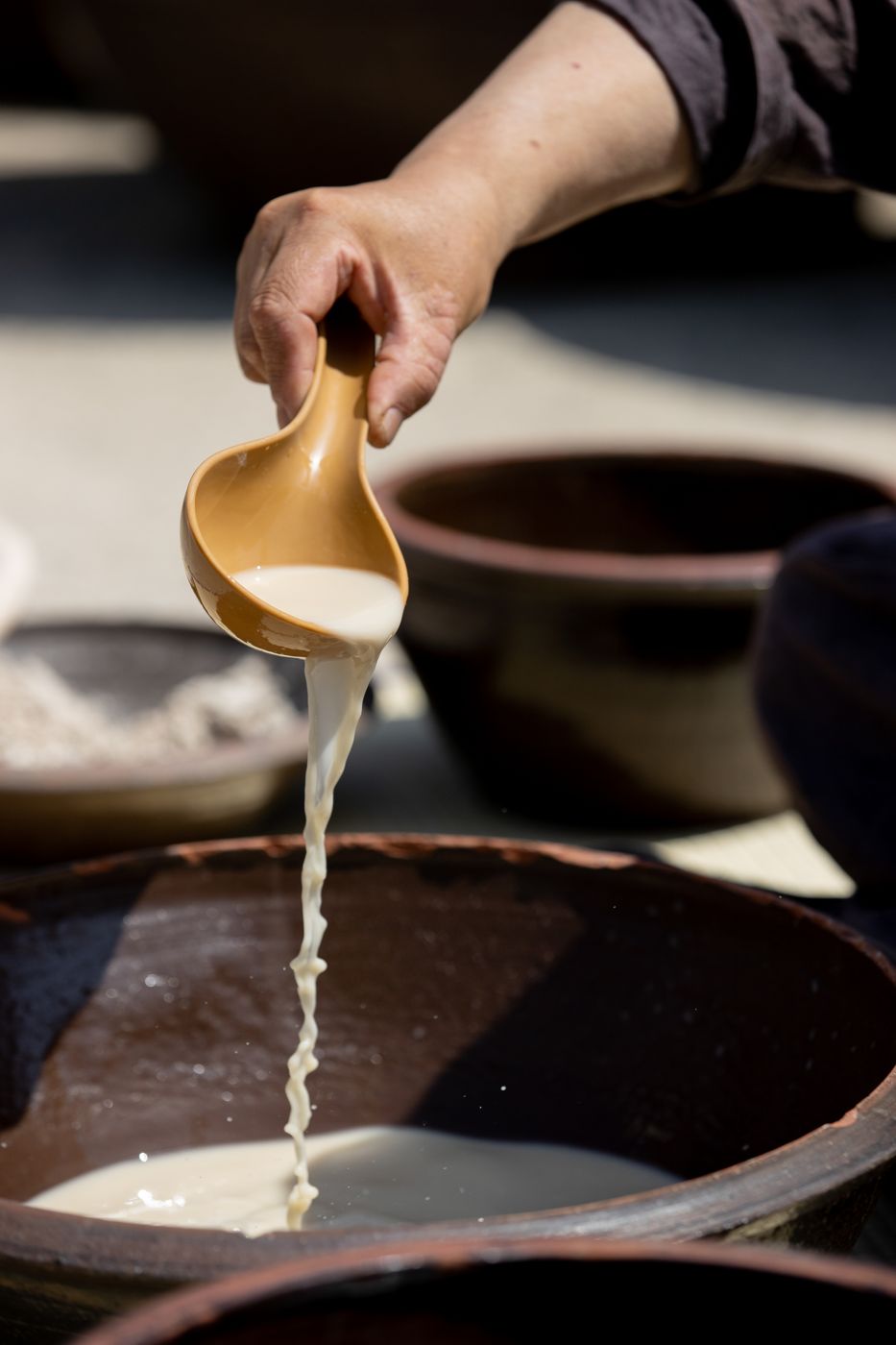 Photo: Republic of Korea, CC BY-SA 2.0, via Wikimedia Commons
Origin & History
The name is usually explained as ‘roughly strained’ or ‘just strained’: the fermented mash is pushed through a sieve or cloth instead of being left to settle into clear yakju. The Encyclopedia of Korean Culture's entry on makgeolli brewing finds an early trace in the 1123 Goryeo dogyeong, whose Song author noted that commoners, unable to get the fine palace wine, drank a thinner, darker brew. Makgeolli went by many names, from the literary takju (cloudy wine) to everyday takbaegi, and it was drunk across social classes.
It is made from starchy grain, nuruk and water. Rice was the usual base, but in the 1960s, amid rice shortages, breweries were supplied with wheat flour and flour makgeolli became common; regions also added millet, corn or sweet potato. Nuruk shapes the flavor most. Breweries largely switched from wild-fermented wheat nuruk to ipguk, rice inoculated with cultured white koji mold, from the 1960s. Typical strength is 6 to 8 percent, with lighter 3 to 5 percent products and premium 10 to 12 percent brews from small breweries.
Makgeolli was the farmer's drink, carried to the paddies at rice-planting time, and the wine of village rites. Home brewing was effectively banned after liquor-tax rules tightened in 1935 and became legal again for personal use in 1995. ‘Makgeolli brewing’ was designated a National Intangible Cultural Heritage of Korea in 2021. The encyclopedia calls it ‘liquid rice,’ which is why banchan double easily as anju; sour, well-fermented kimchi is the classic partner, alongside haemul-pajeon, dubu-kimchi and bossam. In the kitchen it is also used to leaven steamed buns (makgeolli-ppang).
Nutrition
| Calories | 52 kcal |
|---|---|
| Protein | 0.98 g |
| Fat | 0.15 g |
| Carbohydrates | 1.13 g |
| Fiber | 0.6 g |
| Sodium | 3 mg |
Values from the Korean Food Composition Table (RDA). Most of the energy comes from alcohol rather than carbohydrate. The same table lists a traditional 10% makgeolli at 119 kcal, 9.6 g carbohydrate and 8.7 g total sugars per 100 g, so sweeter, stronger brews carry noticeably more calories. Actual values vary with ingredients, portion size and preparation.
Health Benefits
- Live cultures: Unpasteurized makgeolli is sold with its lactic acid bacteria and yeasts still alive, which the Encyclopedia of Korean Culture describes as one of its distinctive traits. Research on makgeolli microbes is ongoing; it is not a probiotic supplement.
- It is alcohol: Whatever its cultures, makgeolli is an alcoholic drink. The CDC advises that adults who drink limit intake to two drinks or fewer a day for men and one or fewer for women, notes that even moderate drinking may raise risks of some cancers and other diseases, and advises people who do not drink not to start.
- Who should avoid it: The CDC lists people who are pregnant or may be pregnant, those under 21, people with certain medical conditions or on interacting medications, and people recovering from alcohol use disorder.
- Gluten: Many makgeolli are brewed with wheat nuruk or wheat flour; people with celiac disease should check labels.
- Sugar and calories: Commercial makgeolli is often sweetened; lighter-tasting does not mean low in calories.
Informational, not medical advice. Talk to a qualified professional about your own health and diet.
Dishes with Makgeolli (Unfiltered Rice Wine)
Sources
- 01막걸리 빚기 (Makgeolli brewing) — Encyclopedia of Korean Culture
- 02술 (Sul, Korean liquor) — Encyclopedia of Korean Culture
- 03국가무형유산 막걸리 빚기 (Makgeolli brewing, National Intangible Heritage) — Korea Heritage Service
- 04발효주, 탁주, 막걸리, 알코올 6% (Makgeolli, 6% alcohol) — Korean Food Composition Table, RDA
- 05About Moderate Alcohol Use — U.S. Centers for Disease Control and Prevention
- 06Eating, Diet, & Nutrition for Celiac Disease — NIDDK