History & Culture
The Kimchi Refrigerator: A Modern Kimjang Jar
김치냉장고
Why Korea invented a refrigerator just for kimchi, how it stands in for the buried jar of the past, and how it reshaped winter kimchi-making in apartments.
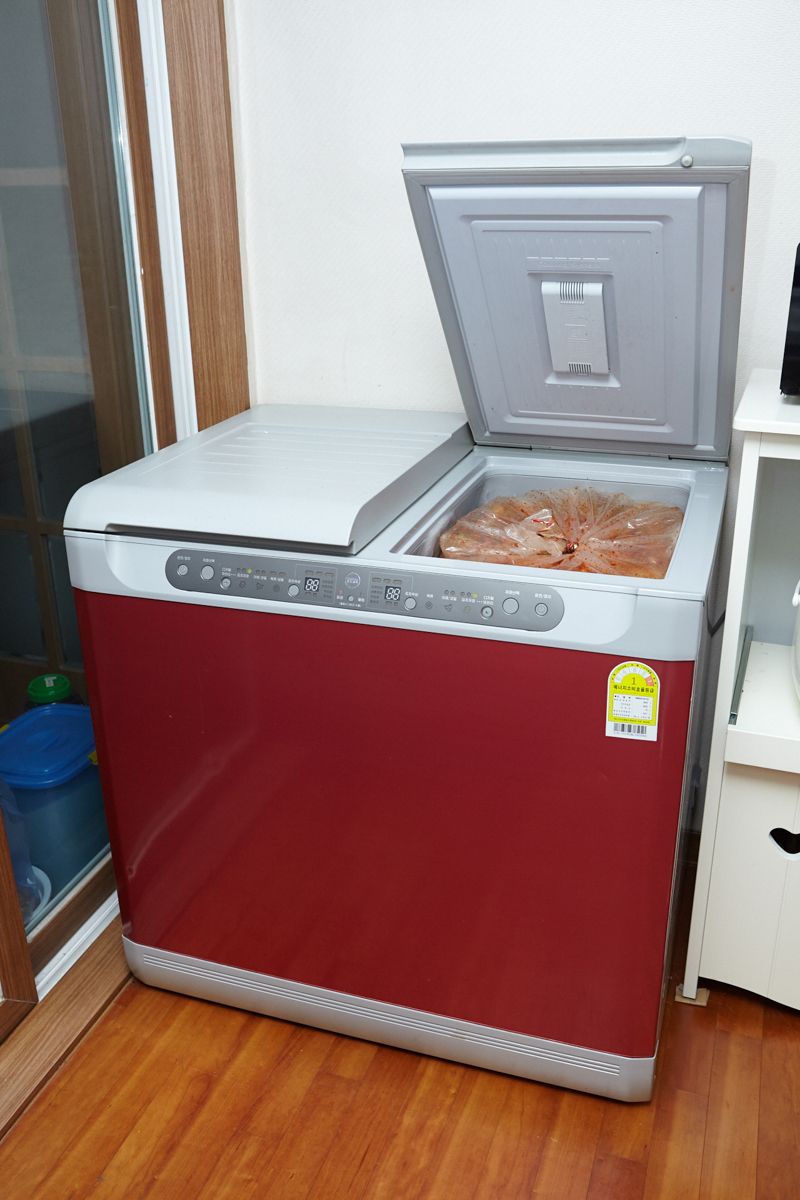 Photo: 국립국어원, CC BY-SA 2.0 kr, via Wikimedia Commons
Few appliances are as tied to one food as the kimchi refrigerator (gimchi-naengjanggo, 김치냉장고). Many Korean homes have two refrigerators: a general one for daily groceries and a second, usually a chest-style or top-opening unit, kept at a precise temperature for kimchi. To see why, start with how kimchi was stored before it existed.
The buried jar it replaced
Kimjang kimchi has to last the winter, which means holding it cold without freezing it while it ripens slowly. The traditional answer was the onggi jar, wrapped in straw and buried deep so that the ground's steady temperature smoothed out swings in the air above (see kimjang and onggi). The Encyclopedia of Korean Culture says kimchi is best kept at about 5°C for four to six weeks. A Rural Development Administration article gives a similar picture: roughly 2 to 5°C and three to four weeks gives the best flavor, and if fermentation keeps going the kimchi turns too sour and the lactic acid bacteria begin to die back.
That arrangement requires a yard. As more families moved into apartments, there was nowhere to bury a jar. The encyclopedia describes the first workarounds: double-walled plastic kimchi pots insulated with foam, or jars sunk in sawdust or rice husks. The kimchi refrigerator was the next step.
From a niche product to a household staple
According to the Rural Development Administration, a company called Biltek developed the first kimchi refrigerator in 1993, and Winia Mando brought its Dimchae model to market in December 1995. A trade-press account credits Dimchae's success to direct cooling, which chills the storage walls themselves instead of blowing cold air, and to a long marketing campaign that put units into housewives' hands for trial use. Sales were modest in the first years, about 4,000 units in the first year and 20,000 the next, but accelerated after Samsung and LG entered in 1998. The same source puts sales at about 1.87 million units in 2002, with more than 20 makers, household ownership above 30 percent and sales of over 1 trillion won.
By 2011, the RDA reported, the market was about 1.1 million units a year and ownership had climbed to 90.4 percent of households, a higher rate than for televisions or ordinary refrigerators at the time. The encyclopedia says dedicated models can keep kimchi for as long as four months.
How it changed kimjang and the table
- The season stretched: With a steady cold temperature available at home, kimchi can ripen slowly and be eaten across the winter and beyond, and families no longer need to bury jars at a specific time. See kimchi types for the many styles that now share the shelf.
- Kimjang got easier to do in small flats: The RDA names the burden of kimjang and the replacement of onggi as drivers of the appliance. It also made smaller, more frequent batches practical.
- Modes for ripening: Many models offer settings for ripening and for plain storage, an echo of the jar's role in a gentle, extended fermentation. See fermented foods.
- Other uses: Many households also store baechu-kimchi alongside fruit, vegetables and other fermented side dishes at the same cold temperature, though this is a use pattern rather than the appliance's original purpose.
The kimchi refrigerator is a good example of a technology designed to preserve a tradition under new housing conditions. Whether a family still holds a full kimjang or buys kimchi, it remains a quiet symbol of how Korean homes adapted to apartment life without giving up the winter jar.