History & Culture
Onggi: Korea's Fermentation Jars
옹기
The glazed earthenware jars that hold Korea's jang, kimchi and jeotgal: how onggi are made, what the 'breathing' claim means, and the jangdokdae where they stand.
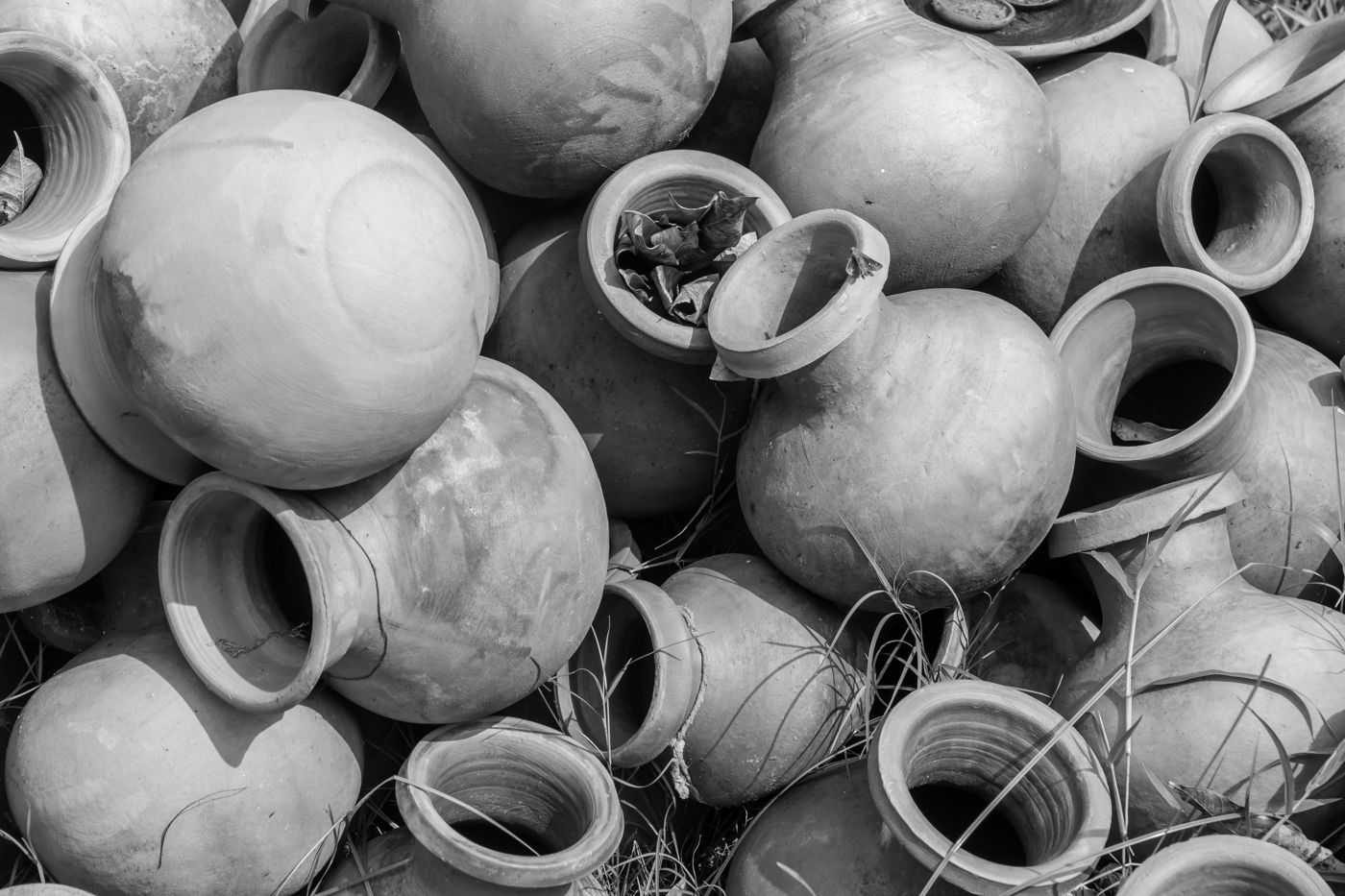 Photo: Bijay chaurasia, CC BY-SA 4.0, via Wikimedia Commons
Walk behind an older Korean house and you are likely to find rows of brown, round-shouldered jars on a raised stone platform. These are onggi (옹기), the earthenware vessels in which Korean households have fermented and stored soy sauce, doenjang and gochujang, kimchi, salted seafood, vinegar, grain and water. More than any other object, onggi connect the Korean kitchen to fermentation.
What counts as onggi
Ong (甕) is the Chinese character for a large storage jar, and such jars are ancient: Goguryeo tomb murals show rows of them, and records from Baekje and Silla mention jars for rice, liquor, oil, soy sauce and jeotgal. In 1123 the Song envoy Xu Jing noted that Goryeo households kept rice and jang in large jars.
In the narrower sense used today, onggi means earthenware coated with a brownish glaze made from yakto, an iron-rich clay, mixed with wood ash. According to the Encyclopedia of Korean Culture, this glazed ware does not appear at fifteenth- and sixteenth-century kiln sites but does turn up at seventeenth-century ones, suggesting it developed after the Japanese and Manchu invasions. It spread rapidly in the eighteenth and nineteenth centuries, and craftspeople usually distinguish it from older unglazed jilgeureut, fired at lower temperatures.
How onggi are made
Onggi are hand-built rather than thrown. The potter kneads iron-rich clay, rolls it into thick coils or slabs, and builds the wall up course by course on a slowly turning wheel, beating and smoothing the wall with a paddle. The base is trimmed and simple decorative lines are added before the pot comes off the wheel. The pots are dried in stages, coated in the ash-based glaze and fired in wood-burning kilns to close to 1,200°C. Traditional firing is unpredictable: a Korea Cultural Heritage Foundation profile of the master potter Kim Il-man notes that only about half a kiln load may come out sound.
The onggi trade nearly collapsed in the twentieth century. During the colonial period, potters began adding red lead (gwangmyeongdan) to glazes to lower firing temperatures and save fuel, a practice that spread after the 1960s. When health authorities moved against lead in 1977, many workshops failed. Cheap plastic containers and forest-protection rules on firewood added to the pressure. The state has protected onggi-making as a National Intangible Cultural Heritage since 1990. Because of that history, it is sensible to be cautious about storing food in old or unlabeled jars whose glaze is unknown.
The "breathing jar"
Onggi are traditionally described as "breathing vessels" (sum swineun geureut). The Encyclopedia of Korean Culture explains the idea this way: as the clay is fired, water bound in its structure escapes and leaves fine pores, so air can pass slowly through the wall, which is said to help contents ferment well and keep longer.
There is some laboratory support for the basic idea, with caveats. A 2023 study in the Journal of the Royal Society Interface imaged pores of roughly 1 to 100 micrometers in an onggi wall and measured gas permeability about twice that of a glass jar; salted cabbage in the onggi produced about 26 percent more carbon dioxide than in glass, a sign of faster fermentation. But the jar tested was unglazed, and the authors note that glazing reduces permeability. Porosity varies with clay, glaze and firing, so the breathing description is best read as a tradition with partial scientific backing rather than a uniform property of every jar.
The jangdokdae
The platform the jars stand on is the jangdokdae (장독대). It is usually built behind the kitchen, raised 20 to 30 centimeters on cobbles and gravel and paved with flat stones so rain drains away, with large jars at the back and small ones in front. A typical platform held around fifteen jars of soy sauce, doenjang, gochujang and seasonings, with households in the central region tending toward larger platforms and poorer mountain households keeping far fewer. Rope charms, pine sprigs or paper sock cutouts were sometimes hung on jang jars to protect the flavor, and charcoal, dried chilies and jujubes floated in the brine served the same hopeful purpose.
Onggi are also tied to kimjang. Kimchi made in late autumn was packed into jars and often buried in the ground, where the soil kept it cold but unfrozen through winter.
From backyard to apartment
The rows of jars began to disappear with modern housing. In 1968 a Seoul campaign urged households to remove their jangdokdae and buy factory-made soy sauce, doenjang and gochujang, a push linked both to the new apartment blocks and to bringing women's labor into industry. Later the kimchi refrigerator, described in food in modern Korea, took over the cold-storage job of buried jars. Onggi survive in country houses, temples, restaurants that make their own jang and the growing number of urban cooks who seek them out for fermented foods.
Sources
- 01옹기 (Onggi) — Encyclopedia of Korean Culture
- 02옹기장 (Onggijang, National Intangible Heritage) — Encyclopedia of Korean Culture
- 03장독대 (Jangdokdae) — Encyclopedia of Korean Culture
- 04장독대 없애기 운동 (Campaign to remove jangdokdae) — Encyclopedia of Korean Culture
- 05옹기장 김일만 — Korea Cultural Heritage Foundation (국가유산진흥원)
- 06Kim & Hu, Onggi's permeability to carbon dioxide accelerates kimchi fermentation — J. R. Soc. Interface (2023)