History & Culture
Dano: Wheel Cakes, Mugwort and Iris Water
단오
The fifth day of the fifth lunar month, once ranked beside Seollal and Chuseok: surichwi-tteok, mugwort, iris-water hair washing and the swings and wrestling of early summer.
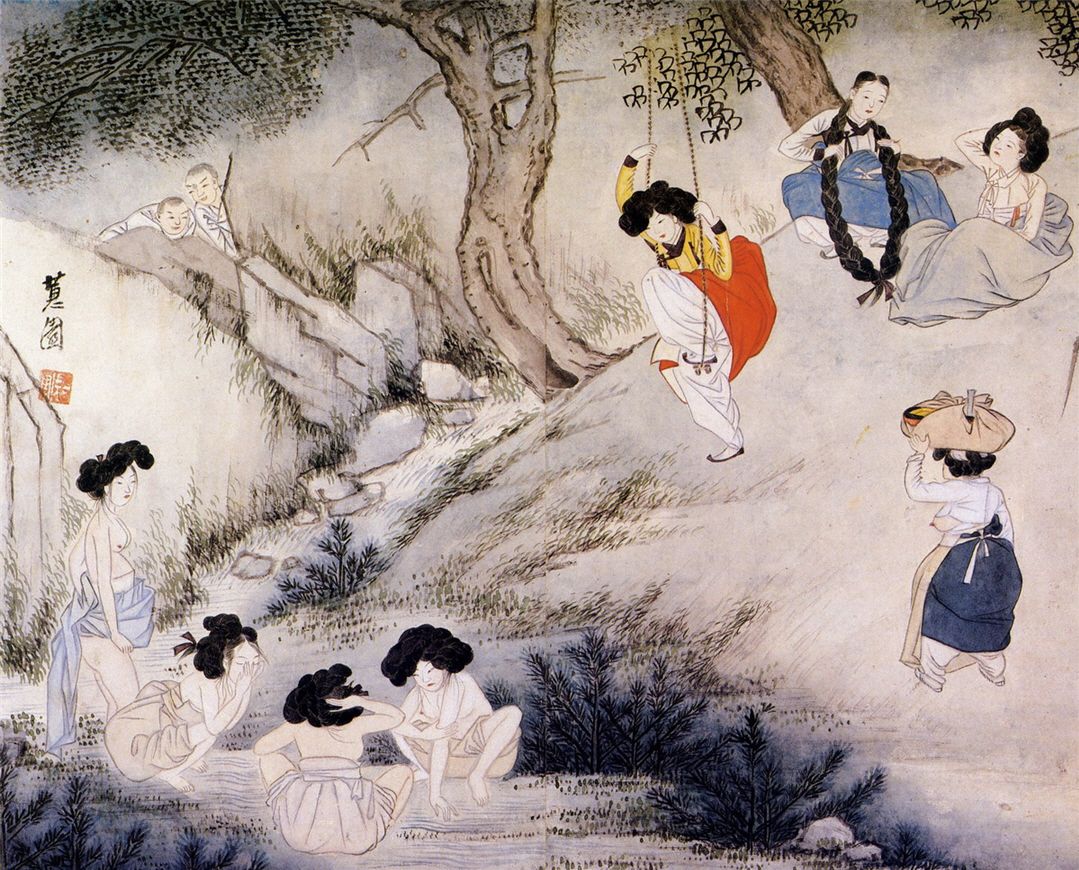 Photo: Shin Yunbok or Hyewon, his pen name (1758- early 19c), Public domain, via Wikimedia Commons
Dano (단오), the fifth day of the fifth lunar month, is also called suritnal, cheonjungjeol and jungojeol. The Encyclopedia of Korean Culture explains that odd numbers were counted as yang, and that this day was regarded as the year's yang peak. It was one of the four major Joseon holidays with Seollal, Hansik and Chuseok, and in 1518 was briefly listed with Seollal and Chuseok as one of the three greatest. Hansik's magazine adds that it was a holiday for praying for a good harvest after rice transplanting. It sits in the calendar sketched in seasonal foods, just before the heat of summer.
Surichwi-tteok: the wheel cake
The signature food is surichwi-tteok (수리취떡), a cake of steamed non-glutinous rice flour mixed with chopped blanched surichwi, a mountain herb gathered in the hills, or with mugwort, pounded smooth, rolled about a centimeter thick, pressed with a wheel-patterned mold and brushed with sesame oil. The Encyclopedia gives it the alternate names surichwi-jeolpyeon, charyungbyeong and aeyeopbyeong. The wheel pattern ties to the name: suri is read as the old word for cart, and Dano is also called Suritnal; the entry on Dano itself records another explanation, from the Yeoryang sesigi, that rice was thrown in water on this day. The court's medical office presented the cake together with jeho-tang, a cooling drink. A mugwort cake is the same but for the herb; see ssuk, and the broader family in tteok.
Cool drinks and sweets
According to Hansik's article, Dano foods also include cherry confection (aengdu-pyeon) and jeho-tang, a drink with five-flavor berry (omija) believed to guard against summer heat; the Encyclopedia describes jeho-tang as a cooling drink of medicinal ingredients with honey served in cold water, made by the court. These are traditional beliefs, not health claims. See also boknal and summer foods.
Iris water and hair washing
Women washed their hair in water boiled with changpo (창포, sweet flag), which the Encyclopedia says was believed to make hair thick and glossy and keep it from falling out. Women also cut the root into a hairpin (changpo-bi), sometimes marked red or written with the characters for longevity and fortune, since red was thought to repel evil spirits. Korea.net adds that women pinned fragrant flowers in their hair. These are customs; the sources do not test whether it benefits hair.
Mugwort and protective customs
At midday on Dano, farmers picked mugwort and motherwort, believed to restore appetite and health. Bundled mugwort stood by gates against misfortune, and royal mugwort tiger ornaments and printed talismans were meant to repel evil. In the court, the king gave fans made in Jeonju and Namwon to officials.
Games, festivals and regions
Swinging was among the few outdoor pleasures women enjoyed freely; men held ssireum wrestling. The Encyclopedia says Dano was celebrated more elaborately in the north and less in the south, where Chuseok was stronger. The best-known survival is the Gangneung Danoje, which UNESCO lists as intangible heritage; see Gangneung.